SoraNews24 —Japan News—
Bringing you yesterday's news from Japan and Asia, today.
-
TOP
» Internet
-
TOP
• Japan
-
TOP
• Korea
-
TOP
-
TOP
• USA
-
» Washington Post writer catches heat for “dirty Korean beer” joke
Featured
- Weird
- Studio Ghibli
- Jobs
Washington Post writer catches heat for “dirty Korean beer” joke
 Master Blaster May 26, 2015
- Tweet
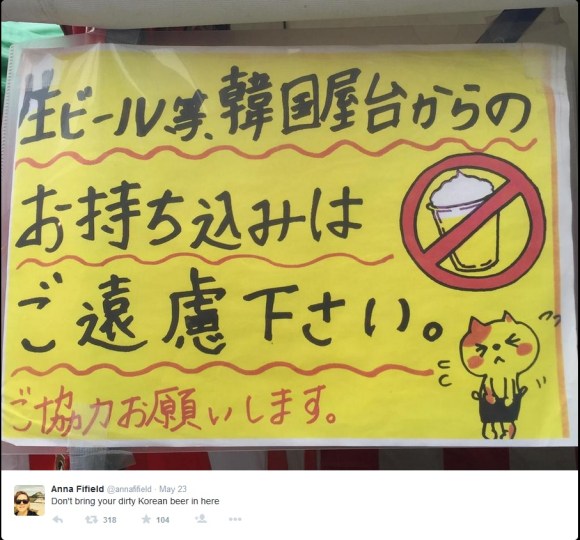
There’s a reason I don’t write for the Washington Post. Actually, there are about a thousand reasons, almost all of which pertain to my own ineptness. Another one these reasons is that I occasionally write some embarrassing joke that gets completely misunderstood and blows up in my face.
So, I can relate on some level to the Washington Post’s writer and Tokyo bureau chief Anna Fifield. Her tweet, which jokingly translated a customer request sign as “Don’t bring your dirty Korean beer in here,” has led to some considerably harsh feedback from Japanese Twitter users.
Don't bring your dirty Korean beer in here pic.twitter.com/4GTMjktKjz
— Anna Fifield (@annafifield) May 24, 2015
The sign, photographed in Shingawa Station, literally reads: “Don’t bring in beer etc. from Korean food stands please. Thank you for your cooperation” alongside a picture of a glass of beer with way too much head and a “no” sign overlaid. In keeping with municipal signage laws, there’s also a cute little calico cat that apparently needs to pee.
Commenting on the image in her tweet, Fifield seemingly made the “dirty Korean beer” remark as a joke about how Korean food stalls were pointedly singled out in the sign’s message.
At first the joke drew several puzzled and angry responses from people who didn’t seem to get her intent.
.@annafifield You should correct your forgery translation. There is no "dirty" word.
Are you liar?— Inetgate Writer (@Inetgate) May 24, 2015
https://twitter.com/goo_goo_inali/status/602338729861062656 https://twitter.com/sob_2nd/status/602346553626365954
You're the loudspeaker which promotes discrimination arbitrarily. RT @annafifield Don't bring your dirty Korean beer in here
— 甘茶 (@amateur2010) May 24, 2015
Like anyone, Fifield was not happy with being labeled a “loudspeaker which promotes discrimination arbitrarily,” and replied.
@amateur2010 I'm not promoting discrimination. just seemed weird to single out the Korean stand when Japanese stands were also selling beer
— Anna Fifield (@annafifield) May 24, 2015
@amateur2010 I was being flip. Why not just say "don't bring food from other stalls in here"?
— Anna Fifield (@annafifield) May 24, 2015
Despite this explanation, the angry tweets continued to flood in, and Fifield took a startling amount of flack, much of which appeared to be coming from people concerned about the exact kind of discrimination Fifield herself was alluding to in her original tweet.
Of course the million-dollar question here is why the pictured sign mentions Korean food stands in particular. There is the possibility this establishment is run by some Archie Bunker-style bigot, but there are also many other potential reasons.
Perhaps this vendor had chronic problems exclusively with a specific nearby Korean stall’s customers. Many Twitter users said that Korean tourists are often unaware of the impoliteness of taking food from one restaurant into another. I’m not sure if that’s true or not, but it still doesn’t really explain the logic of the sign.
If the sign was meant to warn Korean visitors, however, then it should probably be written in Korean or at least English rather than just making a vague reference to Korean food stalls. And so, the mystery of why it was written like that remains unknown.
Even so, some criticized Fifield for not asking the sign’s owner about its true meaning.
https://twitter.com/totty2nd/status/602362217753808896
Others just didn’t care.
https://twitter.com/kAssy0121/status/602401801577451520
@annafifield @amateur2010 so you just made up a story.
What is your profession again?— Kokuten (@kokuten917) May 24, 2015
Much of the criticism seemed focused on the use of the word “dirty” to describe the “Korean beer” – a word that was not used on the sign to begin with. Granted, when looking at the word in its strict meaning of either “polluted” or “immoral” it sounds a lot harsher than it might to a native English speaker used to such cliches.
On the other hand, that doesn’t really excuse the remark either. It could also be easily misinterpreted online in Korea in the same literal way and spread around as a false example of Japanese discrimination “as reported by a member of the Washington Post”. This is also a point which Fifield quickly addressed.
I'm sorry if I caused offense by writing "dirty". I meant it as a joke. I'm genuinely concerned Korea-Japan relations. No laughing matter
— Anna Fifield (@annafifield) May 24, 2015
In the end, I suppose this serves as a reminder that we must all watch what we say online, because we never know when our words will be misinterpreted or our intentions misunderstood.
I’m just glad none of my bombed jokes were about international relations and instead all focused on things like escalator etiquette and moronic YouTubers.
Source: Twitter, Togetter (English/Japanese)
Like this:
Like Loading…
- Internet, Japan, Korea, New Zealand, USA
- (Anna Fifield • discrimination • language • Washington Post)
Related Stories
 North Korean travel agency tweets about “North Korean Dragon Ball” to entice Japanese tourists
 Selfie love shown between South and North Korean gymnasts
 Japanese man complains about foreign languages on Tokyo train, Twitter drowns him in kindness
 Okinawa pub posts “Japanese only” admission sign based on some shaky logic
 Engrish sign at the Tokyo Olympics turns out to be hilariously accurate
- “Where are all the laser beams?” Our reporter heads to Nevada’s Area 51 on a top-secret mission
- Dedicated fan recreates video play-through of Super Mario Bros… in Minecraft
- Trackbacks (0)
Trackbacks
- There are no trackbacks yet.
- Trackback URL
Trending Today
- Nara deer send record number of people to hospital, over 70 percent of patients are foreigners
- Studio Ghibli and Uniqlo reveal brand-new T-shirt collaboration [Pics]
- Starbucks Japan unveils new Christmas Matcha Tiramisu Frappuccino
- What is Japan’s Yamagata soba, and do you have to go to Yamagata to eat it?
- Tommy Lee Jones becomes Pikachu in Japan for Suntory
- Tokyo’s Shibuya Sakurazaka cherry blossom street to be decommissioned, number of trees to increase
- Complaints of bar scams from foreign tourists in Tokyo’s Shinjuku triple compared to last year
- KFC Japan creates contract with Dr. Doom for Marvel supervillainy fried chicken
- We try Japan’s craziest energy drink…from a Street Fighter card!
- Akihabara restaurant with 1.7 million sushi bowl options will have us coming back again and again
- “Where are all the laser beams?” Our reporter heads to Nevada’s Area 51 on a top-secret mission
- Dedicated fan recreates video play-through of Super Mario Bros… in Minecraft
-
Recent Posts
- Tokyo’s Shibuya Sakurazaka cherry blossom street to be decommissioned, number of trees to increase
- KFC Japan creates contract with Dr. Doom for Marvel supervillainy fried chicken
- Tommy Lee Jones becomes Pikachu in Japan for Suntory
- What is Japan’s Yamagata soba, and do you have to go to Yamagata to eat it?
- Starbucks Japan unveils new Christmas Matcha Tiramisu Frappuccino
-
MOST POPULAR
- Today
- Weekly
- Monthly
- Yearly
Today
 Nara deer send record number of people to hospital, over 70 percent of patients are foreigners
 Studio Ghibli and Uniqlo reveal brand-new T-shirt collaboration [Pics]
 Starbucks Japan unveils new Christmas Matcha Tiramisu Frappuccino
 What is Japan’s Yamagata soba, and do you have to go to Yamagata to eat it?
 Tommy Lee Jones becomes Pikachu in Japan for Suntory
 Tokyo’s Shibuya Sakurazaka cherry blossom street to be decommissioned, number of trees to increase
 Complaints of bar scams from foreign tourists in Tokyo’s Shinjuku triple compared to last year
 KFC Japan creates contract with Dr. Doom for Marvel supervillainy fried chicken
 We try Japan’s craziest energy drink…from a Street Fighter card!
 Akihabara restaurant with 1.7 million sushi bowl options will have us coming back again and again
Weekly
- Nara deer send record number of people to hospital, over 70 percent of patients are foreigners
 Ichiran releases an at-home counter kit that turns your desk into a ramen restaurant
- Studio Ghibli and Uniqlo reveal brand-new T-shirt collaboration [Pics]
 Tokyo cracks down on Airbnb-style rentals with new laws limiting operator days and more
 America’s first-ever permanent One Piece store is now open [Photos]
 Tokyo neighborhood adds new “smart trash cans” to deal with increasing amounts of tourist litter
 Starbucks Japan releases new Bearista glass tumbler that changes character with every drink
 Starbucks Japan reveals new Joyful Capsule gacha toy release date
- Akihabara restaurant with 1.7 million sushi bowl options will have us coming back again and again
 Japanese viewers of Godzilla Minus Zero angered by unusual number of restroom goers
Monthly
- Nara deer send record number of people to hospital, over 70 percent of patients are foreigners
 Pokémon Company announces first-ever permanent Pokémon store to open outside Asia
 Japan ends tax-free shopping system for foreign tourists, new refund request system now in effect
 Japan’s TeamLab digital art group is opening a permanent museum in America
- Ichiran releases an at-home counter kit that turns your desk into a ramen restaurant
 Beautiful Ghibli diorama kits lets you build anime characters’ homes inside yours [Photos]
- Studio Ghibli and Uniqlo reveal brand-new T-shirt collaboration [Pics]
 Family Mart releases 47 convenience store socks and stickers, one for every prefecture in Japan
 Chainsaw robots helping keep trains running safely in east Japan [Video]
 New Studio Ghibli anime gets extended run at the only cinema in Japan where it’s being shown
Yearly
 Japan announces sudden 400-percent increase in visa fees for foreigners entering the country
 Japan’s human washing machines will go on sale to general public, demos to be held in Tokyo
 Studio Ghibli has a new anime out, and there’s only one place in the world where you can see it
- Nara deer send record number of people to hospital, over 70 percent of patients are foreigners
 Starbucks Japan releases new drinkware and goods for Valentine’s Day
 Starbucks Japan releases new sakura goods and drinkware for cherry blossom season 2026
 Japan’s newest Shinkansen has no seats…or passengers [Video]
 Tokyo subway installing new ticket gates that don’t accept payment through Suica or other IC cards
 Japanese ninja certification exam attracts 131 candidates from Japan and abroad
 Salomon releases Japan-exclusive Mt. Fuji hiking gear that doubles as an amazing souvenir
-
RECOMMENDED STORIES
 Japanese beer giant Asahi buys British London Pride brewery; U.K. writer hopping mad
 Tokyo bar offers “babysitting” service for annoying husbands and boyfriends
 Twitter story about accidentally being a chauffeur gentleman reveals how oblivious men can be
 Japanese Twitter user misses joke, stresses that “beati dogu” is not traditional Japanese culture
 Japanese employee finds frightening warning in office bathroom, disguised as a friendly reminder
 W.T.F. Japan: Top 5 hand gestures that Japanese people don’t understand【Weird Top Five】
 Japan’s beer-selling war veteran anime penguins get new merchandise line【Photos】
 Japan announces Kanji of the Year for 2019, and it was really the only logical choice
- Japanese restaurant in Thailand hangs lanterns announcing “I love boobies” and other philosophes
 We stroll down memory lane while actually strolling down Sazae-san-dori in Fukuoka City
 Tokyo hotel asks guests to take their used toilet paper with them【Why Does Engrish Happen?】
 Japan’s beloved Zima discontinued after sales hurt by COVID-19
-
-
Categories
Categories Select Category Africa (33) Anime & Manga (193) Art (64) Australia (42) C America (9) C Asia (17) Canada (59) Cats (72) China (847) Culture (180) Cute (187) Entertainment (248) Europe (345) FN24 (1) Food & Drink (314) Games & Tech (167) Global (1,073) India (11) Internet (2,198) Italy (13) Japan (34,608) Korea (375) Lifestyle (76) Mexico (6) Music (12) N Asia (4) New Zealand (11) News (61) North Korea (72) Oceania (10) Russia (56) S America (33) S Asia (66) SE Asia (378) Space (2) Taiwan (203) UK (18) Uncategorized (19) USA (979) W Asia (25)
-
Archives
Archives Select Month November 2026 (77) October 2026 (144) September 2026 (156) August 2026 (174) July 2026 (197) June 2026 (174) May 2026 (138) April 2026 (142) March 2026 (150) February 2026 (124) January 2026 (138) December 2025 (136) November 2025 (136) October 2025 (151) September 2025 (154) August 2025 (143) July 2025 (158) June 2025 (165) May 2025 (162) April 2025 (181) March 2025 (157) February 2025 (127) January 2025 (139) December 2024 (148) November 2024 (149) October 2024 (153) September 2024 (154) August 2024 (158) July 2024 (156) June 2024 (150) May 2024 (166) April 2024 (150) March 2024 (157) February 2024 (169) January 2024 (159) December 2023 (165) November 2023 (166) October 2023 (166) September 2023 (173) August 2023 (183) July 2023 (171) June 2023 (180) May 2023 (158) April 2023 (152) March 2023 (167) February 2023 (160) January 2023 (171) December 2022 (175) November 2022 (176) October 2022 (179) September 2022 (191) August 2022 (202) July 2022 (193) June 2022 (178) May 2022 (178) April 2022 (181) March 2022 (212) February 2022 (199) January 2022 (224) December 2021 (230) November 2021 (214) October 2021 (215) September 2021 (238) August 2021 (225) July 2021 (207) June 2021 (218) May 2021 (209) April 2021 (206) March 2021 (225) February 2021 (209) January 2021 (224) December 2020 (225) November 2020 (224) October 2020 (231) September 2020 (238) August 2020 (227) July 2020 (220) June 2020 (209) May 2020 (215) April 2020 (238) March 2020 (235) February 2020 (222) January 2020 (233) December 2019 (187) November 2019 (214) October 2019 (237) September 2019 (195) August 2019 (205) July 2019 (183) June 2019 (201) May 2019 (231) April 2019 (192) March 2019 (242) February 2019 (211) January 2019 (238) December 2018 (212) November 2018 (217) October 2018 (214) September 2018 (203) August 2018 (217) July 2018 (218) June 2018 (208) May 2018 (204) April 2018 (193) March 2018 (216) February 2018 (192) January 2018 (223) December 2017 (204) November 2017 (209) October 2017 (218) September 2017 (209) August 2017 (228) July 2017 (222) June 2017 (245) May 2017 (229) April 2017 (197) March 2017 (165) February 2017 (151) January 2017 (180) December 2016 (260) November 2016 (267) October 2016 (302) September 2016 (387) August 2016 (351) July 2016 (379) June 2016 (379) May 2016 (312) April 2016 (347) March 2016 (414) February 2016 (379) January 2016 (359) December 2015 (359) November 2015 (378) October 2015 (435) September 2015 (419) August 2015 (152) July 2015 (218) June 2015 (179) May 2015 (237) April 2015 (223) March 2015 (119) February 2015 (121) January 2015 (394) December 2014 (376) November 2014 (376) October 2014 (414) September 2014 (349) August 2014 (379) July 2014 (316) June 2014 (375) May 2014 (384) April 2014 (354) March 2014 (318) February 2014 (284) January 2014 (270) December 2013 (224) November 2013 (242) October 2013 (244) September 2013 (226) August 2013 (241) July 2013 (214) June 2013 (222) May 2013 (191) April 2013 (173) March 2013 (149) February 2013 (85) January 2013 (106) December 2012 (111) November 2012 (149) October 2012 (151) September 2012 (118) August 2012 (99) July 2012 (56) June 2012 (57) May 2012 (54) April 2012 (62) March 2012 (40) February 2012 (27) January 2012 (24) December 2011 (18) November 2011 (12) October 2011 (1) September 2011 (9) August 2011 (11) March 2011 (1)
-
- About Us | Jobs | Contact | Contribution | Partner with Us
© SoraNews24 —Japan News— / SOCIO CORPORATION
- Advertise |
- About Us |
- Work with us |
- Contact |
- Contribution |

%d