SoraNews24 —Japan News—
Bringing you yesterday's news from Japan and Asia, today.
-
TOP
» Japan
-
» Japanese teacher shares surprising reason why the kanji for crow has one less line than bird
Featured
- Weird
- Studio Ghibli
- Jobs
Japanese teacher shares surprising reason why the kanji for crow has one less line than bird
 Oona McGee Jul 29, 2020
- Tweet
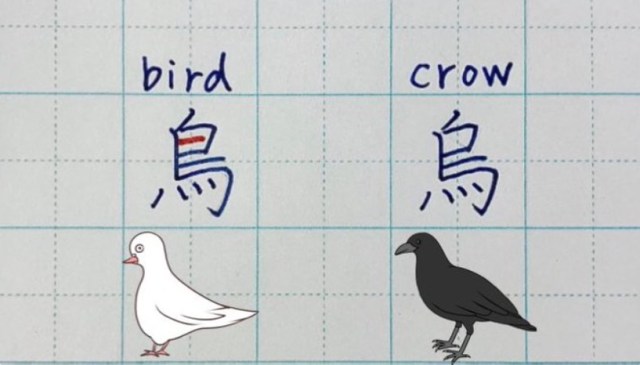
Learn how to never mistake the two kanji ever again.
With thousands of kanji to learn in the Japanese language, it can be hard to remember them all, especially when there’s only one stroke difference between some of them. However, knowing the etymology of the kanji can help a lot when it comes to creating a permanent, unshakeable foundation by which to recall them, and one instance is the history behind the kanji for the word “crow”.
▼ “Crow“, or “karasu” as it’s known in Japanese, looks strikingly similar to the kanji for “bird“, or “tori“.
The above image, shared online by Japanese teacher Kayo sensei, who goes by the handle @kayoshodo on Twitter, asks why the kanji for “crow” is missing that one line in the centre marked in red. Kayo sensei is here to explain the reason behind it all with a look at the original image from which the kanji for “bird” came from.
The horizontal stroke represents the eye of the bird, which is easily visible when the bird is white or relatively pale in colour. However, the crow is jet black, making the eye hard to make out, and this is the reason why there is no horizontal line in the kanji for “crow”.
Knowing the reason behind this small difference in appearance makes it easy to distinguish between the two similar kanji, and it’s something a lot of Japanese learners online were grateful to learn, sending Kayo sensei’s tweet viral with over 31,000 likes and 8,000 retweets.
A kanji of crow is one less horizontal stroke compared with a character of bird.
Why??
This horizontal stroke express their eyes, but we can't find where crow's eyes are because they are all black.
So, the kanji of crow has no eyes(one horizontal stroke) in it.🤗 pic.twitter.com/ydRxyJFQja
— Kayo sensei (@kayoshodo) July 22, 2020
▼ Her quick crow kanji tutorial was also a hit on Instagram:
https://www.instagram.com/p/CC9ai7WnkM8/?igshid=h9r0nkk57qo
The kanji for “bird” actually acts as a base kanji for a number of avian species to build upon. For instance, the kanji for “pigeon” or “hato” in Japanese adds the kanji for “nine” (pronounced “ku”) to the left of “bird”, as this reflects the “kuu kuu” sound pigeons make.
This character means pigeon( はとhato).
This character is based on the sound of pigeon. 🕊
The pronunciation of the left part of character is "ku ". Pigeon cries like "kuu, kuu", so old people applied this kanji to pigeon.(The right part means bird.) pic.twitter.com/l1Ie45T9On
— Kayo sensei (@kayoshodo) July 22, 2020
It’s a fascinating look at some of the ways kanji have developed over the years, and the real-world scenarios embedded in their etymology really help to cement them in our brains. For more tips on learning and remembering kanji and ways to quickly improve your writing skills, be sure to give Kayo sensei a follow on Twitter and Instagram.
And if you really want to up your kanji game, you might want to review the kanji with the longest readings and master the top five most difficult kanji ever. Happy studying!
Source: Twitter/@kayoshodo, Instagram/kayo_japanese_lesson
Top image: Instagram/kayo_japanese_lesson
Insert images: Instagram/kayo_japanese_lesson
● Want to hear about SoraNews24’s latest articles as soon as they’re published? Follow us on Facebook and Twitter!
Like this:
Like Loading…
- Japan
- (birds • crow • Japanese • Japanese language • Japanese teacher • kanji • language learning • learning japanese • linguistics • teaching)
Related Stories
 Umamusume is officially collaborating with the Denver Broncos football team [Video]
 Bus driver fired for licking inside of the bus during livestream
 Hello Kitty would like to be squeezed between your thighs in her new plushie form [Pics]
 Has a Shibuya restaurant solved the problem of one of Japan’s most divisive soba noodle toppings?
 Open just three hours a day, a new Tokyo soba joint serves up wildly addictive regional noodles
- You can open a Japanese-style bathhouse for your pets or anime figures with the Bird Sento【Pics】
- We try squeezing our boss’ face until it gets smaller【Experiment】
- Trackbacks (0)
Trackbacks
- There are no trackbacks yet.
- Trackback URL
Trending Today
- Umamusume is officially collaborating with the Denver Broncos football team [Video]
- Bus driver fired for licking inside of the bus during livestream
- Hello Kitty would like to be squeezed between your thighs in her new plushie form [Pics]
- Has a Shibuya restaurant solved the problem of one of Japan’s most divisive soba noodle toppings?
- Open just three hours a day, a new Tokyo soba joint serves up wildly addictive regional noodles
- Krispy Kreme Japan has a new Year of the Ram donut and one more lucky New Year’s treat
- 4-cheese-pizza-flavored soda unleashed on Japan [Taste Test]
- Make Gifu’s famous autumn chestnut sweet at home with just two Japanese supermarket snacks
- Family Mart releases 47 convenience store socks and stickers, one for every prefecture in Japan
- Studio Ghibli releases new Howl’s Moving Castle merchandise, complete with spinning clock and talking Calcifer
- You can open a Japanese-style bathhouse for your pets or anime figures with the Bird Sento【Pics】
- We try squeezing our boss’ face until it gets smaller【Experiment】
-
Recent Posts
- Bear Proof Cider invites everyone to drink their bears away
- Open just three hours a day, a new Tokyo soba joint serves up wildly addictive regional noodles
- Krispy Kreme Japan has a new Year of the Ram donut and one more lucky New Year’s treat
- Bus driver fired for licking inside of the bus during livestream
- Hello Kitty would like to be squeezed between your thighs in her new plushie form [Pics]
-
MOST POPULAR
- Today
- Weekly
- Monthly
- Yearly
Today
 Umamusume is officially collaborating with the Denver Broncos football team [Video]
 Bus driver fired for licking inside of the bus during livestream
 Hello Kitty would like to be squeezed between your thighs in her new plushie form [Pics]
 Has a Shibuya restaurant solved the problem of one of Japan’s most divisive soba noodle toppings?
 Open just three hours a day, a new Tokyo soba joint serves up wildly addictive regional noodles
 Krispy Kreme Japan has a new Year of the Ram donut and one more lucky New Year’s treat
 4-cheese-pizza-flavored soda unleashed on Japan [Taste Test]
 Make Gifu’s famous autumn chestnut sweet at home with just two Japanese supermarket snacks
 Family Mart releases 47 convenience store socks and stickers, one for every prefecture in Japan
 Studio Ghibli releases new Howl’s Moving Castle merchandise, complete with spinning clock and talking Calcifer
Weekly
 Nara deer send record number of people to hospital, over 70 percent of patients are foreigners
 Tokyo’s Shibuya Sakurazaka cherry blossom street to be decommissioned, number of trees to increase
- Studio Ghibli releases new Howl’s Moving Castle merchandise, complete with spinning clock and talking Calcifer
 Studio Ghibli and Uniqlo reveal brand-new T-shirt collaboration [Pics]
 Life-size Gundam statue’s head returning to Tokyo neighborhood this month
 Starbucks Japan reveals new Christmas advent calendar and holiday drinkware collection
- Umamusume is officially collaborating with the Denver Broncos football team [Video]
 Japan’s beautiful new Pokémon hotel room gives you and Dragonite a place to take a break
 Japan’s JR East reveals new train company mascot character, online comments aren’t kind
 Starbucks Japan unveils new Christmas Matcha Tiramisu Frappuccino
Monthly
- Nara deer send record number of people to hospital, over 70 percent of patients are foreigners
 Japan ends tax-free shopping system for foreign tourists, new refund request system now in effect
- Tokyo’s Shibuya Sakurazaka cherry blossom street to be decommissioned, number of trees to increase
- Studio Ghibli and Uniqlo reveal brand-new T-shirt collaboration [Pics]
- Studio Ghibli releases new Howl’s Moving Castle merchandise, complete with spinning clock and talking Calcifer
 Ichiran releases an at-home counter kit that turns your desk into a ramen restaurant
 Japan’s TeamLab digital art group is opening a permanent museum in America
 Beautiful Ghibli diorama kits lets you build anime characters’ homes inside yours [Photos]
 Chainsaw robots helping keep trains running safely in east Japan [Video]
 Tokyo cracks down on Airbnb-style rentals with new laws limiting operator days and more
Yearly
 Japan announces sudden 400-percent increase in visa fees for foreigners entering the country
 Japan’s human washing machines will go on sale to general public, demos to be held in Tokyo
 Studio Ghibli has a new anime out, and there’s only one place in the world where you can see it
- Nara deer send record number of people to hospital, over 70 percent of patients are foreigners
 Starbucks Japan releases new drinkware and goods for Valentine’s Day
 Starbucks Japan releases new sakura goods and drinkware for cherry blossom season 2026
 Japan’s newest Shinkansen has no seats…or passengers [Video]
 Tokyo subway installing new ticket gates that don’t accept payment through Suica or other IC cards
 Japanese ninja certification exam attracts 131 candidates from Japan and abroad
 Salomon releases Japan-exclusive Mt. Fuji hiking gear that doubles as an amazing souvenir
-
RECOMMENDED STORIES
 Krispy Kreme Japan has a new Year of the Ram donut and one more lucky New Year’s treat
 4-cheese-pizza-flavored soda unleashed on Japan [Taste Test]
 Make Gifu’s famous autumn chestnut sweet at home with just two Japanese supermarket snacks
 Family Mart releases 47 convenience store socks and stickers, one for every prefecture in Japan
 Studio Ghibli releases new Howl’s Moving Castle merchandise, complete with spinning clock and talking Calcifer
 Yoshinoya’s 2027 lucky box is already here and brings the newest piece of mini Yoshinoya-ware
 East Japan Railway Company says it will use all three of its mascot replacement characters
 Is Starbucks Japan’s new Matcha Tiramisu Frappuccino really like a Christmas tree?
 Bear Proof Cider invites everyone to drink their bears away
 Final Fantasy/Dragon Quest Christmas trees go up as Chocobo and Slime celebrate holidays in Japan
 Japan’s JR East reveals new train company mascot character, online comments aren’t kind
 Starbucks Japan reveals new Christmas advent calendar and holiday drinkware collection
 KFC Japan releases new Desire-Filled Immoral Burgers with Mac & Cheese… but are they as sinful as they look?
 Instant curry blessed by priests at shrine of god of learning go on sale in Japan
-
-
Categories
Categories Select Category Africa (33) Anime & Manga (193) Art (64) Australia (42) C America (9) C Asia (17) Canada (59) Cats (72) China (847) Culture (180) Cute (187) Entertainment (248) Europe (345) FN24 (1) Food & Drink (314) Games & Tech (167) Global (1,073) India (11) Internet (2,200) Italy (13) Japan (34,637) Korea (375) Lifestyle (76) Mexico (6) Music (12) N Asia (4) New Zealand (11) News (61) North Korea (72) Oceania (10) Russia (56) S America (33) S Asia (66) SE Asia (378) Space (2) Taiwan (203) UK (18) Uncategorized (19) USA (980) W Asia (25)
-
Archives
Archives Select Month November 2026 (106) October 2026 (144) September 2026 (156) August 2026 (174) July 2026 (197) June 2026 (174) May 2026 (138) April 2026 (142) March 2026 (150) February 2026 (124) January 2026 (138) December 2025 (136) November 2025 (136) October 2025 (151) September 2025 (154) August 2025 (143) July 2025 (158) June 2025 (165) May 2025 (162) April 2025 (181) March 2025 (157) February 2025 (127) January 2025 (139) December 2024 (148) November 2024 (149) October 2024 (153) September 2024 (154) August 2024 (158) July 2024 (156) June 2024 (150) May 2024 (166) April 2024 (150) March 2024 (157) February 2024 (169) January 2024 (159) December 2023 (165) November 2023 (166) October 2023 (166) September 2023 (173) August 2023 (183) July 2023 (171) June 2023 (180) May 2023 (158) April 2023 (152) March 2023 (167) February 2023 (160) January 2023 (171) December 2022 (175) November 2022 (176) October 2022 (179) September 2022 (191) August 2022 (202) July 2022 (193) June 2022 (178) May 2022 (178) April 2022 (181) March 2022 (212) February 2022 (199) January 2022 (224) December 2021 (230) November 2021 (214) October 2021 (215) September 2021 (238) August 2021 (225) July 2021 (207) June 2021 (218) May 2021 (209) April 2021 (206) March 2021 (225) February 2021 (209) January 2021 (224) December 2020 (225) November 2020 (224) October 2020 (231) September 2020 (238) August 2020 (227) July 2020 (220) June 2020 (209) May 2020 (215) April 2020 (238) March 2020 (235) February 2020 (222) January 2020 (233) December 2019 (187) November 2019 (214) October 2019 (237) September 2019 (195) August 2019 (205) July 2019 (183) June 2019 (201) May 2019 (231) April 2019 (192) March 2019 (242) February 2019 (211) January 2019 (238) December 2018 (212) November 2018 (217) October 2018 (214) September 2018 (203) August 2018 (217) July 2018 (218) June 2018 (208) May 2018 (204) April 2018 (193) March 2018 (216) February 2018 (192) January 2018 (223) December 2017 (204) November 2017 (209) October 2017 (218) September 2017 (209) August 2017 (228) July 2017 (222) June 2017 (245) May 2017 (229) April 2017 (197) March 2017 (165) February 2017 (151) January 2017 (180) December 2016 (260) November 2016 (267) October 2016 (302) September 2016 (387) August 2016 (351) July 2016 (379) June 2016 (379) May 2016 (312) April 2016 (347) March 2016 (414) February 2016 (379) January 2016 (359) December 2015 (359) November 2015 (378) October 2015 (435) September 2015 (419) August 2015 (152) July 2015 (218) June 2015 (179) May 2015 (237) April 2015 (223) March 2015 (119) February 2015 (121) January 2015 (394) December 2014 (376) November 2014 (376) October 2014 (414) September 2014 (349) August 2014 (379) July 2014 (316) June 2014 (375) May 2014 (384) April 2014 (354) March 2014 (318) February 2014 (284) January 2014 (270) December 2013 (224) November 2013 (242) October 2013 (244) September 2013 (226) August 2013 (241) July 2013 (214) June 2013 (222) May 2013 (191) April 2013 (173) March 2013 (149) February 2013 (85) January 2013 (106) December 2012 (111) November 2012 (149) October 2012 (151) September 2012 (118) August 2012 (99) July 2012 (56) June 2012 (57) May 2012 (54) April 2012 (62) March 2012 (40) February 2012 (27) January 2012 (24) December 2011 (18) November 2011 (12) October 2011 (1) September 2011 (9) August 2011 (11) March 2011 (1)
-
- About Us | Jobs | Contact | Contribution | Partner with Us
© SoraNews24 —Japan News— / SOCIO CORPORATION
- Advertise |
- About Us |
- Work with us |
- Contact |
- Contribution |

%d