Japan Culture NYC – SoraNews24 —Japan News— https://soranews24.com Bringing you yesterday's news from Japan and Asia, today. Thu, 19 Feb 2015 20:30:33 +0000 en-US hourly 1 https://wordpress.org/?v=7.1.5 https://soranews24.com/wp-content/uploads/sites/3/2020/05/en_rocket_1024.png?w=32 Japan Culture NYC – SoraNews24 —Japan News— https://soranews24.com 32 32 176746664 Taking a page from Japan, Meow Parlour, KittyKind team up for NYC’s first cat cafe https://soranews24.com/2015/02/20/taking-a-page-from-japan-meow-parlour-kittykind-team-up-for-nycs-first-cat-cafe/ https://soranews24.com/2015/02/20/taking-a-page-from-japan-meow-parlour-kittykind-team-up-for-nycs-first-cat-cafe/#comments Thu, 19 Feb 2015 20:30:30 +0000 http://en.rocketnews24.com/?p=220426 
Cat lovers in New York City have rejoiced since mid-December, when Meow Parlour, the city’s first cat cafe, opened its doors.
For the uninitiated, lets explain what a cat cafe is. It’s not a place where you take your own cat to hang out and have coffee. It’s not a restaurant that has cats on the menu. It is a place where you can enjoy the companionship of cats while sipping on coffee and munching on a cat-shaped macaron.
The concept is such an established phenomenon in Japan that RocketNews24 published a guide to Tokyo’s best cat cafes last February. The craze is spreading across Asia and Europe, and the first cat cafe in the United States opened in Oakland last October. Based on the popularity of Purina ONE’s four-day, pop-up cat cafe in April 2014, where guests stood in line for more than three hours just to spend one hour with a cat and a coffee, it was only a matter of time before a permanent cat cafe would make its way to New York.
Enter Christina Ha and Emilie Legrand. Ha opened Macaron Parlour in 2010 with her husband, Simon Tung, and Legrand was one of their first employees. As the co-founders of Meow Parlour, they reached out to KittyKind, a non-profit, no-kill cat rescue and adoption organization run entirely by volunteers, to supply the cats with whom customers will cuddle. But in contrast to the cat cafes in Japan, the ultimate goal of the Meow Parlour/KittyKind partnership is for these cats to be adopted.
Many Japanese people are unable to own cats due to restrictions by their apartment buildings, so cat cafes give them the satisfaction of enjoying time with a cat without worrying about the responsibilities that come with cat ownership. At Meow Parlour, the focus is more on the cats’ needs rather than the customers’.
“We’re actively trying to adopt,” says Kathy Schecter, a volunteer adoption representative for KittyKind who spoke with JapanCulture•NYC in early December, before Meow Parlour officially opened. “For us the goal is to find homes for the cats. Christina and Simon adopted with us and fostered with us. It was a dream of theirs to do a cat cafe, and they came to us because they already had an established relationship, but they also respected our standards, how we take care of our cats and how we find them homes.”
▼ Puddin’

▼ Lucky Lemon

“Christina has been talking a lot about it being a place where we can showcase some of our special needs or hard-to-adopt cats,” says Miriam Hibel, who has been involved in rescuing cats for more than eleven years, handling adoptions, running the foster program, and being a member of the intake team that determines which cats are entered into their system.
Hibel defines “hard-to-adopt” as cats who are older – most people want kittens – or have imperfections. Currently living at Meow Parlour are Fang, a gorgeous 10-year-old, half-faced calico; and Cisco, an equally gorgeous kitty who had a back leg amputated as a result of a car accident. Hibel fears that cats such as Fang and Cisco could be overlooked at KittyKind’s adoption center, which is located at Petco in Union Square.
▼ Fang

▼ Cisco

“I think that our dream would be to have a shelter where people could interact with the cats,” says Hibel. “What the cat cafe provides is an opportunity for them to do that. A lot of our cats could be perfectly delightful, but they don’t really show well in a cage.”
“I’m here a lot, and I see sometimes cats get really scared of the noise, and [Meow Parlour] is a calmer environment where people can choose their cat and to make sure that owning a cat is for them,” says Schecter. “I see it as an opportunity for more people to interact with the cats in a different way from leaning into a cage and sometimes getting the wrong idea of their personalities . . . But I also think it allows people who don’t really know a lot about cats to experience the pleasure of playing with cats and get over the stereotypes they have. I can’t tell you how many people come in and say, ‘Oh yeah, my girlfriend made us get a cat, and now I’m a total cat person.’”
Several factors go into choosing which cats will be showcased at Meow Parlour. Including the older, hard-to-adopt cats, KittyKind selects cats that interact well with people and other cats. The volunteers also consider how long a cat has been waiting to be adopted and if a cat’s previous adoption was unsuccessful.
Hibel and Schecter tell the story of Julian, who was born last spring. Julian’s two brothers were adopted together, and he went to a home that already had an older cat. The dichotomy of the settled feline versus the rambunctious kitten proved to be the wrong match, and Julian was returned to KittyKind.
Eleven cats were roaming around Meow Parlour on a recent Sunday morning. Along with Fang and Cisco was Julian, who has become the most popular cat in the cafe because of his playful, outgoing personality.
▼ Julian

Hibel says that KittyKind receives around 40 inquiries each week from good samaritans who have found strays or from people who, for a variety of reasons, can no longer keep – or no longer want – their cats. The volunteers go through a detailed checklist before a cat is processed into the KittyKind adoption system, making sure the cats are spayed or neutered and have no medical conditions or are receiving treatment for their medical conditions.
 They advise good samaritans to foster the rescued cats for a period of time and to fill out an “intake questionnaire” that gives KittyKind insight into the cats’ personalities, likes and dislikes, and behaviors in certain situations, such as when children are nearby or when a stranger visits.
According to Hibel, KittyKind rescues and places 500 to 600 cats every year.
“There are always ten times as many cats who need us,” she says. “It breaks our heart because we can’t help every one of them, we can’t take in every one of them.”
Hibel is hopeful that KittyKind’s partnership with Meow Parlour will allow more cats to be rescued as well as increase awareness of the organization in general.
“I think it’s an opportunity for us to expand our intake,” says Hibel. “We are and always have been primarily a street rescue group in that we work with the good samaritan who has found a cat or a network of amazingly dedicated rescuers . . . We might expand our owner-surrendering intake because those might be candidates for the cafe because they’re coming from a home. It gives us a venue for a different type of cat we can take in. I think it will also maybe provide an opportunity for people who are interested in volunteering with us, so in that way expand our donor/supporter/volunteer network.”
In some ways Meow Parlour’s operation mirrors KittyKind’s meticulous process. Unlike the Purina ONE pop-up cat cafe, there are no crowds of crazy cat people standing in three-hour lines that wind around the corner. Instead, Meow Parlour implemented an online reservation system through which it controls the amount of guests at any given time, and there are no walk-ins. (Technically, each time slot is already booked until March, but there are occasional openings due to cancellations, so follow @MeowParlour on Twitter and Instagram to receive updates.)
▼ Meow Parlour’s cat-friendly furniture

Upon arrival at the appointed time, guests must sign a waiver, remove their shoes, and sanitize their hands before entering the clean and attractively appointed space. Once inside, guests are free to play with all of the cats and order snacks from the Macaron Parlour located around the corner. Customers interested in adopting the cats must fill out an application and meet with KittyKind’s adoption representatives, who will also schedule a home visit.
“We’re not a walk-out-the-door-with-a-cat kind of place,” says Schecter. “We do our best to make sure it’s a safe home.”
“We often encourage people if they are drawn to a cat to do a trial foster because we want the commitment to be serious,” says Hibel. “I think one thing the cat cafe will do is get them to really see the cat because no matter how much I say to someone, ‘I think this is a great cat’ and the intake questionnaire is saying it’s a great cat, if they don’t feel that connection, they might not give that cat a chance even on a foster . . . To that extent it might encourage people to take a chance on a cat.”
Editor’s note: Since the original publication of this article on JapanCulture•NYC, we’re happy to announce that at least two of Meow Parlour’s cats have been adopted and found new forever homes. Keep up the great work, guys!
▼ Checking out Hester Street

More from JapanCulture•NYC
- Four Japanese Films in NY International Children’s Film Festival
- Japanese Cats on Instagram Tell the Story of Setsubun
- Shinbashi Tasting Introduces Matsusaka Beef to NYC
]]> https://soranews24.com/2015/02/20/taking-a-page-from-japan-meow-parlour-kittykind-team-up-for-nycs-first-cat-cafe/feed/ 0 220426 MEOWp Puddin Lucky-Lemon Fang Cisco Julian Miriam-and-Kathy Roger-in-shelf Meow-backwards Japanese Americans tell STORIES FROM TOHOKU https://soranews24.com/2014/06/30/japanese-americans-tell-stories-from-tohoku/ https://soranews24.com/2014/06/30/japanese-americans-tell-stories-from-tohoku/#comments Mon, 30 Jun 2014 12:00:35 +0000 http://en.rocketnews24.com/?p=161747 Filmmakers Dianne Fukami and Debra Nakatomi are sansei (third-generation Japanese Americans) from California who met while serving on the 2009 Japanese American Leadership Delegation, a cross-cultural program sponsored by the U.S.-Japan Council. When the triple tragedy of earthquake, tsunami, and nuclear disaster hit the northeastern region of Japan on March 11, 2011, Fukami and Nakatomi decided to make a documentary that told the stories of survivors.
They met a woman who managed to recover her old kimono and makes dolls out of the fabric; a struggling organic farmer in Fukushima; a cafe owner who cooked breakfast, lunch, and dinner to refugees in a shelter during the first six months after the disaster; and mothers in Fukushima who commute to a kindergarten an hour away so that their children can play outside.
Fukami and Nakatomi were impressed by the survivors’ gaman, the Zen Buddhist concept of endurance in the face of overwhelming challenges with dignity, and it reminded them of how their own families behaved during and after being interned in concentration camps throughout the US during World War II. During the filming, those stories intertwined with the stories of Japanese Americans from California who went to Tohoku to help in the recovery effort.
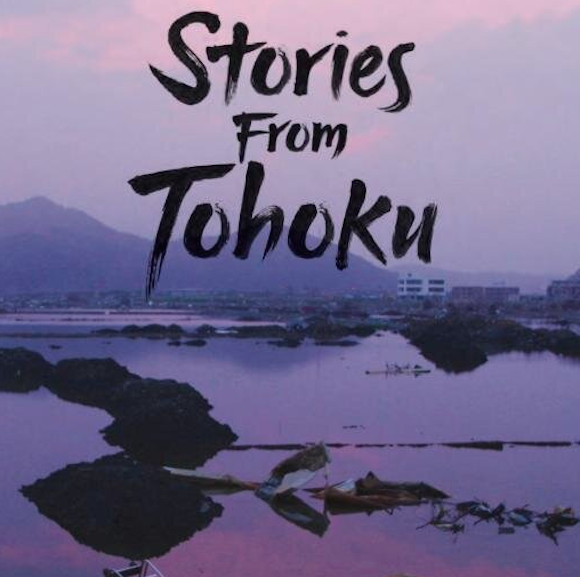
At the East Coast premiere of Stories from Tohoku, both Fukami and Nakatomi talked about the making of the film at a special screening hosted by Bank of Tokyo-Mitsubishi UFJ at Japan Society on June 25. Moderated by Japan Society board member and Reuters journalist Fred Katayama, the discussion focused not only on the beautifully rendered film, but on how making the film affected Fukami and Nakatomi as Japanese Americans.
“Every time I see the documentary . . . there are moments that grab my heart and bring tears to my eyes,” says Nakatomi, who closely identified with the farmer from Fukushima because her father had also been a farmer. “[Working on the documentary] made me reflective of what my parents went through [as camp internees].”
For Fukami, working on Stories From Tohoku wasn’t personal at first, but she soon “gained a deeper appreciation” for what it means to be Japanese American. As with Nakatomi, Fukami made connections between the situation of the 3.11 survivors and her own family’s internment.
“While shooting, we were panning the temporary housing,” says Fukami, “and you can’t help but see the barracks [in which WWII internees lived]. We kept hearing them say, ‘shikata ga nai,’ [It can’t be helped], and ‘gaman‘, so it resonated with me.”
The experience also had a profound affect on the subjects of the film, including 20 high school students who accompanied LA-based photojournalist Darrell Miho to Tohoku as volunteers from the Terasaki Foundation. These yonsei and gosei, in addition to helping the survivors, also embraced their Japanese ancestry. At least four of the students are returning to Japan, according to Nakatomi, two as members of the JET Program.
“That’s what separates this documentary from others out there,” says Katayama, “It reawakens the bonds, or kizuna, that Japanese Americans have for their heritage.”
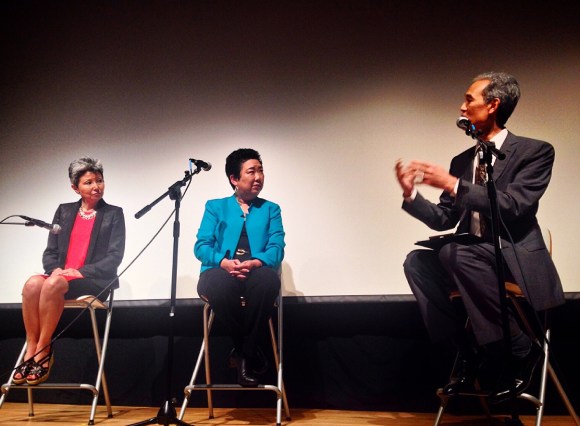
▼ Fred Katayama discusses STORIES FROM TOHOKU with Debra Nakatomi (far left) and Dianne Fukami
In the film Miho says that he will probably return to the area every year for the rest of his life. What struck him about his volunteering stints is that survivors want people to visit the area, but most important, they don’t want people to forget them.
Nakatomi says 98,000 people are still living in temporary housing in Tohoku. “The median age of people we interviewed was I think around 72,” says Nakatomi, “So, it’s likely they will end their days in temporary housing.”
“When the media [are] there, the disaster is in the spotlight,” says Fukami. “The immediate issue of Tohoku is not on the top of their minds [elsewhere in Japan]. But we saw a sea change happen there, especially among the young people. Young entrepreneurs are starting to think, ‘Maybe we can reinvent Tohoku.’”
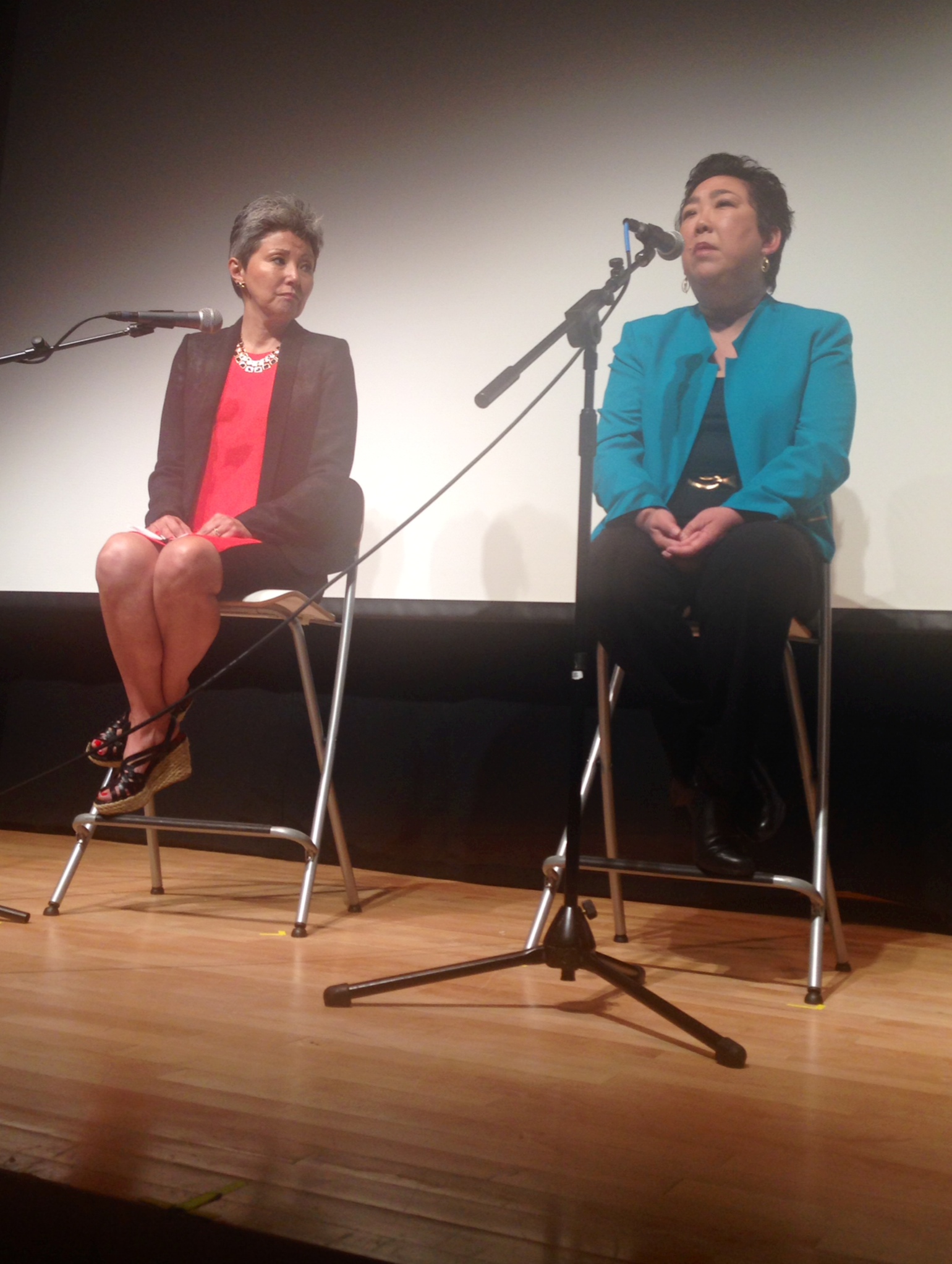
Debra Nakatomi and Dianne Fukami
Perhaps Stories from Tohoku can help move that reinvention forward; the documentary is making an impact. It is being translated into Japanese to expand distribution, and the filmmakers are entering it in film festivals. In fact, Stories from Tohoku was recently accepted to be screened during the Asian American International Film Festival in New York on July 27.
Fukami recently returned from Japan, where she screened the film in Tokyo, at Miyagi University, and for volunteers in the devastated town of Ishinomaki. During those screenings Fukami realized thatStories from Tohoku can teach the Japanese something about the US.
“Young people had never learned about the Japanese American experience in World War II,” says Fukami, so listening to Paul Terasaki and other Japanese Americans from California was eye-opening for them.
The doll maker in the film, Mrs. Abe, had the opportunity to visit another Mrs. Abe, the Japanese Prime Minister’s wife because someone who saw the documentary was touched by her story. Through Fukami’s company, Media Bridges, people are able to purchase Mrs. Abe’s dolls, with the proceeds going to rebuilding a school in Ishinomaki and to a new shop run by the Fukushima farmer featured in the documentary.
The filmmakers continue to keep in contact with the subjects of their film, but there are no plans for a sequel to Stories from Tohoku. The two are now in pre-production for a documentary on the life of former Secretary of Transportation Norman Mineta.
This article originally appeared on partner website JapanCulture•NYC
]]> https://soranews24.com/2014/06/30/japanese-americans-tell-stories-from-tohoku/feed/ 0 161747 Stories-from-Tohoku-cover Fred-Dianne-Debra Debra-and-Dianne New York City’s Barcade is all about the classic Japanese games https://soranews24.com/2014/06/21/new-york-citys-barcade-is-all-about-the-classic-japanese-games/ https://soranews24.com/2014/06/21/new-york-citys-barcade-is-all-about-the-classic-japanese-games/#comments Sat, 21 Jun 2014 02:00:20 +0000 http://en.rocketnews24.com/?p=159142 Nostalgic for Japanese video games from the late 1970s and ‘80s? Barcade, a combination bar and arcade, recently opened in Chelsea, Manhattan with about a dozen classics from Japanese game developers such as Taito, Nintendo, Namco, and Konami.
The games are still only a quarter (there are change machines on site), and the machines are in great condition. Marvel at the old-school graphics of Space Invaders, Galaga, Mappy, Crazy Climber, and Frogger.
▼ Space Invaders


▼ Galaga


▼ Mappy

▼ Crazy Climber

Box against Piston Hurricane in Nintendo’s Punch-Out, and test your strength in that game’s spin-off, Arm Wrestling, which was released only in North America in 1985.

You won’t find Pac-Man, but Ms. Pac-Man is here. There’s generally a crowd of people around that console.
But who needs Pac-Man when there’s one of the most popular arcade games in the history of arcade games: Donkey Kong. Donkey Kong, with its barrel-throwing ape and barrrel-jumping carpenter, was one of the first video games to be a narrative. Rather than simply shooting at things, video game players could follow a storyline that was the precursor to the wildly popular Mario franchise.


▼ Jumpman, the original Mario

“Newer” Japanese games are Konami’s Teenage Mutant Ninja Turtles (1989) and X-Men (1992).
There are a host of non-Japanese games as well; click here for a full list.
The best part of Barcade is that it’s a game room for adults. There are shelves between each machine on which patrons can rest their beers. It’s important to have both hands free while playing games, of course.
The original Barcade opened in Williamsburg in 2004 and has locations in Jersey City and Philadelphia. The Chelsea location is reportedly twice as large as the Barcade in Brooklyn, with 24 American beers and tap and pub food on the menu. Barcade’s next location will be on St. Mark’s, in the space formerly occupied by Mondo Kim’s.

For more about Japanese culture in New York City visit JapanCulture•NYC
]]> https://soranews24.com/2014/06/21/new-york-citys-barcade-is-all-about-the-classic-japanese-games/feed/ 0 159142 Donkey-Kong-screen-e1402092842925-980x1024 Space-Invaders-1024x795 Space-Invaders-screen-1024x768 Galaga-e1402092288354-768x1024 Galaga-screen-e1402092358876-768x1024 Mappy-e1402092444458-768x1024 Crazy-Climber-e1402092506800-768x1024 Nintendo-boxing-e1402092649372-768x1024 Donkey-Kong-e1402092746869-886x1024 Donkey-Kong-screen-e1402092842925-980x1024 Donkey-Kong-Mario-e1402092921793-768x1024 Taito-control-e1402093097273-768x1024 Nago mayor says US bases “a legacy of misery” in Okinawa https://soranews24.com/2014/05/24/nago-mayor-says-us-bases-a-legacy-of-misery-in-okinawa/ https://soranews24.com/2014/05/24/nago-mayor-says-us-bases-a-legacy-of-misery-in-okinawa/#comments Sat, 24 May 2014 04:00:43 +0000 http://en.rocketnews24.com/?p=150796 Nago is located in northern Okinawa, a tourist town with beautiful beaches and a pineapple park. Its waters are home to gorgeous coral and seagrass beds that serve as the feeding grounds to Japan’s last remaining population of dugong, an endangered sea mammal related to the manatee. Nago is also the site of the proposed relocation of Futenma airbase, the US Marine complex that is at the core of a controversy between the Okinawan, Japanese, and US governments.
The mayor of Nago, Susumu Inamine, was in New York last weekend to deliver speeches and have informative discussions regarding the issue.
Mayor Inamine’s trip to New York was sponsored by the New Diplomacy Initiative, a think tank that seeks to cultivate peaceful diplomatic relationships between the US and East Asia through the dissemination of information that is not generally seen in mass media. The non-profit NGO helped organize several events for Mayor Inamine, including a lecture at Columbia University, an audience with The New York Times, and an afternoon discussion session at the Gallery of the Community Church of New York on Saturday, May 17. The mayor also took his message to Washington, DC, on Monday and Tuesday.
Mayor Inamine was re-elected to his second term in January of this year, running on a platform against the construction of the base in Henoko, Oura Bay, a pristine ecosystem of mangrove forests and rivers in eastern Nago. His demeanor during his speech at Community Church was calm and reserved, but his message was passionate and reflected the urgency of the base situation.
“In 1952 Japan signed the San Francisco Peace Treaty and regained its independence, but at the expense of Okinawa”
The mayor appeared in New York to help people understand US-Japan relations as it pertains to the military situation in Okinawa. Saying his subject matter was “a challenging theme,” Mayor Inamine began by giving a brief history lesson of US-Japan relations after World War II ended in 1945, when “Japan became a US colony and did General McArthur’s bidding, whatever he wanted,” says Mayor Inamine. In 1952 Japan signed the San Francisco Peace Treaty and regained its independence, but at the expense of Okinawa.
“Amami Oshima and Okinawa would be cut off from Japan to be maintained as a colony of the US military,” says Mayor Inamine. “We can say that in order to achieve its independence, Japan allowed the US to hold Okinawa hostage.”
The main island of Okinawa comprises 0.6% of Japan’s land area and is smaller than Long Island, yet it hosts 74% of the US military bases in Japan. Each branch of the US military has facilities on Okinawa.
“We are literally surrounded above and below us by the US military,” says Mayor Inamine.
The issue of the Futenma relocation is not a new one. Talks of returning the land which Futenma currently occupies began in 1996, when then Ambassador Walter Mondale and then Japanese Prime Minister Ryutaro Hashimoto agreed that Futenma would be returned to Okinawa in seven years. Mayor Inamine maintains that these talks started only because a year earlier, in 1995, three US military personnel raped a 12-year-old girl, sparking outrage among Okinawan citizens, who demanded the removal of the base.
“After they promised to return the land to Okinawa, they decided to change the conditions and say that it would be moved to a different location on Okinawa,” says Mayor Inamine. “We have struggled mightily ever since then, and we believe that in 69 years after the war, we have suffered enough under the presence of the US military bases. We have no more capacity to accept a new base on the island. And as a result, the anti-base movement has grown strong. Eighteen years later nothing has changed at Futenma airbase; it is still exactly the same.”
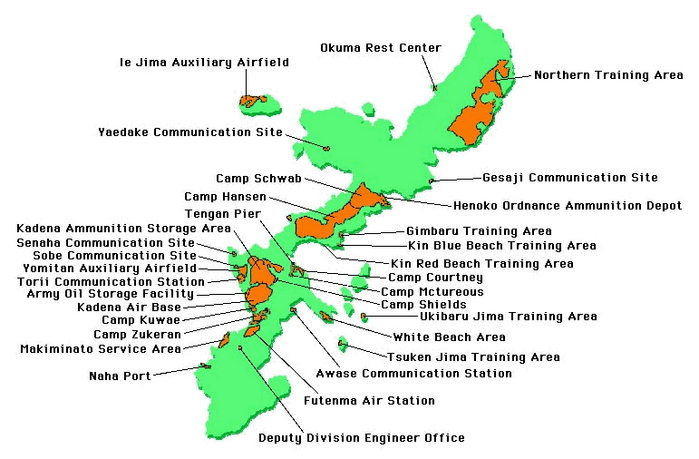
US Military Facilities on Okinawa from Okinawa Prefecture website
The plans for the relocation include expansion well beyond the dimensions of the current airbase, calling for landfill to accommodate its new dimensions. The building out of the bay to create space for runways and docks will negatively impact the biodiversity of that area, effectively destroying the coral and the natural habitat for the dugong.
“They’re not just moving Futenma, they’re adding a great deal of additional facilities that now Futenma lacks,” says Mayor Inamine. “An armory for storing ammunition, ports for battleships, runways. They’re basically turning it into a military super-fortress. This extremely dangerous airbase apparently is built to last 100 years.”
Mayor Inamine says that 74% of Okinawans are opposed to the new construction of the Futenma Replacement Facility. When Okinawa reverted to Japanese control in 1972, citizens had two demands, that no nuclear weapons would be stored on Okinawa and that the distribution of US military bases would be proportionate to the rest of Japan. Clearly, those demands were not met, as published accounts name Henoko as a storage location for nuclear weapons, and Okinawa continues to shoulder the burden of the bases.
“What this means is that since we survived the end of the war, the San Francisco Treaty, the ‘return’ to Japan, we still have to live with 74% of US military bases in Japan on Okinawa, and not just that, for the next 100 years. We will have to live not only with the bases, but with the accidents and the crimes that they cause, so that after we die we will leave our children and grandchildren a legacy of misery.”
“Twice I stood for mayor, and the biggest promise I made was that we would keep the new base out of our city – both times I won”
Debunking the myth that the bases support the economy of Okinawa, Mayor Inamine says that the number of jobs for Okinawan citizens would actually increase after the land from the bases is returned to Okinawa. Turning reclaimed land into resorts would provide more jobs to local citizens than the bases do and would further bolster Okinawa’s tourism industry.
“Twice I stood for mayor in the election, and the biggest promise I made was that we would keep the new base out of our city, and both times I won those elections because the citizens, while they were voting ‘Yes’ to me as mayor, they also voted ‘No’ to the new base. I think that these election results speak for themselves, and they are critical for democracy. Denying those election results is denying democracy itself.”

Mark Selden of The Asia-Pacific Journal: Japan Focus
Joining Mayor Inamine in discussion were Mark Selden, Senior Research Associate in the East Asia Program at Cornell University and coordinator of The Asia-Pacific Journal: Japan Focus, an online journal offering analysis of what’s happening in Asia, and Steve Rabson, Professor Emeritus of East Asian Studies at Brown University, an Asia-Pacific Journal Associate, and translator of Okinawan literature.
After pointing out that Okinawa lost between one quarter and one third of its population in the Battle of Okinawa during World War II, Selden wonders why the US military bases are still there.
“We don’t like to use that term ‘colony,’ but Okinawa was an American military colony from 1945 until 1972, and I want to ask whether it remains an American military colony today in a different sense,” says Selden. “It seems to me [the Japanese government officials] are going to have to be ready to lock up and maybe beat up the grandmothers and grandfathers that have been resisting all these years.”
Selden called Mayor Inamine the “soul of the Okinawan resistance” and “an important person to have here in America at a time when the United States is talking about an Asian pivot, expanding our military presence in Asia,” stating that it is his hope that “the voices that Mayor Inamine is so eloquently bringing to the States and the voices of others will be heard and sanity, justice, and democracy can prevail in the case of Okinawa.”
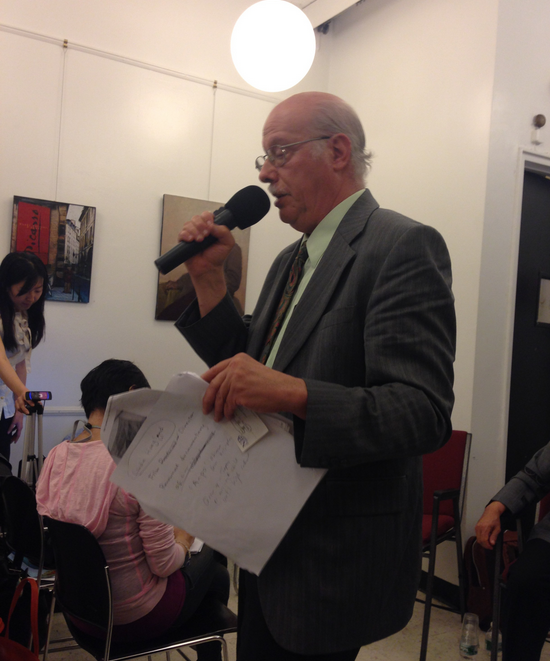
Steve Rabson
Rabson, who was stationed in Okinawa from 1967 until 1968, says, “I believe that one of the reasons that the Marines remain in Okinawa is because it’s so comfortable there. They have their golf courses that are tended by Japanese persons. They have wonderful facilities, gymnasiums, and supermarkets and PXes of little cost to them . . . The bases in Okinawa are not there to defend Japan. Going all the way back to the Korean War, the bases in Okinawa are basically there to support the training of troops and the transfer of supplies and weapons to American military actions elsewhere. This started with Korea, and when I was there it was the Vietnam War.”
Citing that members of the US Senate Committee on Armed Services – including Chairman Carl Levin (D – MI), John McCain (R – AZ), and former Senator Jim Webb (D – VA) – were opposed to the relocation plan because it is unaffordable and unnecessary, Rabson urges Americans to write our senators and congressmen to voice our opposition to the Futenma Replacement Facility. (Rabson wrote one such letter in January, and it was published in The Japan Times on May 17.)
“Even if you support American military policies in Asia Pacific, even if you go along with the pivot to Asia, those Marines do not need to be there. There is no need for them to be there in such large numbers. That base does not have to be built,” Rabson says. ”Maybe if we didn’t have them, our government wouldn’t be so tempted to get involved in these incursions abroad that kill so many of our soldiers and send them back in pieces.”
“Why is it okay to force this situation on the people of Okinawa?”
“While we face these massive problems, both the US and Japanese governments are about to collude in committing an enormous crime. This cannot be allowed to happen,” says Mayor Inamine. “If they were taking place and the same situation were unfolding in New York or the United States or in another country, it would not be allowed. But why is it okay to force this situation on Nago and on the people of Okinawa? That’s why I’m here, to try to bring our protest to the people of New York and Washington, DC, because we want you to be aware of the reality and the truth of the situation, of what is going on in Okinawa with the US military bases. And we turn to you for help for us to fight back against this situation.”
To hear Mayor Inamine’s speech and the Q&A session, please visit Independent Web Journal’s USTREAM videos. Fore more information, follow the Network for Okinawa page on Facebook.
“What this means is that since we survived the end of the war, the San Francisco Treaty, the ‘return’ to Japan, we still have to live with 74% of US military bases in Japan on Okinawa, and not just that, for the next 100 years. We will have to live not only with the bases, but with the accidents and the crimes that they cause, so that after we die we will leave our children and grandchildren a legacy of misery.”
– Susumu Inamine
Mayor of Nago City, Okinawa
]]> https://soranews24.com/2014/05/24/nago-mayor-says-us-bases-a-legacy-of-misery-in-okinawa/feed/ 0 150796 US-Military-Facilities-on-Okinawa-Okinawa-Prefecture-website Screen Shot 2014-05-23 at 10.21.37 AM Screen Shot 2014-05-23 at 10.21.51 AM Deconstructing Lolita fashion https://soranews24.com/2014/04/14/deconstructing-lolita-fashion/ https://soranews24.com/2014/04/14/deconstructing-lolita-fashion/#comments Mon, 14 Apr 2014 11:00:00 +0000 http://en.rocketnews24.com/?p=140574 Since Her Excellency Tomomi Inada, Minister in charge of Japan’s “Cool Japan” strategy, visited New York, JapanCulture•NYC has been trying to define “Cool Japan” as it relates to New Yorkers. The broad range of the term can encompass an overwhelming number of areas: Food, fashion, design, travel, the list goes on.
To focus on one type of fashion, JapanCulture•NYC turns to the expertise of New York-based accessories designer Jen Green, who attended Japan Society’s Lolita fashion discussion on February 5. In this special guest post, Jen deconstructs the Lolita look and phenomenon for the uninitiated.
Petticoats, sugar-coated pastels, lace, over-sized bows and ruffles worn with beautiful ornate full skirt dresses in sweet prints and accessorized with knee socks and maryjanes. I haven’t seen this much frill outside of Takeshita Dori in Harajuku! This is not the typical attire one would see on a frigid February night in Manhattan, but the winter weather didn’t stop ladies from coming out in their Lolita finest to attend Japan Society’s Lolita Fashion: Costume or Culture? The evening was part panel, part fashion show followed by a meet-and-greet reception.
Lolita fashion was popularized on the streets of Harajuku in the 1990s. Heavily detail-oriented and extremely feminine, Lolita fashion was Japan’s interpretation of the Rococo & Victorian eras. Jumper skirts layered with petticoats and blouses are the quintessential Lolita cupcake silhouette. Once only found in Japan, the Lolita fashion trend has spread globally in the past decade.
A panel of Lolita fashion experts, moderated by Gwynn Galitzer, spoke about what Lolita fashion is to them. Galitzer is a performance artist and founder of Dirty Bird Productions, a creative network and full-service event management community. As a moderator this was her introduction to Lolita fashion, and she embraced that by dressing the part. Looking kawaii in a pastel pink and blue Sweet Lolita ensemble, Gwynn was excited to learn more about Lolita fashion from the panel of experts.

One expert was Misako Aoki, a well-known Japanese model for Lolita brands like Baby, The Stars Shine Bright, Putumayo, and Agonqiuns. Misako served an official role for the Japanese government as “Kawaii Ambassador,” or Ambassador of Cute. As Kawaii Ambassador, Misako traveled the world to spread the word and appreciation of Japanese fashion and pop culture. She was first introduced to Lolita fashion by modeling for Kera, a Japanese street fashion magazine, at a time when there was only one Lolita store in Harajuku.
The other two panelists are the co-creators of the upcoming RuffleCon, the first Northeast conference in the United States celebrating Lolita and alternative fashion. Carolyn Dee has been involved with Lolita fashion for more than a decade and is known for her popular Lolita blog, F Yeah Lolita. Dee’s interest in this style came through online photos when the J-Rock scene became popular in the US goth scene around 2001 to 2003.
Christina Gleason runs the blog Ramble Rori, which includes surveys to gather information about the growing Lolita community in the US. She got into Lolita fashion by accident. She purchased a Wa Lolita dress, a style that combines traditional Japanese clothing elements with the Lolita silhouette, from a second-hand store. When she wore it someone asked her if she was Lolita, and the rest is history.
Just like any fashion event, the panel started with the ever-important question: What are you wearing? Aoki wore a dress from Baby, The Stars Shine Bright with a ballroom motif and her favorite, princess sleeves. Although she didn’t mention it, she wore an amazing floral and ruffle bonnet, as the headpiece is a key accessory in Lolita fashion. Gleason went for the “mint & white” look wearing a white Baby, The Stars Shine Bright dress layered with mint blouse & accessories. Dee wore a 2004 Innocent World piano dress that had a hemline border detail that was pleated piano keys!
The three most common types of Lolita style are classic, sweet, and gothic. Dee says most Lolitas overlap styles in their dress, not sticking to just one look. She prefers to dress in a combination of classic & gothic. Aoki loves anything pink, so she favors Sweet Lolita but will combine other Lolita elements into her look.
 Photo: Jen Green
Explaining the difference between costume & Lolita fashion, Dee says to wear Lolita is to be yourself, but to wear a costume is to be something else. According to Aoki, in Japan Lolita fashion is often confused with cosplay, but since Lolita fashion started in Japan she feels it is established. Although the look has become more mainstream in Japan, Aoki says there is a way to go as a subculture.
“Just like any fashion the Lolita scene sees evolution and waves in trends”
In other subcultures fashion and music go hand in hand, like punk rock or hip-hop. Lolita fashion is not directly associated with a particular music scene, but Dee feels it has become a subculture in the past decade thanks to the “language” the Western Lolita community has adopted. The Lolita lingo is a combination of abbreviations like OTT for “over the top,” JSK for “jumper skirt” mixed with Lolita brand names and Japanese words.
Just like any fashion the Lolita scene sees evolution and waves in trends. For example, OTT sweet Lolita was very popular but started phasing out in 2010. The classic Lolita style has had a resurgence, but according to Dee, it can still be just as OTT with bonnets, corsages, etc. Perhaps the community is growing up because most people who dress OTT Sweet are in their early 20s, and those who dress in classic Lolita are late 20s.
Surveys on Rambling Rori have shown Gleason that there seems to be two age groups of Lolita: 18 to 24 and 24 to 27. As you get older, the classic or goth Lolita styles are more practical because they can be easily toned down for work or other events.
The Internet plays a huge role in the Lolita community, bringing Lolitas together through photos and message boards. While it is crucial for Lolita communities spread out in the US, Aoki believes that the Japanese scene is evenly split between online correspondence and actually getting together to shop or have a tea party. Despite the negativity some US online Lolita communities have received for being elitist or judgmental, both Carolyn and Christina believe it is false representation. They encourage everyone to talk to a real-life Lolita if they are interested in learning more about the style.
 Photo: Jen Green
After a Q&A session with the audience, there was a Lolita fashion show with looks provided by Baby, The Stars Shine Bright and Alice and the Pirates, two popular Lolita brands in Japan.
The first look was a Sweet Lolita skirt from Baby, The Stars Shine Bright Strawberry Days collection worn with a sailor blouse, an oversized coordinating bow in the hair and strawberry vine over-the-knee socks tucked into red tea party shoes. There was also a classic Lolita look from Baby, The Stars Shine Bright in a pink sparkle striped fabrication and accessorized with a floral headband and wand to evoke a Spring Fairy feel. Another classic Lolita look followed, a Baby, The Stars Shine Bright coordinate that first debuted at the brand’s floating tea party in 2013. This one-piece dress had princess imagery and the classic cupcake silhouette created by petticoats worn underneath. The last look from Baby, The Stars Shine Bright was “Wedding Dress for the Maiden from the Star” and depicted what a Lolita bride might wear down the aisle. An oversized bow bustle and mini top hat veil completed the look.
The first look from Alice and the Pirates was “Lost Paradise,” showing imagery of Adam and Eve in gilded frames with snakes entwined in apple trees in an A-line silhouette. Part of the Lucifer series, the next look was that of a royal prince with an embellished black tailcoat with corset lacing worn over pants and accessorized with a top hat. The Alice and the Pirates brand celebrated its tenth anniversary by revisiting the original pirate motif in the next look, topped off with a feminine white pirate hat with veil. The last look of the evening was a black asymmetrical bustle and a high-wasted jeweled corset showing the epitome of the brand’s gothic Lolita signature look.
 Photo: Jen Green
The meet-and-greet reception, complete with heart-shaped cookies, was the perfect opportunity for those in the New York area Lolita community to meet others and discuss fashion, which is clearly a hot item from Cool Japan.
All Photos: Jen Green
As a kindergartener, Jen Green appeared in the Japanese play Momotaro*, which sparked her love of all things Japanese. Now she is an accessories designer who has worked in the fashion industry for 14 years. Twice a year she travels to Tokyo in search of inspiration and runs into Lolitas on the streets of Harajuku. Follow her adventures in New York and Japan on Instagram @jenpanese.*
For more Japanese culture in the Big Apple, check out JapanCulture•NYC
]]> https://soranews24.com/2014/04/14/deconstructing-lolita-fashion/feed/ 0 140574 Screen Shot 2014-04-14 at 1.58.01 PM Screen Shot 2014-04-14 at 1.48.31 PM Screen Shot 2014-04-14 at 1.53.20 PM Screen Shot 2014-04-14 at 1.55.46 PM What will Ma-kun mean for New York? https://soranews24.com/2014/02/08/what-will-ma-kun-mean-for-new-york/ https://soranews24.com/2014/02/08/what-will-ma-kun-mean-for-new-york/#comments Sat, 08 Feb 2014 09:00:08 +0000 http://en.rocketnews24.com/?p=122700 New York Yankees’ pitchers and catchers report to spring training on February 14, and among the new faces will be Masahiro Tanaka, a 25-year-old phenom from Japan who signed a seven-year, US$155 million deal in late January.
Ma-kun, as Tanaka is affectionately known (“kun” is an informal Japanese suffix generally used to address young boys or subordinates), is coming off an unbelievable season, going 24-0 with a 1.27 ERA. He also had eight complete games, more than any MLB team in 2013. Now it’s time to test his arm against MLB lineups.
Whenever I think of Ma-kun, I think of September 10, 2011. On that day, I was among the sold-out crowd as the Eagles hosted the Nippon Ham Fighters at Kleenex Miyagi Stadium in Sendai, a city hit hard by the massive earthquake that struck northeastern Japan on March 11. Almost six months to the day of the most devastating natural disaster to hit Japan in 140 years, we witnessed two gems by two young pitchers, Nippon Ham’s Yuki Saito and Ma-Kun.
This was a dream matchup of two rivals, both 23 at the time, who faced each other in an epic showdown at the National High School Baseball Championship in 2006. The aces battled to a 1-1 tie, and the game was suspended after 15 innings. They both pitched in the rematch the following day, with Saito striking out Tanaka to end the game and win Waseda Jitsugyo’s first title. Ma-kun went straight to the Eagles after high school, while “Yu-chan” joined Nippon Ham in 2011, after attending Waseda University for four years.
▼ Ma-kun on the big screen at Kleenex Miyagi Stadium on September 11, 2011

In their first professional head-to-head matchup, both Yu-chan and Ma-kun were impressive, each throwing complete games. Tanaka prevailed against his old rival 4-1, and he seemed to grow more confident and dominant as the game progressed. He carried a shutout into the 9th, allowing a run on a two-out, bases-loaded walk, the only blemish in his 12-strikeout performance.
That game in 2011 is a microcosm of Ma-kun’s ability. In seven seasons at Rakuten, he compiled a 99-35 record with 53 complete games, a 2.30 ERA, and 1,238 strikeouts. Going 24-0 in 2013 and winning the Japan Series with the Eagles put an exclamation point on an impressive career.
Ma-kun’s prowess wasn’t new to the Yankees, as the young pitcher was on their radar early.
The Yankees declined JapanCulture•NYC’s request for comment, but Andy McCullough of The Star-Ledger quoted General Manager and Senior Vice President Brian Cashman as saying, “We started evaluating him back in 2007. So clearly we’ve been scouting over in Japan for quite some time . . . Certainly paid attention to him back in the 2009 WBC, when we were first able to evaluate him with a major-league baseball, against major-league hitters . . . We made a determined effort to put ourselves in the position to know as much as we possibly could, in the event that he was ever posted.”
And Rakuten posted him in December, sending MLB teams vying for the right to negotiate with the superstar, each offering a “release fee” set by the Eagles. After the Yankees and the right-hander agreed to the huge contract, their $20 million release fee officially became Rakuten’s to keep, as dictated by MLB’s updated agreement with Nippon Professional Baseball, which is a bargain for the Yankees.
 Photo credit: Chicago Now

In 2011 Yu Darvish’s posting fee from the Texas Rangers was a record-high $51.7 million bonanza for the Nippon Ham Fighters. Daisuke Matsuzaka’s, former team, the Seibu Lions, received $51.11 million from the Boston Red Sox in 2006. The Lions used a large portion of that money to make improvements to the stadium: a new carpet of artificial turf, upgraded bathrooms, a 165-foot-wide scoreboard (the widest in Japan), and a picnic area.
The Eagles pocket much less cash, but that’s not the team’s immediate concern. The defending Japan Series champions must make do without their best player – and with the expected loss of revenue from fewer sales of tickets, concessions, and Tanaka-related merchandise.
“Of course the loss of Ma-kun Tanaka is huge,” says Eagles Senior Advisor Marty Kuehnert via email. “He had a once-in-a-century-type season going 24-0 for us last year. That cannot be easily replaced, but we were most lucky to get the number one draft pick in the country for this season, left-handed pitcher Yuki Matsui.”
 Photo via: Wallgiv

Kuehnert reminds us that a team, especially a championship team, doesn’t revolve around only one player, and Ma-kun isn’t the only player who left.
“The loss of Casey McGehee [signed with the Miami Marlins], too, is very big,” says Kuehnert. “McGehee was the first foreign player in our nine-year history to play in all 144 games. However, we have Kevin Youkilis coming in, and if he is healthy again – we have our fingers crossed – he could well make up for the loss of Casey. It is always hard to lose top players, but good organizations continually go after good players and rebuild. We have done that, and I believe we’ll put a very competitive team on the field again in 2014. As far as our fans go, they are naturally disappointed at losing great players like Tanaka and McGehee, but they are excited about our incoming new players. They are also proud to be fans of the reigning champs, and they, like our organization, have eyes set on V2. I expect our attendance will go up this season.”
As confident as Kuehnert is in his new-look Eagles, Cashman expressed concerns about how Tanaka’s talents will translate to MLB. The NPB schedule is shorter, the baseball is different, and starters pitch every seventh day but throw on the side every day.
“That’s something you can’t ignore or deny,” says Cashman. “But despite that, clearly, by the competitive bidding on him as a free agent, with his age, talent and the scouting assessments and the pitching market the way it is, the available pitching – it’s certainly something that we were willing to take the risk.”
“In New York I expect Ma-kun to be a stalwart of the Yankees rotation,” says Kuehnert. “He has a great selection of pitches, including one of the best splitters in the world. He also is a bulldog. His velocity and tenaciousness often goes up as the game goes on, and he has an extra gear when he gets in trouble, a trait of all great pitchers. I believe Yankees fans are going to be very, very happy with their acquisition.”
As Ma-kun and the Yankees head to Florida on Valentine’s Day, it remains to be seen if the fans will fall in love with him.
Article by Susan Miyagi Hamaker
Check out more Japan-meet-New York at JapanCulture•NYC
]]> https://soranews24.com/2014/02/08/what-will-ma-kun-mean-for-new-york/feed/ 0 122700 ma kun Screen Shot 2014-02-07 at 2.46.20 PM Screen Shot 2014-02-07 at 3.07.47 PM