Rona Moon – SoraNews24 —Japan News— https://soranews24.com Bringing you yesterday's news from Japan and Asia, today. Fri, 17 May 2024 23:33:10 +0000 en-US hourly 1 https://wordpress.org/?v=7.1.4 https://soranews24.com/wp-content/uploads/sites/3/2020/05/en_rocket_1024.png?w=32 Rona Moon – SoraNews24 —Japan News— https://soranews24.com 32 32 176746664 Milf or maiden? One third of single Japanese men surveyed say they prefer an older lover https://soranews24.com/2013/12/20/milf-or-maiden-one-third-of-single-japanese-men-surveyed-say-they-prefer-an-older-lover/ https://soranews24.com/2013/12/20/milf-or-maiden-one-third-of-single-japanese-men-surveyed-say-they-prefer-an-older-lover/#comments Fri, 20 Dec 2013 08:30:22 +0000 http://en.rocketnews24.com/?p=111210 
From December 6-9 of this year, Japanese Facebook dating app Match Alarm quizzed 2,944 singles in their twenties and thirties about their dating habits. They were asked to identify if they prefer to date someone of the same age, older or younger. Hmmm…Do we have to pick just one??
A resounding 81.3% of women replied that they would rather be with a silver fox than a younger stud. And one in three men said they preferred an older lover.
Think about it. Of course, an older lover tends to have plenty more tricks (and probably money) up their sleeve, a lot more emotional maturity, and maybe even a decent job, a car or an apartment. Less prone to wild accusations and intense jealousy, more prone to intense orgasms, the older lover comes with many benefits. You might find the odd youngster who knows what they want, and happens to be a mature forty-year-old in a tween’s body, but these are few and far between. More commonly, the idealized younger lover will be twerking to Miley and pouting and sulking when they don’t get their way.
Breaking it down by age group, more than half of 20- to 24-year-old men preferred an older lover to impress their friends with. An older lover to rope them in and show them the ropes. Unfortunately for them, not too many 25- to 34-year-old women returned their affection, but about one in three 35- to 39-year-old women might go for a younger-man liaison.
When one Fukuoka man in his late twenties was asked why he would rather be with a mature lover, he replied, “I want someone who’ll gently comfort me when I get lonely.” Don’t we all? Hug me, squeeze me, love me! Another man from Tokyo in his early twenties said, “When I’m with [an older lover], I feel calm and secure.” Many men extolled the infinite virtues that only “the older lover” possesses.
▼ Breakdown by age group

By contrast, the single women in Japan overwhelmingly preferred older men as lovers. Could it be financial security, experience, confidence, or women’s social conditioning? In successively older male and female age brackets, the popularity of older lovers seems to fall. Still, older men take hope—younger single women seem to prefer an older man at least half the time, and probably more than half.
On the other hand, some women do prefer a younger man. One Tokyoite in her early twenties said that younger men have a generally more forgiving nature. An Osaka woman in her early thirties commented that younger men could be trained, and were more tolerant. I guess you can’t teach an old dog new tricks, but young dogs are keen to learn.
Finally, it’s worthwhile remembering that these things are highly arbitrary. I used to think I preferred older men. Why? Because I thought that if my lover was the same age as me, he’d be more likely to leave me for a younger woman at some stage down the track. Instead of suffering the pain of being replaced with a “newer model”, I thought it might be nicer to be that younger woman myself. Not that I’d ever want anyone to break up on my account, but all the same, better safe than sorry. Anyway, this was a purely hypothetical situation which never came to pass, and now I couldn’t be happier with my fresh-faced boytoy.
Age is only a number, so it’s best not to attach too much importance to it. We’re all individuals, not statistics, so whoever legally floats your boat, I say go for it! Older, younger, or the same age: we can all have mutually satisfying relationships.
Source: MyNavi News
]]> https://soranews24.com/2013/12/20/milf-or-maiden-one-third-of-single-japanese-men-surveyed-say-they-prefer-an-older-lover/feed/ 0 111210 Bona fide pork ice cream put to the taste test: “Good for diabetics!” https://soranews24.com/2013/12/13/bona-fide-pork-ice-cream-put-to-the-taste-test-good-for-diabetics/ https://soranews24.com/2013/12/13/bona-fide-pork-ice-cream-put-to-the-taste-test-good-for-diabetics/#comments Thu, 12 Dec 2013 21:00:05 +0000 http://en.rocketnews24.com/?p=109304 
There are some extreme flavours of ice cream out there: all the flavours of the meat rainbow. Ice cream chock-full of pork, beef, or even chicken. We’re not talking about ice cream that adds a little meat extract to approximate the taste. We’re talking about a carnivore’s wet dream, the meat ice cream that practically walks on all fours; a dessert confection that blasts chunks of meat into your mouth with every spoonful. That’s the kind of pork ice cream our Japanese RocketNews24 reporter Kuzo found in Taiwan, sampled, and wrote this article about.
・Oh yeah, this ice cream shop also has normal ice cream…
Snow King Ice Cream (雪王冰淇淋) in Taipei City is the ice cream shop that sells this pig-flavoured ice cream. They also sell normal ice cream, but the meat ice cream is so famous, people come from all over just for a taste.
▼Big blue and white signs advertise the Snow King ice cream shop.

▼There are some seats inside.
▼Literally, “snow” + “king”.
▼A sampling of the menu. Hmmm, can’t decide between the pork floss and pig knuckle flavours. What the hey, I’ll make a pig of myself and get both!
・Bursting with the goodness of pork gelatin
Our intrepid reporter Kuzo selected the pork gelatin ice cream. He placed his order, and the pig was scooped into a cup and served. To his untrained eye, this ice cream looked even whiter than most vanilla ice cream. And it smelled salty as a country ham. Time to pig out…
・Sorry, Kuzo can’t say he enjoyed it!
“Urghhh!! Blerk, gak! WTF is this?? Salty, oily, greasy, gungy!” Just when he thought it was over, the aftertaste was the worst. Truly a disgusting experience all round. Obviously, Kuzo is not a fan. But maybe he just couldn’t ham-dle it.
▼Pork ice cream…
▼If you eat this spoonful, your life may be forever changed…
▼NOOOOOOOO!!
・”Why don’t you try some normal ice cream next time?”
When Kuzo sheepishly handed back his unfinished ice cream, the shop staff told him: “It may be not good for your health, but it’s not bad ice cream. If only you’d tried a more standard flavour (lol)… Because it contains no sugar, people with diabetes can enjoy it too. Next time, try a normal flavour!” A normal flavour… you mean, like “sesame oil chicken ice cream”? Or like “oolong tea ice cream”? I’d definitely try tapioca pearls before swine. Shudder.
・Location and hours of business
Restaurant: Snow King Ice Cream (雪王冰淇淋)
Address: 65 武昌街一段, Zhongzheng District, Taipei City, Taiwan
Hours of business: 12pm to 10pm
Holidays: Not usually closed on any particular days (but check first to be sure!)
▼Local scenery, or “kanban musume”?
▼Welcome to a world of unimaginable taste sensations.
You know, you can put lipstick on a pig, when you wrap your lips around pig ice cream. With no sugar in it, it may even be low carb. With rashers of sweet pork confections breaking out all over the world, including incredibly good bacon sweets and tonkatsu parfait, I’m sure it won’t be long before we see seasonal pork-flavoured KitKats in Tokyo convenience stores.
Images: RocketNews24
]]> https://soranews24.com/2013/12/13/bona-fide-pork-ice-cream-put-to-the-taste-test-good-for-diabetics/feed/ 0 109304 pork3 pork4 pork5 pork6 pork7 pork8 pork9 pork19 We wish you an age-appropriate Christmas and a happy Pokémon tree! https://soranews24.com/2013/12/06/we-wish-you-an-age-appropriate-christmas-and-a-happy-pokemon-tree/ https://soranews24.com/2013/12/06/we-wish-you-an-age-appropriate-christmas-and-a-happy-pokemon-tree/#comments Fri, 06 Dec 2013 12:30:45 +0000 http://en.rocketnews24.com/?p=107556 
On the sixth day of Christmas, my true love gave to me, a Pikachu in a Christmas tree. At the Pokémon Center in Tokyo!
This amazing tree was recently spotted on Japanese site Pokésoku, with the question: “I thought I’d buy my nephew a Pokemon for Christmas, but can a six-year-old child handle it?”
What do you think? Is six too young for your first Pokémon? I know my nephew was mad keen on Pokémon at eight years of age, and he didn’t seem to suffer any ill effects. I think that even a six-year-old would be into catching ’em all. Although in some rare cases children may blame their gambling problem on early experiences with game cards and decide to sue, to the best of my knowledge claims like these have been unsuccessful.
Some Japanese netizens agreed that Pokémon would be a good gift for a six-year-old, saying if it was just for fun he’d be fine, and they had begun their Pokémon careers in kindergarten, while others argued that the game was challenging even for a 22-year-old, and if the poor kid didn’t fully understand all the ins and outs, he’d be a laughing stock.
I guess it’s difficult for anyone to catch ’em all, no matter how old you are, but you have to start somewhere, right? Our courage will pull us through? You teach me and I’ll teach you?
And who deserves to be the Pokémon angel on top of the tree? Butterfree, Togekiss, Charizard, or Shedinja? Dilemmas, dilemmas. Christmas is often fraught with these kind of predicaments.
…Now bring us some Figy Berry, now bring us some Figy Berry, we wish you a Poké-Christmas and a happy New Dragonair!
Source: Pokésoku
Image: rivalhyuu
]]> https://soranews24.com/2013/12/06/we-wish-you-an-age-appropriate-christmas-and-a-happy-pokemon-tree/feed/ 0 107556 Is this as fauked up as it looks? https://soranews24.com/2013/11/26/is-this-as-fauked-up-as-it-looks/ https://soranews24.com/2013/11/26/is-this-as-fauked-up-as-it-looks/#comments Tue, 26 Nov 2013 06:30:26 +0000 http://en.rocketnews24.com/?p=104489 
To the casual observer, this might look fauking ridiculous. Posing for a gangster-style purikura (photobooth) pic, it looks like these two cute high school girls still haven’t learned to spell one of the first words English students learn (you always start with the “bad words” when learning a language, right?). But don’t be so quick to judge, it may not be such an open and shut case!
This picture surfaced on Japanese Twitter and was picked up by Alfalfalfa, drawing mockery from netizens who called them stupid and unable to spell or pronounce the word properly. Interestingly, the discussion evolved from questions about “forks” and comparisons with Chari De Kita (boy gangster meme “We came by bike”) and Hauk’s Moving Castle, to lamentations on how the youth of today should have googled it, and what were they thinking making their eyes so big, when suddenly one netizen posted a link to this word written on a T-shirt. Well, if it’s written on a T-shirt, it must be legit! Shame on you doubters. Finally, one netizen thought it looked like German…
No one even mentioned the brand French Connection UK. There are also different ways of fauking it up online—according to Urban Dictionary, gamers use words like that to avoid getting filtered, and David Beckham likes to rock a fauk (faux mohawk). Who knew.
Too cute to be flipping the bird in purikura, don’t you think? Fine, I’ll fauk off already…
Source: Alfalfalfa
Image: Twitter
]]> https://soranews24.com/2013/11/26/is-this-as-fauked-up-as-it-looks/feed/ 0 104489 Sat on cat: giant cat couch for humans https://soranews24.com/2013/11/26/sat-on-cat-giant-cat-couch-for-humans/ https://soranews24.com/2013/11/26/sat-on-cat-giant-cat-couch-for-humans/#comments Mon, 25 Nov 2013 20:00:41 +0000 http://en.rocketnews24.com/?p=104305 
Ever wished you could snuggle up and be totally enveloped in your cat’s warm embrace, or just lie on them like a sofa? If only cats were big enough for that. Wait… if cats were that big, you’d feel mouse-sized. Which I think is a little creepy. Still, you could achieve the impossible dream… to sit on your cat, and not the other way round.
Here we have a giant cat sofa to snuggle up on. I don’t know, I imagined it a lot furrier, more like a Persian longhair, and less limp. Cattiness aside, how many cat couches are out there? This is the first one I’ve seen.

Created by Belgian design studio Unfold for an installation in Luchtbal, Antwerp, this mega-kitty recently attracted admiration on Japanese site Roomie.
Known as Felis Domesticus, this installation turned human visitors into “guest in a giant cat’s habitat”. Eeeep. We haven’t felt this small since the bad old days of Panthera atrox. A massive 3.5 metres long and made of felt, this sleeping feline dwarfs even the American lion.

Now, how do we get this size of cat into our living rooms? Maybe this style of couch is better suited to be outdoor furniture…
Source: Unfold via Roomie
Images: Unfold, BuzzFeed
]]> https://soranews24.com/2013/11/26/sat-on-cat-giant-cat-couch-for-humans/feed/ 0 104305 GiantKitty1 Toyota’s new vehicle changes colour and suggests destinations according to your mood https://soranews24.com/2013/11/08/toyotas-new-vehicle-changes-colour-and-suggests-destinations-according-to-your-mood/ https://soranews24.com/2013/11/08/toyotas-new-vehicle-changes-colour-and-suggests-destinations-according-to-your-mood/#comments Fri, 08 Nov 2013 01:00:59 +0000 http://en.rocketnews24.com/?p=100027  Toyota Motor plans to unveil a new vision of an astounding future reality at the Tokyo Motor Show (23 November to 1 December): the Toyota FV-2, a vehicle that can read its driver’s mood and changes colour accordingly. Imagine how this could work—you’re cruising down the road in a great mood, with your car a friendly, sunny yellow. Suddenly, you spot another vehicle in a messed-up shade of dark red. Uh-oh, road rage alert, better give that one a wide berth. You start to feel nervous, so your car turns a sickly green. Then you notice a hottie in the car next to you as you pull up at the lights, and your car blushes bright pink.
For people like me who distinguish cars mainly based on their colour—“uh, it’s a blue one”— this chameleon trick opens up a whole new world of confusion. How are you supposed to spot your friend’s car if it’s constantly changing colour? Oh right, he’s always in a bad mood, so it’s probably the black one. Anyway, I’m sure they’ve already thought of this!

Switching colours is only one of the stunning new features. Based on the expression of its driver, the FV-2 apparently proposes possible destinations. “Driver, you look tense. How about we go see your favourite masseuse? Or maybe drive-through Mickey D’s is what you need? Vroommm.”
▼ This driver is feeling a bit spaced out and nebulous.

And that’s not all… the FV-2 will even watch out for other vehicles (and humans) to ensure a safe distance is maintained.
▼ “Attention. Human, 3.26m. Terminate?”

The technology is not yet perfected, but the concept rocks. Takeo Moriai of Toyota’s product development team commented that these new vehicles will appeal to the “digital generation of consumers” who have been raised with smartphones and iPads.
If you happen to be a smartphone user, you can give the Toyota FV-2 a virtual test drive by downloading their app for Android or iPhone 4/5, which sends you on various missions to collect new “illuminations” for your car. And if it turns out that you’re a whiz at it, no matter where you are in the world you can win international fame by participating in the FV-2 Championship leading up to the Tokyo Motor Show.
▼ It’s just like riding a… jetski.

These young consumers won’t even need to go to the trouble of understanding their own feelings or deciding where to drive to—their car will do it for them! That’s all well and good, and the car looks beautiful, but I’m hanging out for the automatic parallel parking function. Again, I’m sure they’ve already thought of that!
▼ The Toyota FV-2, a horse of a different colour.

▼ Visions of Akira dance through my brain. We are now entering Neo-Tokyo…

These one-person vehicles embody the concept of “fun to drive”. Human and machine communicate in body and spirit to become true driving partners. Sound too good to be true? The future is now.
If you’re headed for the Tokyo Motor Show, it’s at Tokyo Big Sight from November 23 to December 1 (preview night 22 November). Look out for the special interactive exhibition for Toyota FV-2!
Source: ChinaNet
Images: Toyota Motor Corp
]]> https://soranews24.com/2013/11/08/toyotas-new-vehicle-changes-colour-and-suggests-destinations-according-to-your-mood/feed/ 0 100027 Since when was Halloween so popular in Japan? https://soranews24.com/2013/10/28/since-when-was-halloween-so-popular-in-japan/ https://soranews24.com/2013/10/28/since-when-was-halloween-so-popular-in-japan/#comments Mon, 28 Oct 2013 06:00:55 +0000 http://en.rocketnews24.com/?p=97532 
Just like in many Western countries right now, in Japan ’tis the season to be spooky. Halls in Tokyo are decked with orange; cute pumpkins, witches and ghosts wink from shop windows; and you might even find a special seasonal pastry in your local bakery or supermarket.
Now firmly established in the annual Japanese calendar, not so long ago hardly anyone even knew that such a thing as Halloween existed. How could this day, which has become more like a month-long festival in Japan, go from zero to hero so quickly? What brought this on, and why is it so big in Japan? Japan’s Madame Riri looks at four different reasons.
▼ Distinctive pumpkin Mickeys pump up Halloween’s public profile

Image by Masashi Yanagiya
1. Theme parks introduce “Happy Halloween”
Up until about the year 2000, Halloween was something people would only hear of by learning English or watching TV programs from other countries. But when Tokyo Disneyland got in on the act (let’s face it – there’s money to be had from a simple spooky makeover), people began to sit up and take notice. On 31 October 1997, visitors to Disneyland wore costumes to be part of “Disney Happy Halloween”. Then in 2000, 400 visitors and Disney characters in costume held a “Happy Halloween Twilight Parade” in the park.
Already enamored of Disneyland, the people of Japan were enchanted by this new idea of Halloween. The event was a hit in 1997, and the scale of the party increased along with public awareness, until Halloween became established as an annual autumn event. Currently the lavish celebration kicks off sometime in early September.
Universal Studios Japan opened its doors in 2001, and got in on the act from 2002 with “Hollywood Halloween”. The two major theme parks of Japan gradually brought Halloween more and more into the public consciousness.
2. Cosplay culture

Image via Samurai Dave

A big part of Halloween’s popularity could be attributed to “fancy dress”. I mean, how many other events do you get to dress up for? And dress up to look hot. Reindeer sweater or jingle bell earrings? Not so sexy. Vampire or werewolf? Reowww!
Plus, Japan is the homeland of cosplay, where many love to transform themselves into their favourite anime or video game characters. Japanese fashion also tends to be less conservative. Walk down Takeshita street in Harajuku anytime, and you’ll spot out-there outfits. Even before Halloween landed in Japan, the Takenoko-zoku were dancing it up on the street in attention-grabbing wear, and the yankii were bleaching and teasing up a storm to create their distinctive punk looks.
With such a distinguished history of fancy dress, the quick adoption of Halloween costume parties isn’t too much of a surprise. If only Easter or Thanksgiving had such great costumes, they might also be as well known by now!
3. Children learning English

Image by Yoshihito Miki
Some people in Japan probably first heard of the foreign concept of decorating pumpkins when they were children during their English classes. But when they came home, primed to attack pumpkins with carving knives, their families would have been confused, not having heard of any such event.
Time has flown by since then. The world is growing increasingly global, and Japan places a high importance on English language proficiency. In 2011, English became a compulsory subject for Year 5 and 6 primary school students. In addition, major companies such as Uniqlo and Rakuten have lately adopted English as their official language for all operations. The movement to proactively learn English gained momentum.
In this climate, children’s English education came to the fore. The number of parents taking their children to English conversation lessons soared, and as the kids picked up more English conversation, the idea of Halloween spread. For young learners, it’s not just about memorizing lists of verbs—the majority of schools aim to make learning fun by incorporating elements of foreign culture. So don’t be too surprised if you hear a knock on the door of your manshon (high-end apartment) and a high-picthed chorus of “Trick or treat!”
4. Japanese national character

Image by Takuma Kimura
Halloween in Japan is a little different to the Halloween of other countries. Halloween was originally a celebration of the autumn harvest and a ritual to appease spirits of the dead–the Japanese equivalent would be the Bon Festival. But not many Japanese people know that Halloween was said to be the day on which the spirits of the dead visit their family homes. To be honest, I didn’t really know that myself, and I’m not planning on leaving food out for them, except candy. Sorry, ancestors!
Basically, Japanese Halloween is a fun celebration, purely for amusement value and without cultural subtext. It’s highly commercialized, just as Christmas is.
Japan has a tendency to adopt festivities from other cultures, like Valentine’s Day, Christmas, and even Beaujolais Nouveau, which may be related to the insatiable passion Japanese consumers have for new and interesting seasonal flavors—just look at all the different varieties of KitKat!
Accustomed to honoring the four seasons, most businesses use seasonal celebrations as part of their marketing strategy. Events which may have begun as a commercial exercise may take on a wider social meaning (like Valentine’s Day). The popularity of Halloween in recent years may be directly tied to this consumer affection for seasonal celebrations.
Either way, I can’t resist a pumpkin choux creme. Hello, Halloween!
Source: Madame Riri
Featured image by iyoupapa
]]> https://soranews24.com/2013/10/28/since-when-was-halloween-so-popular-in-japan/feed/ 0 97532 halloween Tribute to Nausicaä: Ohm-rice of the Valley of the Wind https://soranews24.com/2013/10/25/tribute-to-nausicaa-ohm-rice-of-the-valley-of-the-wind/ https://soranews24.com/2013/10/25/tribute-to-nausicaa-ohm-rice-of-the-valley-of-the-wind/#comments Fri, 25 Oct 2013 00:30:37 +0000 http://en.rocketnews24.com/?p=96838 
The post-apocalyptic Japanese fantasy film Nausicaä of the Valley of Wind (Kaze no Tani no Naushika) came out in 1984. If you watched it as a kid, the odds are that your life was changed in some drastic way. Maybe you decided you wanted to be just like princess Nausicaä when you grew up, and learned how to fly. Or, you might have secretly decided to move to Japan, where those amazing creatures might live. Or, like one Niconico contributor, you were inspired to create an incredible replica of the king of the giant insects… the gigantic, trilobite-like Ohm… in the form of a rice omelette.
Omu-rice is an omelette made with fried rice—a popular Japanese dish, commonly served up with ketchup on top in a zigzag or smiley-face. This Ohm-rice tribute to Nausicaä looks a lot more ominous. If you’d like to try making Ohm-rice with squid ink sauce and spinach powder, you can have a go with the rough recipe provided below!
▼ In case you haven’t seen any Ohms around lately, this is the ideal look we’re going for! Trilobite or a relative of Armadillidiidae… you decide!

The basic ingredients used were as follows:
- Some soft cake flour
- Sweet corn, 1 can
- Some roasted sesame seeds
- Baby tomatoes (7)
- Squid ink sauce, half a packet
- Spinach powder, 5 tablespoons
- Bacon
- Ketchup
- White rice
- 4 eggs

You can begin by making the tentacles or mandibles first! Mix flour, spinach powder and sesame seeds, then add the squid ink sauce (in this case, a packet of Italian squid ink sauce was used for a realistic coloring) to make dough. Knead the dough, roll small pieces into tentacle shapes, and boil them.

▼Mmmm, looks like leeches from the Amazon.

Next up is the body (the underlying rice)— panfry the white rice with a can of sweet corn, bacon, and ketchup, then shape it into the body of the Ohm.

Finally, the omelette topping. Beat four eggs in a bowl then mix in some squid ink and spinach powder, and fry it in a pan to create a sheet of fried egg that looks like a sheet of seaweed from a distance, and the skin of a living creature close up. Shudder.

Finally, wrap the rice in the dark green sheet of fried egg like an Ohm, with the tentacles in front, and the baby tomatoes cut in half for eyes!
▼Tada!
▼ The Ohm thanks you.

Apparently the taste was very green, as you’d expect, and the rice was the tastiest bit.
The creator of this video says that for their next challenge, they may go on to make the scary tatari-gami (demon) from Princess Mononoke out of sobameshi (a mix of rice and noodles). I admire their bravery. By this stage, I’m a Ghibli wreck!
Source: Neto Labo
Images: Niconico
]]> https://soranews24.com/2013/10/25/tribute-to-nausicaa-ohm-rice-of-the-valley-of-the-wind/feed/ 0 96838 ohm5 Malaysian food artist Samantha Lee serves up more platefuls of amazeballs https://soranews24.com/2013/10/23/malaysian-food-artist-samantha-lee-serves-up-more-platefuls-of-amazeballs/ https://soranews24.com/2013/10/23/malaysian-food-artist-samantha-lee-serves-up-more-platefuls-of-amazeballs/#comments Tue, 22 Oct 2013 15:30:27 +0000 http://en.rocketnews24.com/?p=95926 
Imagine if your mom made you meals that became famous all over the world… you’d probably belong to the Clean Plate Club, right?
Malaysian food artist and mother of two Samantha Lee began by making Japanese lunch boxes (bento) in 2008 to encourage her elder daughter to eat independently. Bento boxes may be stylishly arranged and decorated to look like popular movie, TV or video game characters (kyaraben) or people, animals or buildings (oekakiben). There is some amazing bento art out there, but soon Lee was taking it to a new level on a daily basis.
Despite her lack of formal training, Lee’s creativity found an outlet in the incredibly detailed, cute and nutritious meals she painstakingly put together for her two girls, using only run-of-the-mill household tools like scissors and knives. She describes herself as “an ordinary, regular and average mom, crazy about making a mess in the kitchen.” Although she’s keeping her feet on the ground, her star has risen quickly in the international media in recent months, from Belgium to the Ukraine and all over the world. She now works as a kids party planner, doing sewing, crafting, baking and doodling in her spare time.
Check out her latest creations, including a step-by-step pictorial guide to crafting your own!
▼ Time to think about Halloween costumes… for your rice balls! Onigiri Charlie Brown is made from rice, nori seaweed, omelette and cheese, with a tomato jack ‘o lantern.

▼ Minnie and Mickey Mouse are so sweet…

▼ Michael Jackson says, “so eat it, just eat it”.

▼ King of popping veges into your mouth, love me tender greens…
▼ If you had a chance to change your plate, would you? I would change mine for this one…
▼ It must be Wednesday.
▼ Wilma Flintstone looking lovely in dark green seaweed
▼ Her husband, Fred, rocks the dreaded broccoli.
▼ Best cure for the “mean reds”.
▼ Red Apple Riding Hood and the Big Chocolate Wolf get gobbled up together!
▼ Here’s a yummylicious Miss you can make at home with a bread roll, cream cheese and Nutella! See below for step-by-step details.

Tasteful and delightful, Lee’s charming food art transcends national boundaries. How does she do it?? Getting home-made food on a plate for your family is difficult enough, even without making each meal a masterpiece.
We’re looking forward to Samantha Lee‘s continuing adventures in food, in and out of the plate!
Source: My Modern Met via Samantha Lee’s blog Eatzy Bitzy, Facebook, Instagram
Images: Samantha Lee
]]> https://soranews24.com/2013/10/23/malaysian-food-artist-samantha-lee-serves-up-more-platefuls-of-amazeballs/feed/ 0 95926 food3 food4 food5 food6 food7 food8 food9 food10 food11 food12 food13 Haters gonna hate! Writer conducts experiment, discovers that responding to internet dissing is futile https://soranews24.com/2013/10/22/haters-gonna-hate-writer-conducts-experiment-discovers-that-responding-to-internet-dissing-is-futile/ https://soranews24.com/2013/10/22/haters-gonna-hate-writer-conducts-experiment-discovers-that-responding-to-internet-dissing-is-futile/#comments Tue, 22 Oct 2013 04:30:58 +0000 http://en.rocketnews24.com/?p=95487 
Maybe you wrote an article, a story or a novel. Perhaps you created a website, blogged, put a video up on YouTube, or you’re an actor, fashion designer, musician, film maker… Whatever you’re doing, you’re putting yourself out there creatively and daring to make something new and explore. And then your work is uploaded onto the internet and exposed to the merciless gaze of millions of potential viewers…
If your work attracts any interest at all, next thing you know, the haters are all over you, getting up in your face. “I can’t BELIEVE you killed off Mr Darcy, what were you thinking?!” “Your eyes are too far apart,” “Why don’t you eat makeup, so you can be beautiful on the inside,” Or even, “Drink petrol and die.”
Japanese writer Sebuyama from comedy news site Omocoro recently carried out a social experiment aiming to demonstrate just how useless it is to respond to haters on the internet and use reason. He tried to find out why they were hating, and discovered three different flavors of hater!
Even if you’re not even remotely well-known and you only write a couple of articles here and there, if you have readers on Facebook or Twitter, you’ll get haters, most likely because it’s so easy to tap out a quick snarky response without thinking anything of it. I was personally quite taken aback at how angry my first ever online critic was. What had I done to deserve such aggression? I mean, he was relatively polite—he just said that I was stupid and lazy. I realize the guy didn’t and doesn’t know me at all. Still, when I read those harsh words I started to shake all over and it was a while before I even attempted to write anything else. Most likely the writer had quite forgotten about it all, but it really got to me.
Why do they write these terrible things about people they don’t even know? What gives them the right to look down and pass judgment? Why are they hating?
Sebuyama believes that the answer is simple: They hate, because that’s the kind of creatures they are. Creatures who live to bad-mouth people online, as a hobby, as a way of life. It might be hard to understand, but they are just those kind of creatures. It’s the nature of these beasts.
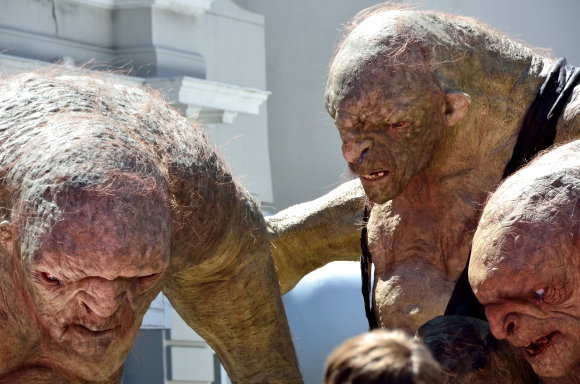
Image by Tristan Schmurr
Haters gonna hate, trolls gonna troll. Some of the harshest critics are frustrated creatives, bitter and twisted about their own unsuccessful dreams of achieving what you have already–which is putting yourself out there and getting noticed.
Be that as it may, being insulted gets most people a little warm under the collar. You get angry, and the first thing you want to do is respond to it—hit back, or give your rebuttal, or ask why. Sadly, responding is usually useless.
Once in a while, some kind person might attempt to set them straight. You might think that if you explain things to them, they’ll understand, but unfortunately the concepts “explain” and “understand” only work if you are using the same kind of words. If you try talking to them in human words, they’ll respond in troll. What a waste of breath!
To prove the futility of responding to haters, Sebuyama carried out an “ego search” experiment on Twitter. (Ego searching is a term for searching for your own name to see what is out there about you on the internet… you know, like Googling yourself.)
Finding some pretty unkind tweets about him, he deliberately replied to each one, a process which naturally requires some mental toughness. The responses he got in return generally fell into three different patterns… (We have translated the following discourse into English.)
1) Evasion

When Sebuyama searched for his own name on Twitter, the first hit was the tweet above. Some random throwing his name around and telling him to “quit the internet”.
Wait—maybe there was a very good reason Sebuyama should quit the internet? Could this guy be a time-travelling agent sent back from the future, desperately trying to stop Sebuyama using the internet because of the terrible chain of consequences this set in motion?? To find out, Sebuyama sent him the reply below…

“Why?” I mean, there might be a good reason why…?
Ooh, a reply came back!
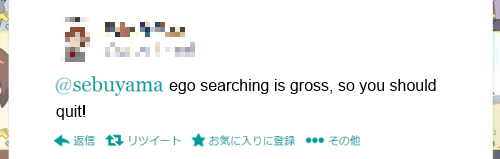
Well, that’s good to know, but… Huh? Seems like something’s not quite clicking here… like they’re just talking past each other.

Trying to get to the bottom of this, Sebuyama asked him why one more time. “Quit the internet”—what does that mean anyway? Just never use it ever again?? Sounds reasonable.
But there was no direct reply.
Instead, the tweets below were fired out in rapid succession…

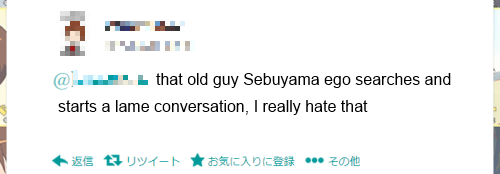

I guess this guy got peeved at having to evade the question, and started bagging not just Sebuyama but the website he writes for, Omocoro.
Anyway, replying, it seems, is just like pouring oil on the fire!
2) No rhyme or reason
Next, Sebuyama stumbled upon this kind of tweet:
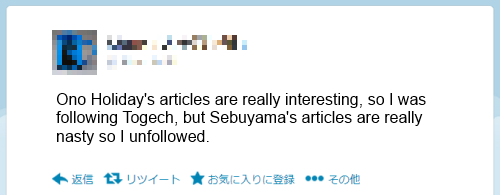
Looks like this tweeter wants to praise Ono Holiday and diss Sebuyama!
Of course, it’s fine if someone’s work is not to your taste and you decide to unfollow them on Twitter, but why would you go to the extent of posting rude comments about it? Seems like a lot of effort for no reason other than to be, well, kind of a jerk.

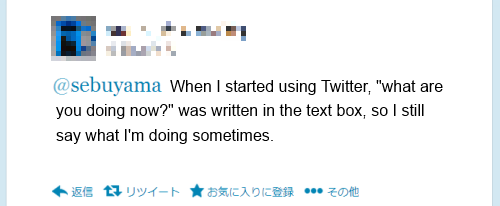
What the…?
So this “hater” had no real malicious intent. There was no real rhyme or reason to their criticism. It wasn’t like they were thinking, “I want to destroy Sebuyama’s career, mwahahahaha!!!” They were only tweeting what they were doing, just like tweeting “having dinner now” or “in Shibuya now”.
So if you were to reply to them, it’s like asking them “Why are you in Shibuya now? WTF?!” …they probably won’t even have any particular reason.
If someone’s tweeting bad things about you without any particular reason, you won’t get anything out of questioning it. You may as well interrogate the weather.
3) Ignorance
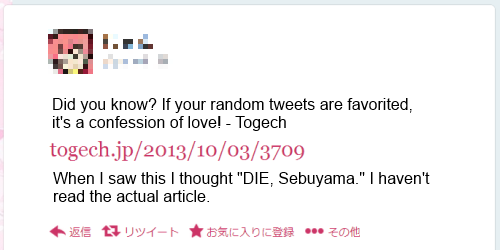
Apparently, even reading just the title of Sebuyama’s article was enough to drive this tweeter to wish death on him. They can’t be bothered reading it, they just want him to die?
Well, perhaps it wasn’t the best article ever, but isn’t this taking things too far? Let’s see.

Good question, Mr. Sebuyama. Well????

Oh, right, they are totally ignoring Sebuyama’s response to their death wish tweet.
Again, this interaction was futile.
- But wait, isn’t it okay to respond to haters if it makes us feel better?
“Replying to abuse on the internet may be useless, maybe you don’t gain anything by it, but on the other hand you don’t lose anything by it, right? If you hit back, you’ll feel better!”
Unfortunately there is one major drawback. Check out the tweet below!
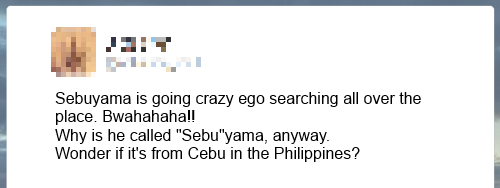
This is some other stranger on the internet who happened to notice the other interactions and get in on the action. Here’s one more person thinking “Sebuyama’s doing an ego search and responding to all the hits! Weak sauce.”
The problem is that even your fans might see you engaged in these kind of slagging matches and realize that you’re no better than the douchebags getting up in your face. Replying to stupid tweets sinks you down to their level. If you have the time and energy to ego search and engage with the haters, it’s a hundred times better to use that time and energy creating something new.
- How about shutting out all criticism?
Some say that if you only listen to praise, your work gets gradually worse and worse. And honestly, that may be so.
However, this is a different kind of criticism. We need constructive criticism, not mindless abuse. For example, someone tells you “that bit was good, but if you tried putting in a bit more of the other, it would improve things.” Now that is extremely valuable, and a great way to improve.
But if people are just writing things like “boring (yawn)”, “WTF”, “I don’t get it”, or “this sucks” without giving any concrete reasons, how can you get anything out of that? If people can’t express their own feelings with any better words than that, how can they express any criticism that would be useful?
Sebuyama thinks the opinions of people like that are boring, WTF, and he doesn’t get it. And yeah, they suck.
- Hey, we have a right to free speech! That’s how I feel, so that’s what I wrote! What’s so bad about that? Leave us alone!!
Of course. So do we all.
This article is another good example of free speech. Just as you say, what’s so bad about that? Leave me alone!
- Hang on… so this whole article is really just a lame response to haters?
Eeeek! You’re totally right, that’s exactly what this is. So let’s cut to the chase!
- Finally…
The reason Sebuyama wanted to write his article was that he had met with many young artists who wanted to put more work out there but were frozen in fear of internet hate.
Up until then, he had thought that abuse on the internet was just like graffiti scribbled on a toilet wall, or a stray dog barking… relatively harmless and lacking in any real meaning. But actually, abuse written on a toilet wall can still sting. Being barked at by a stray dog can be scary.
Some think that if you don’t have a thick skin, you don’t have what it takes to be an artist… but along with the growth of social media has come a greater level of public abuse and intimidating, bullying behavior. Don’t let it hinder your efforts to create! Don’t waste time even worrying about it—that time is better spent making the world a more amazing, colorful place. There will always be haters, but we don’t have to pay attention to their mindless noise. Responding is futile. Let’s focus on what’s really important.
Source: Omocoro
Images: Tristan Schmurr, Omocoro
Featured image: RocketNews24
]]> https://soranews24.com/2013/10/22/haters-gonna-hate-writer-conducts-experiment-discovers-that-responding-to-internet-dissing-is-futile/feed/ 0 95487 tweet13e tweet14e Could you eat a horse… raw? Try home-made horse sashimi straight from the butcher! https://soranews24.com/2013/10/17/could-you-eat-a-horse-raw-try-home-made-horse-sashimi-straight-from-the-butcher/ https://soranews24.com/2013/10/17/could-you-eat-a-horse-raw-try-home-made-horse-sashimi-straight-from-the-butcher/#comments Wed, 16 Oct 2013 18:30:41 +0000 http://en.rocketnews24.com/?p=94419 
Basashi is raw horse meat cut into slices–“horse sashimi”, and a delicacy consumed in some parts of Japan. The most famous place to experience basashi is Kumamoto Prefecture in Kyushu, southern Japan.
You can order a plateful of the stuff in Japanese pubs (izakaya), and it’s said to go incredibly well with nihonshu, but our intrepid RocketNews24 reporter Mami Kuroi couldn’t find any horse meat in Tokyo supermarkets to slice up to make her own basashi to try at home. Eventually, she happened to be visiting Komoro City in Nagano Prefecture and stumbled on a butcher who stocked it. There was even a poster outside proclaiming that the shop sold the “best-quality basashi“! Seizing this once-in-a-lifetime chance for home-made horse sashimi, she bought some, sampled it and wrote about her horsy adventure for us to enjoy. Of course, it was totally raw!
・The three different types of horse meat
In the shop, three different cuts of horse meat were on display. According to the shopkeeper, horse meat is generally divided into categories of “very fatty”, “lean”, and something in-between the two extremes (the price is highest for high fat content). The meat looked like cuts of deep-red, fatty tuna. Written on the shelf were the words: “Inspected, OK for sashimi”. Yessss!
・Expiry date: one week!
Mami couldn’t decide which cut to buy, but reasoning that the best way was to choose the path of moderation, she chose the in-between cuts of meat with a nice mix of fat and lean. Wrapping it up, the butcher seemed proud of the meat’s freshness: “Taking it back to Tokyo?” he asked, “No problem! It’ll be fine for about a week!” Wow, can you really keep raw horse for a week?
・Voila! Home-made basashi
So the very next day, Mami had the horse meat in her hot little hand and was headed for the editorial department. She sliced it up right away, and arranged it on a plate with ginger and soy sauce on the side, and a bottle of sake completed the beautiful picture. Voila! Here it was, the home-made basashi she’d been longing for. Some staff members in their early 30s volunteered to give it a taste test and let us know how it went…
“So meaty. The texture is incredibly fleshy.” (Ms. K)
“It doesn’t smell bad at all. It’s good!” (Mr. K)
“Yeah, this is great! This is basashi, the real deal.” (Mr. H)
“Yum! This might just be the best basashi I’ve ever had!!” (Ms. M)
…and surprisingly, it was very well received! At first, not a single chopstick ventured toward the meat—worried about food poisoning? But, after trying it once and getting a good taste of horse, the team were positively wolfing it down. As Mami looked on with amazement, the plate was completely emptied. Just one taste did the trick!
・Flavor and texture with plenty of horse power
The basashi served up in most Japanese pubs can be soggy (maybe because it’s been frozen and then defrosted?), and the texture is definitely inferior. But the fresh stuff has the characteristic plump mouth-feel and flavor of raw meat.
・Great as a snack with sake!
There was no unpleasant smell accompanying the fine flavour of the horse, and the rice wine went down a treat with the meat… Whoever came up with the idea of having ginger, soy sauce and horse meat with Japanese sake was a genius… oops, take it easy on the sauce during the working day… (eek!)
Anyway, the home-made basashi was a great success, and Mami loved it so much she said she’d definitely do it over and over again! If you’re in Japan and you’d like to make the pilgrimage to basashi‘s homeland Kumamoto but it’s too far away, why not try Nagano basashi for starters! It’s just three hours from Tokyo on the train. And if you love Japanese sake, you should try the interesting combo of sake-and-horse!
▼ The sign on the right is advertising “best-quality basashi“

▼ Hmmm, the shape of this horse meat is just like a cut of fatty tuna!

▼ The naked meat, out of the plastic pack.

▼ Here it is again, all cut up.

▼ The perfect partners… With ginger, soy sauce and Japanese sake for a winning combination.

▼ So raw you can almost taste it just from the photo!

▼ The three types of basashi (the meat in the yellow tray is the highest grade)

▼ Sign says “Inspected. OK for sashimi”. See? Totally safe!

I don’t know about you, but that certainly whetted my appetite… I’d try most things once! Come on people, get on your horse! Why the long face…? If you feel in the mood now for some other tasty Japanese treats, try some poisonous puffer fish or check out these meat sculptures!
Original Japanese article by Mami Kuroi
Images: RocketNews24
]]> https://soranews24.com/2013/10/17/could-you-eat-a-horse-raw-try-home-made-horse-sashimi-straight-from-the-butcher/feed/ 0 94419 Cats in bowls, buckets and boxes: smile guaranteed! https://soranews24.com/2013/10/08/cats-in-bowls-buckets-and-boxes-smile-guaranteed/ https://soranews24.com/2013/10/08/cats-in-bowls-buckets-and-boxes-smile-guaranteed/#comments Mon, 07 Oct 2013 20:00:22 +0000 http://en.rocketnews24.com/?p=92282 
Feeling blue? Is Monday ruining the week for you? Try a bowlful of snuggly warm kitty, cozily comfortable and soooo cute, in a ridiculously small vessel. It’s good for what ails you.
These cats should feel right at home in an average Tokyo apartment!
▼ Mmmm, I’ve found my happy place and it’s time for a snooze…

▼ At one with nature, the felis catus cleverly camouflages his presence.

▼ I am a cat—I don’t have to vacuum clean, and I can sleep in buckets.
▼ Last night, I got totally jarred.
▼ I asked for a Grey Goose straight up, and this is what I get??
▼ “My mummy always wished for a goldfish.”
▼ Those polystyrene packing chips are so last week.
These images can be found on Nekowan, a lovely Japanese website devoted to cats and dogs. Nawww, it’s cats like these that make the internet go round.
Feeling better now? If you still need a little more cuteness, check out this babe of a kitty.
Images: Nekowan
]]> https://soranews24.com/2013/10/08/cats-in-bowls-buckets-and-boxes-smile-guaranteed/feed/ 0 92282 cat3 cat5 cat6 cat7 cat8 cat9 Why reading their own language gives Mongolians a headache https://soranews24.com/2013/09/27/why-reading-their-own-language-gives-mongolians-a-headache/ https://soranews24.com/2013/09/27/why-reading-their-own-language-gives-mongolians-a-headache/#comments Thu, 26 Sep 2013 17:00:02 +0000 http://en.rocketnews24.com/?p=87717 
Being able to read is something many people take for granted. I mean, English with its Latin alphabet only consists of 26 letters. Now imagine that the writing system (or script) of your country was changed for political reasons. Cities and towns across the border share almost the same spoken language, but with a totally different way of writing it down. This has been the situation in Mongolia. Drastic changes in scripts throughout the twentieth century have led to recurrent headaches for native readers.
I’ve met many a foreigner in Japan, or third culture kid who despite their fluent spoken language skills was unable to read. Here’s an example. A friend of mine who learned Bulgarian from her parents was visiting her native land. She jumped into a taxi, confident that she’d be driven to her destination, and fluently gave the address. The taxi driver gave her an extremely odd look. It turned out that where she wanted to go was right there, but she couldn’t read the signs to figure that out.
Spoken Japanese is fairly easy to pick up if you live in Japan, while memorizing the bare minimum of 2,136 kanji characters for everyday use requires serious study. And that doesn’t include the incredibly varied characters for personal names or place names. Foreigners who can chat comfortably in Japanese are a lot less likely to be able to read signs or menus, let alone newspapers. Let’s just say I’ve seen even native speakers sneakily looking up how to write a particular kanji on their phones.
Not being able to read easily is tough, wherever you live. In Mongolia, reading can be a huge pain for native speakers… this is why!
– “Ma, why do I have to learn my alphabet twice?”
There are currently two forms of writing the Mongolian language. One is the traditional Mongolian script (“Old Mongol script”) written vertically down the page like this:

The other is Mongolian Cyrillic, written horizontally like this:
Монгол Кирилл үсэг
Cyrillic is used in the state of Mongolia, while the traditional Mongolian script is used in neighboring Inner Mongolia (an autonomous region of the People’s Republic of China). You might expect that because Mongolian is now written in Cyrillic it’s similar to Russian, but in terms of grammar Mongolian is much more like Japanese.
Traditional Mongolian script is said to date from 1204, when scribe Tatar-Tonga was captured by the Mongols and introduced the Uyghur form of writing, originally written horizontally. Eventually, this became written vertically—Mongolians might say that happened because it was easier to write down the horse’s neck rather than across.
However, by the end of the century this would change. The Yuan dynasty of Kublai Khan (famous grandson of Genghis) promoted the imperial Phagspa script for the vast area they controlled. This intricate writing system was invented by Tibetan lama Zhogoin Qoigyai Pagba for Kublai Khan. It ambitiously aimed to be a script able to be used for all the languages under their sway, including Chinese, Tibetan and Mongolian.
▼ Phagspa script

In 1368 the Yuan dynasty collapsed, and as the Mongols retreated to the steppes, this writing system soon fell out of use and was replaced by traditional Mongolian script once more. The reason Phagspa disappeared so quickly could have been its privileged existence as a faithful representation of the language of the imperial court—it didn’t reflect how ordinary people spoke.
About 600 years later, Mongolian script reached another turning point. In 1921 revolution broke out, and by 1924 communist rule was established in the new Mongolian People’s Republic.
– “Workers of the world, unite!” Different alphabets adopted under Soviet pressure
▼ Latin script propaganda
In 1924, the literacy rate was below 10 percent. Mongolian script was held up to ridicule, and Latin script was named the alphabet of the revolution for writing Mongolian. Away with the old ways of thinking and in with the new—the traditional teaching of Buddhist parables gave way to educational reform.
From the early 1930s, there were attempts to switch from Mongolian to Latin script, but these early attempts met with strong opposition. However, in the latter half of the decade circumstances changed as continued use of Mongolian script was denounced as “nationalist” in the wake of Stalin’s Great Terror. Everyone was forced to support the Latinization of Mongolian writing, in fear for their lives.
In February 1941, the government gave an official green light to the use of Latin script, but the following month, these same public officials decided Mongolian should be written using the same Cyrillic alphabet as Russian. Clearly, there had been some kind of pressure exerted by Moscow.
In the 1950s, linguistically-divided Chinese Inner Mongolia also began to consider adopting Cyrillic. But from the end of the decade the Sino-Soviet split came to a head and cast a pall over this movement, which eventually sputtered and died.
During the perestroika period, Moscow’s grip loosened. People regained their appreciation for tradition, and cultural renaissance was in the air. A new movement to abolish Cyrillic and restore Mongolian script arose. In September 1992, education began in Mongolian script from the first year of primary school. Unfortunately, when these children reached third year, Cyrillic was adopted once more. In the face of harsh economic reality, the budget couldn’t stretch to train teachers and educate students in the vertical Mongolian script.
– Writing systems divided by national borders
As a result, while the state of Mongolia and Chinese Inner Mongolia speak almost the same language, it is written in totally different ways in each country. It’s possible that these writing systems may never be united.
The phenomenon of border lines creating linguistic division can be seen all over the world. A country which gains independence generally wishes to gain independence from the language of the oppressors and a distinct voice, especially if there is a shared border. Crucially, the changes in written Mongolian did not come about through the will of the Mongolian people, but through the political posturing of surrounding nations. Next time you come across a written English word that you don’t know how to pronounce, spare a thought for Mongolia’s differing systems of writing.
Source: Yukiyasu Arai, Japan Business Press
Featured image: Rona Moon
Insert images: Wikipedia, Akihabara Area Blog

]]> https://soranews24.com/2013/09/27/why-reading-their-own-language-gives-mongolians-a-headache/feed/ 0 87717 Steppes Monggol bicig.svg Phagspa script Must try before you die: Fugu and shiokara from Japan make bizarre food “bucket list” https://soranews24.com/2013/09/19/must-try-before-you-die-fugu-and-shiokara-from-japan-make-bizarre-food-bucket-list/ https://soranews24.com/2013/09/19/must-try-before-you-die-fugu-and-shiokara-from-japan-make-bizarre-food-bucket-list/#comments Wed, 18 Sep 2013 23:30:03 +0000 http://en.rocketnews24.com/?p=86669 
When you’re hovering on the verge of leaving this world, the last thing you want to feel is lingering regret about those unique foods you never had the chance to try and all those unimaginable flavours and textures you missed out on, or never knew existed. To avoid such a terrible fate, a list of 20 strange bucket-list foods has recently been compiled by a British news site and has been widely commented on in Japan, as it features two home-grown favourites: fugu and shiokara. Fugu is the poisonous pufferfish of Simpsons fame, while shiokara is a relatively harmless dish composed of shreds of meat from a sea creature (commonly squid) in a slimy paste of its heavily salted, fermented raw guts. I mean, viscera.
So my taste buds won’t spend an eternity regretting the tragic circumstances that left their fugu and shiokara cherry unpopped, I aim to get to the bottom of these Japanese dishes! Er, okay, maybe not right to the bottom. I’ll have a few cautious bites and see how it goes.
First off, let’s take a look at that bucket list. As you would expect, this list of out-there mean cuisine ranges from the potentially poisonous to various creepy-crawlies. You might want to keep a real bucket on hand, just in case. These excretal, fetal, reproductive, rotten (sorry, fermented) or raw treats leave no food group unmolested.
Warning: Even reading about the following foods may induce nausea.
1. Fugu, Japan
To prepare this risky fish, a special license is required.2. Witchetty grub, Australia
This large white larvae is said to taste like almonds when eaten raw.3. Sannakji, Korea
Still squirming octopus tentacles.4. Puffin heart, Iceland
Eaten raw. Eat your heart out, Gordon Ramsay and Daenerys Targaryen.5. Escamoles, Mexico
“Insect caviar”… or some would say, ant larvae.6. Shiokara, Japan
Do you have the guts to try these?7. Beondegi, Korea
Snack on steamed silk worm pupae.8. Tong zi dan, China
Virgin boy eggs. Part of a longheld tradition of urine therapy spanning many cultures throughout history, these pee-soaked delights are said to “reinvigorate the body“.9. Hákarl, Iceland
Fermented, dried shark—poisonous when fresh.10. Baby mice wine, China/Korea
You can imagine. Although probably you’d prefer not to.11. Cockscombs, Europe
Vital ingredient in legendary Italian sauce Cibreo.12. Surströmming, Sweden
Due to the overwhelming odour of this fermented fish dish, it should be eaten outside.13. Rocky mountain oysters, US
Don’t be fooled by the name, these are actually bull calf testicles.14. Black Ivory coffee
Made from coffee beans which have been eaten by an elephant and collected from the resulting feces.15. Balut, Philippines
Duck embryo in the shell.16. Tepa (“Stinkheads”), Alaska, US
Fermented whitefish heads, traditional food of the Yup’ik peoples.17. Snake wine, South-east Asia
Yesssss, doesss contain sssnakes.18. Century eggs, China
These green-yolked preserved eggs only take weeks or months to make, not 100 years.19. Fried spiders, Cambodia
A species of tarantula, fried with MSG, sugar, salt and garlic.20. Grasshoppers, all over the world
Let me tell you, the sweet grasshoppers served up in Japan have got to be the most delicious!
So how did you score out of 20? The number you have tried may be directly proportional to your death wish…
Now let’s take a closer look at the two dishes from Japan, tried and successfully consumed by yours truly:
- Fugu, poisonous pufferfish
 Image: alq666
Fugu is generally served at restaurants that specialize in serving the dish—I strongly recommend that you don’t try this at home, as one wrong cut could be fatal. Fugu chefs undergo rigorous training to hone their expertise, and must be licensed. In Japan, you will often spot a tank full of fugu swimming around by the entrance.
The best place and season to consume this delicacy is generally agreed to be winter in Shimonoseki, Yamaguchi Prefecture (southern Japan). Sadly, I couldn’t make it down there, so I tried a full course meal in Tokyo instead. Hyped up on adrenalin, I found myself assessing my entire life up to that point. The first item on offer was the hirezake (fin sake), a shot of alcohol with a fugu tail floating inside, which my waiter kindly set on fire and extinguished for me. I gathered my courage and gulped down the sake, including the tail which was chewy and blackened. Ewww. Suddenly I started choking. Wait… that really didn’t taste like it was supposed to be eaten! I called back the waiter and frantically tried to explain my dilemma. Was I doomed? I could already feel the telltale tingling and numbness beginning in my fingertips.
▼ Fugu hirezake
 Image: Motohiro Takayama
The waiter confirmed that it was probably better not to eat the tail, but reassured me that I’d be fine. After I calmed down, I found the rest of the courses fairly bland, except for the outstanding karaage fugu (you can’t go wrong with deep-fried anything) and the arrangement of wafer-thin raw fugu sashimi slices was almost too beautiful (and potentially poisonous) to eat.
- Ika no Shiokara
 Image: Rona Moon
Shiokara may be easier to come by than fugu. If you’d like to give it a whirl, try asking for it at your local Japanese restaurant or supermarket and you may win some respect for your culinary knowledge and refined taste. Just try not to ruin the effect by choking on it when it arrives!
Pronounced “shee-oh-KA-ra”, the most common kind is made from squid or cuttlefish, and it may be on the English menu as something like “fresh cuttlefish pickled”. One of the best ways to initiate yourself is to alternate gulps of shiokara with gulps of whiskey.
The two types of shiokara I got my hands on were made from ika (squid) and flavoured with salt, which has a murky orange color. The other was flavoured with soy sauce, and was darker brown in color. Wow, something smelt fishy—a bit like anchovies. I gingerly chopsticked some slimy squid flesh out of the ooze of fermented viscera and eyeballed it. Here goes nothing, down the hatch. The first impression is overwhelming saltiness, then the sour fishy flavour kicks in. The thinly sliced squid is also quite chewy, as you’d expect, but the pieces are small enough to slip down easily. Just try not to think about the word “viscera”. Mmm. Hey, this is not bad! Not bad at all! Or was it just all that whiskey I drank… Either way, I regret nothing!
Well, I hope your appetite for the bizarre is sated for now. Anyone care to try the foods on this bucket list?
Source: Himasoku via RecordChina
Featured image: Himasoku
]]> https://soranews24.com/2013/09/19/must-try-before-you-die-fugu-and-shiokara-from-japan-make-bizarre-food-bucket-list/feed/ 0 86669 Fluffy cat and dog sushi turns heads and wins hearts in South Korea https://soranews24.com/2013/09/16/fluffy-cat-and-dog-sushi-turns-heads-and-wins-hearts-in-south-korea/ https://soranews24.com/2013/09/16/fluffy-cat-and-dog-sushi-turns-heads-and-wins-hearts-in-south-korea/#comments Mon, 16 Sep 2013 12:30:34 +0000 http://en.rocketnews24.com/?p=86216 
One day, some unsung genius stared at the fluffy pure-white fur of their beloved cat, thought “mmm, looks just like fluffy white rice”, and grabbed a red towel and a black sock to make their dream come alive. Boom! Fluffy cat sushi was born.
Over in South Korea, fluffy cat and dog sushi has become all the rage, with proud netizens displaying their home-made creations anonymously on internet message boards. Don’t get me wrong – this sushi is purely for decoration and made from household pets with beautifully white fur! Furthermore, it’s easy! If you have a pet at home who’s willing to sit still to be adorned, you can make your own delicious little morsel just like these.
Basically, you need a sushi-coloured towel (salmon pink, tuna red or egg yellow) for the neta (topping), a long black sock to serve as the nori seaweed wrapping, and a gorgeous fluffy white pet. Convince your darling to settle in one place, preferably on an elegant minimalist lacquer tray, then just drape the folded towel and sock over their back for artistic effect. Soy sauce and wasabi optional.
▼ Got home and wrapped up some rice for the noms. Purrfection.

▼ Well, I tried to make cat sushi but my rice kept flying out! Oops. S-sorry kitty, honestly I didn’t mean it, I’ll make it up to you…

▼ Who’s this? A new challenger enters…

▼ Could this be… dog flavour?

▼ Yip!

▼ Best-trained sushi in town. Would you like it in a bento box?

▼ This egg dog roll has been expertly styled by the taisho sushi master. Looking fierce!

▼ Awww, come on! You’d look good in anything, wouldn’t you sweetie. Yes you would. Yes you would…
There you have it! The winning combination of cute and delicious makes a scrummy new phenomenon, coming soon to a conveyor belt or living room near you. Some pets refuse to submit to becoming part of this consumer culture, while others seem to enjoy the attention.
The above style of sushi (nigiri or “hand-pressed”) is charming, but I would personally be interested to see an attempt at a sushi roll (maki) with the cat curled up in the middle of a seaweed wrap. Who knows, this may already be a treatment at upmarket pet day spas.
This is not, however, the first time cat sushi has made waves. Many have tried to create the ideal sushi out of their pets, and many have failed. There again, becoming a sushi master is a path fraught with all kinds of difficulties and techniques to master. Good work, cat and sushi lovers, we look forward to your next incarnations!
Images: Otonarisoku via 2chbiyori
]]> https://soranews24.com/2013/09/16/fluffy-cat-and-dog-sushi-turns-heads-and-wins-hearts-in-south-korea/feed/ 0 86216 catsushi4 catsushi5 catsushi6 catsushi7 catsushi8 catsushi9 catsushi10 Blind kitten who regained her sight through loving care is thriving one year on https://soranews24.com/2013/08/26/blind-kitten-who-regained-her-sight-through-loving-care-is-thriving-one-year-on/ https://soranews24.com/2013/08/26/blind-kitten-who-regained-her-sight-through-loving-care-is-thriving-one-year-on/#comments Mon, 26 Aug 2013 00:00:46 +0000 http://en.rocketnews24.com/?p=81035 
One day, one ordinary person and his family found it in their hearts to take in a tiny, abandoned kitten who had lost her sight due to a bad case of conjunctivitis. They already had two dogs under their roof, which would make it difficult to keep a cat. Nevertheless, the father devoted himself to her care as she hovered between life and death, praying for the kitten’s full recovery. He didn’t intend to give the kitten a name at first, as he was worried about becoming too attached, and just called her “cat” (neko in Japanese) but somehow everyone started calling her Niko, which means something like “happy smile”.
“She brought smiles to the faces of everyone who met her.”
When Niko was first rescued, she was unable to see. Her eyes swollen shut, and she was wild with pain and confusion. But after a warm bath, she cuddled up to her new friend, who gently cleaned her eyes with gauze pads soaked in water. He offered her milk and food, but she showed no interest whatsoever. And because she couldn’t see, she just sat there, unable to move.
Gradually, over some days her eyes began to open and she slowly regained her appetite. She started to act more like a playful kitten, but her eyes were still raw and sore.
Because of their two dogs, sadly it wasn’t possible for Niko to stay with her new family long-term. The owner had to find a new home for her, but he was worried that no one would want to take in a sick kitten with such bad eyes.
Through his loving care, and Niko’s fighting spirit, slowly but surely the cat regained her sight and health. In just two weeks, she had become a beautiful, happy kitten that any parent would be proud to show off.
Serendipitously, just as he was thinking of placing ads to find Niko a home, an old school friend got in touch. This friend and his wife had lost their second cat the previous year, and they and their 12-year-old American shorthair were lonely. This seemed like the perfect home for Niko. Not only were they cat lovers, but also trusted friends. One month later, Niko went to her new home in Kamakura, a coastal town just south of Tokyo.
After circling each other warily at first, Niko and her adopted older sister got to know each other, and some of Niko’s natural optimism rubbed off. More than one year later, the two friends are living together happily.
The message Niko’s rescuer would like to stress is the importance of spaying or neutering cats and dogs, to save lives and prevent the suffering of unwanted, neglected and abandoned animals.
Check out the following video, which shows one month of heart-warming kitten recovery, condensed into 17 minutes with English subtitles (hard to read at times!).
And here we see Niko One and her big sister a year on. Looks like they’re learnt to play together pretty nicely!
H/t Jin115 via Karapaia via Labaq (Japanese)
Featured image by MrJin650
]]> https://soranews24.com/2013/08/26/blind-kitten-who-regained-her-sight-through-loving-care-is-thriving-one-year-on/feed/ 0 81035 10 surprising lifestyle habits of Japanese savers: Why are men who throw things out good with money? https://soranews24.com/2013/08/19/10-surprising-lifestyle-habits-of-japanese-savers-why-are-men-who-throw-things-away-so-good-at-saving-money/ https://soranews24.com/2013/08/19/10-surprising-lifestyle-habits-of-japanese-savers-why-are-men-who-throw-things-away-so-good-at-saving-money/#comments Mon, 19 Aug 2013 10:30:16 +0000 http://en.rocketnews24.com/?p=79642 
An online survey was recently carried out on 100 Japanese men in their 30s with an annual salary of 6 million yen (US$61,000) or less who have nevertheless managed to amass more than their annual income in savings, and the results were really quite surprising. The men’s answers seem to overturn the common wisdom on how to save money, resulting in a list of characteristics that natural savers share.
I always imagined thrifty types would hang on to all their old junk in case it came in handy, but for some reason, the men who have proved themselves to be great at saving money also tend to excel at throwing things away and… reading maps.
The common lifestyle habits of 100 excellent money savers in Japan:
1. Rather than giving advice, they more often ask for advice themselves (88%)
2. Find it easy to throw unwanted possessions away (86%)
3. On the weekends, rather than spending more time sleeping, they like to get outside in the open air (85%)
4. In their 30s, they maintain the same body shape they had in their 20s (74%)
5. Rather than having a small circle of close friends, they tend to have many acquaintances (71%)
6. Have changed occupations (55%)
7. Are especially good at reading maps (41%)
8. Always bathe before going to bed (35%)
9. Whether it’s business or personal, always arrive earlier than the appointed time (34%)
10. Are quick to reply to correspondence (24%)
*Survey carried out on 100 single or married men in their 30s earning salaries less than $60,000 with savings of more than their annual income.
The unexpected result in this survey was the high percentage who were great at throwing things away. You would think that if these guys are so good at saving, anything they purchased with their hard-earned cash they’d hold onto and use for as long as possible just to make sure they had their money’s worth, but it seems that’s not usually the case. One man explained that he was not so attached to things in the first place. Content with a bare minimum of furniture, he didn’t feel a burning need to possess the newest TV or Xbox.
Also surprising was the kind of friendships generally enjoyed by savers: 71% said they had a “wide circle” of people they know but maybe aren’t so close to. It would seem logical that the more friends you have, the more you’d have to spend money on them. But wait… maybe if you aren’t all that close to people, you can easily bail at an early stage of the evening without the risk of offending anyone, and save a lot of money on all those rounds of sake bombs later on…
Some financial planners have said that spatial awareness or an ability to read maps well (number seven) is correlated with an ability to plan long-term. But come on, is any guy going to admit he’s not amazing at reading maps?
To sum up, these are a fine set of highly admirable characteristics. Now where do these men live, how many are really single, and how can I get hold of their phone numbers??
Source: 女子SPA!
Featured image by Yoshihito Miki
]]> https://soranews24.com/2013/08/19/10-surprising-lifestyle-habits-of-japanese-savers-why-are-men-who-throw-things-away-so-good-at-saving-money/feed/ 0 79642 Pattern of quakes from New Zealand to Japan stokes fears of another major disaster https://soranews24.com/2013/08/07/serious-earthquake-about-to-strike-pattern-of-quakes-from-new-zealand-to-japan-stokes-fears-of-another-major-disaster/ https://soranews24.com/2013/08/07/serious-earthquake-about-to-strike-pattern-of-quakes-from-new-zealand-to-japan-stokes-fears-of-another-major-disaster/#comments Tue, 06 Aug 2013 18:00:14 +0000 http://en.rocketnews24.com/?p=76145 From 5 August, fears of another major earthquake in Japan began to spread on Twitter. The source of the unease was a screenshot from a Japanese talk show, which laid out the following series of earthquakes leading up to the Tohoku earthquake in 2011, alongside a similar series of earthquakes which have struck in recent days.
Here are the two sequences of events.
- In 2011:
22 February, magnitude 6.3 earthquake in New Zealand
15 days later…
9 March, shindo scale “strong 5” earthquake in Miyagi Prefecture
2 days later…
11 March, the catastrophic Tohoku earthquake and tsunami
- In 2013:
21 July, magnitude 6.5 earthquake in New Zealand
14 days later…
4 August, shindo scale “strong 5” earthquake in Miyagi Prefecture
…
Basically, the “pattern” of two quakes which hit recently strikingly resembles the two which presaged the horrific 2011 Tohoku earthquake two years ago. So if this was indeed a pattern, a large earthquake would be expected to hit on 6 August, 2 days after the Miyagi quake.
On Twitter, people in Japan expressed their feelings about this rumour:
“It’s the usual fear.”
“It’s scary, huh (´;ω;`)”
“Well, probably just a coincidence but…”
“You can’t just take one example to use as a basis, ignoring all other patterns.”
“I wish they’d stop putting this kind of thing on TV!”
While we want to believe this is merely a far-fetched story aimed at boosting viewing figures, it’s important to always be prepared for an earthquake. In any case, we can only fervently hope that these fears are unfounded.
]]> https://soranews24.com/2013/08/07/serious-earthquake-about-to-strike-pattern-of-quakes-from-new-zealand-to-japan-stokes-fears-of-another-major-disaster/feed/ 0 76145 From polar bears and penguins to coelacanths, Japan’s magical ice trays create sea creatures https://soranews24.com/2013/07/31/from-polar-bears-and-penguins-to-coelacanths-japans-magical-ice-trays-create-sea-creatures/ https://soranews24.com/2013/07/31/from-polar-bears-and-penguins-to-coelacanths-japans-magical-ice-trays-create-sea-creatures/#comments Tue, 30 Jul 2013 18:00:11 +0000 http://en.rocketnews24.com/?p=74085 
Fancy a shark, a squid or a manta ray floating in your highball?
Now you can, without all the bother of hauling them out of the ocean. Cute miniature versions perfectly formed from ice that will swim on the surface of your beverage.
These are the result of “Silicone Animal Ice Trays”, available from Colorata in a variety of themes such as “Animals of the Artic and Antarctic”, “Creatures of Japanese coastal waters” and “Deep-sea creatures, sharks and friends”, as seen below. The trays can withstand a maximum temperature of 230°C and a minimum of 20°C, so you can also use them to make chocolate turtles and cupcake sunfish as needed.

▼Nautilus, a ” living fossil”, is a distant relative of octopi and squid, and has now evolved into a pint-sized frozen form.

▼”Animals of the Artic and Antarctic”, including sea otter, killer whale, walrus, polar bear, beluga, humpback whale, crab-eater seal and three different kinds of penguin!

▼His or Her Majesty, King Penguin

Each animal comes with a description handily written in Japanese. For example, sea otters, a member of the weasel family, spend most of their lives at sea. They are well-adapted to an ocean-going lifestyle thanks to their large webbed tootsies, and can dive down to a depth of 90 metres in search of yummy sea urchins.

▼Probably the closest you will get to a polar bear without a severe mauling.

▼Everyone’s favourite group of aquatic flightless birds. If you live in the Northern Hemisphere, at least you can grab these ice blocks, watch some Pingu, and dream about penguins…

▼Cast in a more dangerous mould, the set of sharks.

▼Most impressed by the detail on this rare coelacanth. Maybe someone can clarify whether this is a chalumnae or a menadoensis?

▼Predators tend to be the most graceful and powerful.

▼One of the most valued fish for sushi, Pacific bluefin tuna. In 2012, one of these babies sold at Tsukiji for a record $1.76 million. Japan happens to be a world leader in tuna farming research.

▼Featuring the ocean sunfish (Mola mola!), which often sunbathes at the top of the water in between snacking on jellyfish.

▼This angler fish is uncharacteristically floating on the surface of the water. No doubt exhausted after a bout of polyandry…


Well, I was planning a visit to Tokyo Disney Sea, but maybe I’ll stay home and have a drink with all my little sea buddies instead!
Source: Gigazine
Photos: Colorata
]]> https://soranews24.com/2013/07/31/from-polar-bears-and-penguins-to-coelacanths-japans-magical-ice-trays-create-sea-creatures/feed/ 0 74085 icetray10 icetray12 icetray3 icetray8 icetray4 icetray9 icetray5 icetray6 icetray13 icetray14 icetray11 icetray7 icetray15 icetray10 How deep is Japan’s love of Coke in a glass bottle? https://soranews24.com/2013/07/29/how-deep-is-japans-love-of-coke-in-a-glass-bottle/ https://soranews24.com/2013/07/29/how-deep-is-japans-love-of-coke-in-a-glass-bottle/#comments Sun, 28 Jul 2013 16:00:57 +0000 http://en.rocketnews24.com/?p=73981 
Mmmm, a frosty cold glass bottle of Coca Cola on a summer’s day. The cool, solid feeling of the glass as you raise it to your lips, the satisfying heft of the bottle in your hand. What could be better? A plastic bottle? I don’t think so.
A special limited edition glass bottle is now available in Japan in select supermarkets. The announcement was posted up on Coca-Cola Japan’s Facebook page on 24 July, along with the above picture. Other than on Facebook, the glass bottles weren’t especially publicized or promoted. However, they soon gained more than 10,000 likes. Why do people in Japan seem to crave Coke in a glass bottle so much?
People expressed a liking for the glass bottles well beyond what you might expect. A flood of enthusiastic comments poured in: “Glass bottles are the best!”, “I want to drink it!”, “Let’s go find them!”
Many die-hard fans were also disappointed to find that screw top caps were used, rather than the authentic crown caps which require a bottle opener to open.
Here are some other comments from Japanese netizens:
“This is the real thing!”
“I want to experience the nostalgia of drinking from a glass bottle!”
“Bottled cola is so good…”
“I tried one but it wasn’t as carbonated. Is that because of the new cap?”
“I’m disappointed with the shoddy-looking labels.”
“I remember the Coke bottle vending machine! And the bottle opener there too… People who know about this must be at least in their mid-thirties…”
Judging by the comments in general, it seems that a great love for glass bottles is more about nostalgia than any other reason. There are also a host of other issues to consider—the disposal or recycling of bottles and the dangers of broken glass as opposed to plastic, among other things.
Still, if I had to pick one, I would pick glass. There’s just something about glass…Or maybe one of those super tiny, slim-line cans you can get in Japan, smaller than most inflight cans. Or a Coke made with water from Okinawa, that’s something you don’t see every day! Or perhaps it would be better to purify the Coke before drinking it…
Source: Narinari
Image: Coca-Cola Japan
]]> https://soranews24.com/2013/07/29/how-deep-is-japans-love-of-coke-in-a-glass-bottle/feed/ 0 73981