Scott Wilson – SoraNews24 —Japan News— https://soranews24.com Bringing you yesterday's news from Japan and Asia, today. Wed, 01 May 2024 02:25:02 +0000 en-US hourly 1 https://wordpress.org/?v=7.1.4 https://soranews24.com/wp-content/uploads/sites/3/2020/05/en_rocket_1024.png?w=32 Scott Wilson – SoraNews24 —Japan News— https://soranews24.com 32 32 176746664 W.T.F. Japan: The top five “sora” references of all time! 【Weird Top Five】 https://soranews24.com/2024/05/01/w-t-f-japan-the-top-five-sora-references-of-all-time-%e3%80%90weird-top-five%e3%80%91/ https://soranews24.com/2024/05/01/w-t-f-japan-the-top-five-sora-references-of-all-time-%e3%80%90weird-top-five%e3%80%91/#comments Wed, 01 May 2024 02:25:02 +0000 http://en.rocketnews24.com/?p=373093 
At SoraNews24, we love “sora,” the Japanese word for sky, so let’s take a look at some of the most memorable instances of the word in Japanese history.
Our site name may have changed to SoraNews24, but we’re still the same source for all things cute, ridiculous, and inappropriate from Japan and Asia that you know and love. And to commemorate our new name, we’re celebrating the only way we know how – by writing an article about it!
You may know that “sora” means “sky” in Japanese, but that’s not the only way it’s used. There have been plenty of other usages of the word “sora” in Japanese history, pop culture, drunk anthropomorphic airplanes, and more.
That’s why today we’re counting down the top five “sora” references of all time, to show off the most memorable instances where the word “sora” has been used in Japan.
So let’s get to it! Starting off with…
Honorable Mention: The OG sora… the sky

If we’re counting down the top five “sora” references of all time, then we have to pay respects to the one who started it all: the sky, sora in Japanese.
We all have a lot to thank the sky for. Air to breathe, rain to get us sopping wet while we wait outside for the bus and forgot an umbrella, and most importantly, for posing that eternal question: why is the sky blue? Maybe one day, science will have an answer.
And now anytime you look up at the sky, you can remember the word sora… and then SoraNews… and then the fact that you’ve been forgetting to go to class all semester and today’s the day of the final exam… and then the fact that nope that was only a dream… and then SoraNews24.
Thank you sky. For all the free advertising.
#5. Sora Takenouchi
https://twitter.com/Umi_NokazE/status/800653005032800256
All right, now we’re getting into the serious “sora” references, starting off with helmet-wearer extraordinaire Sora Takenouchi from Digimon.
With her Crest of Love and pink bird Biyomon, Sora was the mother of the group, helping to smooth over fights that broke out between Tai and Matt, the two main boys.
Throughout the series she went back and forth between the two of them, and fans always wondered who would end up together, but in the end it was obviously…
▼ …wait, WHAT?! She married Matt?
And they have two kids?!
9-Sora Takenouchi x Yamato Ishida (Digimon) pic.twitter.com/Mb5nlSaI0B
—
Sigrid Valkyrie
▼ I’ve never agreed with a meme more in my life.
What’s next? Gary Oak marrying Misty?!
https://twitter.com/IrokiOnizuka/status/748196365436592128
▼ …don’t do this to me, internet.
(Ahora que lo recuerdo Gary y Misty se echan muichas miraditas en el Anime, este rol acabara mal..@PostureoHaunter) pic.twitter.com/EHC7X9yLVJ
— Armin Arlert (@ArminExplorando) June 20, 2013
#4. Soramame
 Wikimedia Commons/Richard W.M. Jones
Soramame are known in the English-speaking world as broad beans or fava beans. They get their name from-
@rnlisa64 Susan... Do you wish Fava Beans with your Chianti?..... pic.twitter.com/6U5iI02h5X
— TrumpForceOne
(@la_covfefe) April 6, 2017

Uh, okay. That was weird. Anyway, the reason they’re called soramame is because-
https://twitter.com/louistamonejr/status/815297121016541184
Okay! I get it! Yes, Hannibal Lector has the “fava beans” quote from Silence of the Lambs. Yeah, great, whatever. Anyway, the reason behind-
"I ate his liver with some fava beans and a nice chianti." pic.twitter.com/zqzCrtATOM
— Serial Killer Shop (@serialkillrshop) February 8, 2017
Sigh. Fine. Whatever.
The soramame beans get their name from the fact that the bean pods grow upward, toward the sky — the sora. Now, did you really have to interrupt me like that?
▼ …moving on.
QOTD: #SilenceoftheLambs #AnthonyHopkins #HannibalLector pic.twitter.com/jUujUQcH9P
— Harry Downing (@harrydowning96) March 18, 2017
#3. Kawai Sora
Oh man, now we’re getting into some of the truly greatest “sora” references of all time.
Kawai Sora was a student/travel companion to legendary Japanese poet Matsuo Basho when he made his epic journey from Edo (old Tokyo) to the northern interior region known simply as Oku. He traveled 1,500 miles mostly on foot for 156 days, visited places written about by old Japanese poets, and composed new poems of his own, eventually creating Oku no Hosomichi (“The Narrow Road to Oku”), widely considered one of the greatest works of Japanese literature.
To translate into modern terms, it was two bros taking a roadtrip together, visiting all of the awesome party locations they’d heard about before their time.
▼ “Yo, Basho! Get over here. You gotta try these shiitake mushrooms.”
“Sora… those aren’t shiitakes.”
https://twitter.com/abekawamochi47/status/609925178110246912
Sora didn’t accompany Basho for the entire journey, but for the part that he did his diary has been incredibly valuable in helping historians figure out exactly what happened during their poetic pilgrimage, because Basho had a tendency to, uh, exaggerate.
For example, after returning from his journey, Basho spent years working on Oku no Hosomichi before publishing it. During that time he took some artistic liberties, such as adding in sections where he had exchanges with prostitutes at an inn. But in Sora’s diary, there’s no mention of any such things ever happening.
▼ “Basho-kun didn’t need any prostitutes… he had me!”
is also something not written in Sora’s diary.
https://twitter.com/benu510/status/846908593995603968
#2. Sora-yan
伊丹空港といえば、そらやんに会えるね????? pic.twitter.com/R1MM9aPNS9
— 🅗 🅞 🅚 🅘 (@hoki_o0) March 30, 2017
Just going by the sheer amount of mascots that Japan has, statistically one of them pretty much had to be named “Sora,” and the one we get is pretty awesome.
Her name is Sora-yan (“sora” again meaning “sky” and “yan” being an Osaka/Kansai emphasis word), and she is an anthropomorphic airplane representing Osaka International Airport.
We’ve taken a detailed look at her before when she was unveiled in 2014, but just as a refresher her interests include fashion (hence that stylish bandana), bringing smiles to the faces of customers, and taking walks around the airport.
▼ And with her wobble, red face, and looking like she’s going to fall over, we’d
guess another hobby of hers includes drinking something other than plane fuel.
https://twitter.com/tmm111071/status/832215995645255685
But still, there’s no denying Sora-yan’s cuteness. Just looking at her has a very calming effect, which is probably exactly what her designers wanted, considering flying can be quite stressful for people, especially children.
▼ …is there an age limit on buying Sora-yan plushies?
No? Great. I’ll take ten for my next flight.
帰ってきたら、二日目埃と雨に濡れてスカーフの赤色が抜けて、首回りが紅く染まり、薄汚くなったので、スカーフを外して洗濯ネットに入れて洗濯しました。只今干され中。そらやんオーナー様は、そらやんを濡らさない様にご注意を。#そらやん
洗濯機で洗われてしまったやん。 pic.twitter.com/cqUe7MivhQ
— さんチャソ@
チャンきたよ (@namu9sanchan) March 28, 2017
And the #1 “sora” reference of all time is…
.
.
.
.
.
.
.
.
.
.
1. Sora
«RESERVADO»
Sora - Kingdom Hearts pic.twitter.com/LQ7bVE80yb—
;Fanservice World Rol (@FSW_Rol) August 11, 2015
Yup, you knew this was coming. Even if you didn’t know about any of the other “sora” references on this list, chances are you knew about this Sora, the keyblade-wielding hero from the Kingdom Hearts series.
Love him or hate him, whether you trained with him for hundreds of hours to beat Sephiroth, or if you never even attempted to battle the forces of darkness with Donald Duck and Goofy by your side, either way you’ve probably heard of Sora.
In fact, this Sora has such a monopoly on the word “sora” that he doesn’t even have a last name. He doesn’t need one. He’s just Sora. It’s the other Sora’s out there who need to differentiate themselves from him.
▼ Ugh, he probably thinks SoraNews24 is all news about him too.
- Sora (Kingdom Hearts). Otro héroe plano. Riku es mejor que tú y lo sabes. No te mereces a Kairi. Si yo fuese Donald tampoco te curaría. pic.twitter.com/VognoveE26
— Noa
(@NoahNixie) March 15, 2017

According to Tetsuya Nomura, Sora’s designer, Sora got his name because of his close relationship with two other Kingdom Hearts characters: Riku and Kairi. Riku means “land,” the “kai” in Kairi means “sea,” and Sora means “sky.” Thus all three of them together are “land, sea, and sky.”
▼ All three of them together are also the plot of at least 97-percent of all
Kingdom Hearts fanfiction, but we’ll leave that for you to explore on your own.
- Sora, Kairi y Riku
- Ya que estamos con las OT3, las voy sacando a porrillo
- Son purisimos los tres
- Dejadlos permanecer juntos. pic.twitter.com/9ra6oIaXjC
— Fritanga Eléctrica
(@X0S0G0) March 6, 2017

So there you have it, the top five “sora” references of all time. Did we miss any of your favorite “sora” references? Let us know in the comments, and we hope you like our new site name as much as we do. And now, with the help of this article, maybe the word “sora” won’t be as confusing as the top five most confusing Japanese hand gestures.
References: Wikipedia
Top image: ©RocketNews24
]]> https://soranews24.com/2024/05/01/w-t-f-japan-the-top-five-sora-references-of-all-time-%e3%80%90weird-top-five%e3%80%91/feed/ 0 373093 wtf sora top Train station entrance in Yokohama is straight out of a post-apocalyptic horror game【Video】 https://soranews24.com/2022/04/17/train-station-entrance-in-yokohama-is-straight-out-of-a-post-apocalyptic-horror-game%e3%80%90video%e3%80%91/ https://soranews24.com/2022/04/17/train-station-entrance-in-yokohama-is-straight-out-of-a-post-apocalyptic-horror-game%e3%80%90video%e3%80%91/#comments Sun, 17 Apr 2022 09:00:18 +0000 https://soranews24.com/?p=583773 
Nope.
We’ve seen before that Japan can have some pretty nightmare-inducing trains, but as far as the train stations themselves, they’re usually pretty nice-looking, well kept, and—
Oh. Um.
Actually, after seeing a video of this train station entrance in Yokohama City posted by @Kanagawa_unique, we may have to rescind that comment.
▼ “Japan’s a big place, but I don’t think there’s a sketchier station entrance than this. The ‘West Entrance’ at Kokudō Station.”
https://twitter.com/Kanagawa_unique/status/1514166502588624898
For those who can’t play the video, here’s some screenshots:
▼ Starting off with just a normal street, nothing weird.

▼ Oh. Uh. Why are we turning down this narrow, shadowy alleyway?

▼ And why are we going through this rusted door into pitch-blackness?

▼ We literally cannot see a thing for a few seconds…

▼ …and the bam! We’re inside the train station.
What a totally normal way of getting inside!

The train station in question is Kokudō Station, part of the Tsurumi Line in Yokohama’s Tsurumi-ku, in Kanagawa Prefecture. Apparently the main entrance to the station is the “East Entrance,” but this “West Entrance” is a lesser known hole in the wall… literally.
@Kanagawa_unique explained in another tweet that the entrance is “technically” unofficial, but it’s still very much connected to the train station, and the locals make use of it, so it’s basically as official as any other station entrance.
Most likely the entrance was previously used as a back door by the businesses that used to be in the station, as explained here:
▼ “There are traces of old stores inside the station, so the back door probably eventually started being used as a station entrance.”
https://twitter.com/Kanagawa_unique/status/1514180377283215360
Here’s how Japanese netizens reacted to this doorway of the damned:
“Is this really Japan?”
“I really hope they preserve it like this. The sense of mystery.”
“Oh… that gap was an entrance….”
“That station was already weird enough by itself.”
“I wonder if that entrance takes IC cards.”
“All it needs is a turnstile to appear for it to feel like a Japanese SCP monster.”
“Seems like a place you’d find valuable information in a game.”
Speaking of it seeming like a game, one person took it to the next level and turned it into a Doom scene:
▼ “I apologize for making this.”
https://twitter.com/takehiros/status/1514639462479052802
Yeah, no. We’ll just take the long way around to the East Entrance, thanks.
We’ve already had enough transportation-claustrophobia scares to last a lifetime at that Amigara-Fault-for-cars in Okayama.
Source: Twitter@Kanagawa_unique via My Game News Flash
Images: Twitter@Kanagawa_unique
● Want to hear about SoraNews24’s latest articles as soon as they’re published? Follow us on Facebook and Twitter!
]]> https://soranews24.com/2022/04/17/train-station-entrance-in-yokohama-is-straight-out-of-a-post-apocalyptic-horror-game%e3%80%90video%e3%80%91/feed/ 0 583773 kanagawa eki top After reopening, Japan to require foreigners to eat *daily* sushi to revitalize tourism industry https://soranews24.com/2022/04/01/after-reopening-japan-to-require-foreigners-to-eat-daily-sushi-to-revitalize-tourism-industry/ https://soranews24.com/2022/04/01/after-reopening-japan-to-require-foreigners-to-eat-daily-sushi-to-revitalize-tourism-industry/#comments Fri, 01 Apr 2022 13:00:28 +0000 https://soranews24.com/?p=581309 
Will it taste as good when shoved down our throats?
Due to the coronavirus pandemic, Japan has kept its borders closed to most foreigners for the past two years. Although recently we’ve seen signs of that policy starting to relax, tourists are still by and large not permitted to enter the country.
However, in a recent announcement from the Ministry of Recreation and Planning, it seems that when Japan does reopen to foreign tourists, things are going to be a little… different.
It was announced that, upon landing in Japan and as part of going through customs, tourists will be given a digital or paper “C.O.” card that, among other things, requires them to track that they purchase and eat sushi at least once per day while in the country.
▼ Is too much of a good thing a bad thing?

The Japanese government explained that the goal with the new policy is to help revitalize restaurants and tourism industries that have been floundering ever since the pandemic started.
Udesho Chiga, a representative on the committee that came up with the “C.O.” card initiative, said during a press conference:
“While we hope that foreigners will spend their time enjoying traditional Japanese culture, their amusement patterns can be quite unpredictable, and unfortunately we cannot afford to take any chances. Convenience store rice balls and Don Quijote Pocky are not going to be enough.”
He went on to explain that sushi was chosen because, as an industry, it in particular has been hit hard by the pandemic, with billions of yen of unsold sushi flooding the market and putting many traditional makers out of business.
▼ “The daily sushi requirement aims to open foreigners’ mouths, hearts, and wallets,” Chiga claimed.

However, the new policy does not end with the daily sushi requirement. The “C.O.” card (which stands for “COME ON” Japan) is currently planned to have other daily tasks that foreign tourists must fulfill, including:
- Purchasing traditional geta sandals and wearing them while outside at all times
- Purchasing and wearing traditional fundoshi underwear (which will be periodically checked)
- Using only squat toilets at all facilities
- And more
While that may seem like a lot to keep track of, participating stores will have big “COME ON US!!!” stickers posted on their storefront, along with the COME ON Japan mascot:
▼ Come-inari-kun is based on a lightning bolt, ready to “give a jolt to Japan’s economy!”

Udesho Chiga also added that foreign tourists who are still worried about keeping track of all the new requirements can optionally have a 24/7 native Japanese chaperone assigned to them if they’d like.
“In order to make things fair, the chaperone will have their own daily quotas to fulfill as well,” he said. “Each day, they are required to say ‘Atsui desu ne!’ (‘It’s hot!) or ‘Samui desu ne!’ (‘It’s cold!’) at least 44 times depending on the temperature.”
▼ And adjusting any sort of thermostat will result in a 51,000 yen (US$420.69) fine.

So what do you think? Will the daily sushi requirement revitalize tourism in Japan? Or is it just another nonsensical pandemic policy like last year’s Olympic stadium waifu pillow spectators?
Let us know and remember to have a happy April Fools’ Day!
Source: April Fool’s!
Top image: Pakuasto
Insert images: Pakutaso (1, 2), Pixabay, Pakutaso, Unsplash (edited by SoraNews24)
● Want to hear about SoraNews24’s latest articles as soon as they’re published? Follow us on Facebook and Twitter!
]]> https://soranews24.com/2022/04/01/after-reopening-japan-to-require-foreigners-to-eat-daily-sushi-to-revitalize-tourism-industry/feed/ 0 581309 SAYA151005388371_TP_V High school girls in Japan create and sell “butt-shaped soap,” praised as “way too high quality” https://soranews24.com/2022/03/26/high-school-girls-in-japan-create-and-sell-butt-shaped-soap-praised-as-way-too-high-quality/ https://soranews24.com/2022/03/26/high-school-girls-in-japan-create-and-sell-butt-shaped-soap-praised-as-way-too-high-quality/#comments Sat, 26 Mar 2022 13:00:13 +0000 https://soranews24.com/?p=581763 
Design based on “naked festival” fundoshi butts.
Japan is a country that loves butts, so much so that there’s a popular show about a sentient butt detective who solves crimes, and a book about panda butts sold out faster than toilet paper at a prune party.
So it should come as no surprise that soap in the shape of a butt has also been extremely popular.
▼ For scrubbing any body part clean!
【ロングヒット】岡山市の女子高生が「おしり石鹸」を開発、裸祭り「西大寺会陽」をイメージhttps://t.co/S04z98jBrh
生徒たちが最もこだわったのは形で、締め込み姿になった男衆のお尻が特徴。会陽で投下される宝木にたき込む香に近いと考えたビャクダンの香りになっている。 pic.twitter.com/8HKex314S0
— ライブドアニュース (@livedoornews) March 25, 2022
The soap was made by high school students in Okayama City, Okayama Prefecture. That prefecture is home to Saidaiji Eyo, also known as the “naked festival,” where every February over 10,000 men dressed in nothing more than fundoshi underwear jostle over each other to snatch lucky items thrown by priests into the crowd.
▼ Of course, fundoshi underwear is something you can rock all year round with our staff calendar!

That image of the mostly-naked-men is what inspired the soap. Originally, a group of four high school senior girls in 2020 at Saidaiji Vocational High School created the “butt soap” for a product development class. They worked in tandem with the local government to make it a reality, and sold it as a “naked festival souvenir” for tourists.
The soap has a spiced-wood sandalwood aroma, based on the lucky items thrown into the crowd. At a price point of 1,000 yen (US$8.20) they sold out immediately and were praised for being “way too high quality.” Even now they’re being produced at a pace of about 50 every three months, due to each one being handcrafted, and they’re continuing to sell well.
One of the original members who created them, now a college student, said that, “We worked hard to design and make them, so I’m glad that they’re still being loved.”
Japanese netizens were both amazed and confused:
“Wait… they’re dudes’ butts.”
“That is some jaw-dropping soap for sure.”
“Definitely getting Okayama vibes from it.”
“The soap’s luster… my god….”
“The sheer power of high school girls making man-butt soap.”
And for anyone who is now suddenly craving novelty soap, but might feel a bit awkward rubbing a man-butt all over your body, no worries! There’s plenty of soaps with anime girls trapped inside ready to go too.
Source: Maido News via Hachima Kiko
Top image: Irasutoya (Edited by SoraNews24)
Insert images ©SoraNews24
● Want to hear about SoraNews24’s latest articles as soon as they’re published? Follow us on Facebook and Twitter!
]]> https://soranews24.com/2022/03/26/high-school-girls-in-japan-create-and-sell-butt-shaped-soap-praised-as-way-too-high-quality/feed/ 0 581763 butt soap 2 Japanese first grader wins math contest by quantifying “which hiragana are the hardest to write” https://soranews24.com/2022/03/06/japanese-first-grader-wins-math-contest-by-quantifying-which-hiragana-are-the-hardest-to-write/ https://soranews24.com/2022/03/06/japanese-first-grader-wins-math-contest-by-quantifying-which-hiragana-are-the-hardest-to-write/#comments Sun, 06 Mar 2022 13:00:08 +0000 https://soranews24.com/?p=579645 
The search for the objectively hardest hiragana.
As anyone who has studied Japanese knows, the language has three different sets of characters to write with: kanji, the complex characters that come from Chinese; katakana, phonetic characters used to write foreign words; and hiragana, phonetic characters used to write Japanese words.
Anyone learning to write Japanese, including Japanese children, usually start with hiragana. But just because it’s the first, that doesn’t mean it’s super simple.
In fact, for the Arithmetic and Mathematics Free Research contest put on by the General Incorporated Foundation Research Institute of Science and Math Education last December, a project that calculated exactly how difficult it is to write each hiragana was the winner.
▼ Using math to help solve your Japanese homework!

The author of the project was seven-year-old Japanese first grader Rika Yoshida from the Utsunomiya University-Connected Elementary School in Tochigi Prefecture. Her project was selected as the winner out of 17,429 entries and was praised for its unique concept.
The way she went about measuring the difficulty of each hiragana was by assigning values to different components, then totaling them up. Each hiragana got one point for each stroke, plus another point for a “zig zag,” two points for a “curve,” and three points for a “circle.”
▼ So for example, the hiragana for “a” (winner of Cutest Hiragana) would get 8 points: 3 strokes plus 2 for a curve and 3 for a circle.

According to Yoshida’s research, the easiest hiragana were 「く」and「へ」coming in at only two points each, whereas the hardest one was「ぬ」with a whopping 10 points.
Yoshida said that her reason for performing the research was because, after starting first grade, she noticed that there were some hiragana that were easier to write then others, so she wanted to investigate why.
“By giving each hiragana a number, you can easily see which ones are easy to write and which ones are hard,” she said. As for her reaction to winning, she said, “I worked hard on it so I’m happy,” and “When I start second grade and we learn katakana and kanji, I want to try calculating them the same way.”
As adorable as the project is, it also shows a lot of advanced thinking for a first grader. If you’d asked first-grade me which letter of the alphabet was the hardest to write, I’d probably say something like “B because I don’t like broccoli.” Assigning each one a number is a pretty amazing application of logic for someone so young.
Netizens were similarly impressed and shared their own thoughts on Yoshida’s initial question:
“Great research! I thought she’d just taken a survey of her classmates or something, but taking the non-subjective route is awesome.”
“Personally I find 「む」hard to write.”
“For me it’s「あ」and「や」instead.”
“My「ふ」always look weird.”
“I can’t write a pretty「ゆ」if my life depended on it.”
It seems like we need more data on which hiragana is objectively the hardest to write. Yoshida has broken new ground, and it’s a field that is ripe for fresh research!
And I feel like this video showing each hiragana getting measured for gym class is an excellent place to start.
Source: The Sankei News via My Game News Flash
Top image: Pixabay
● Want to hear about SoraNews24’s latest articles as soon as they’re published? Follow us on Facebook and Twitter!
]]> https://soranews24.com/2022/03/06/japanese-first-grader-wins-math-contest-by-quantifying-which-hiragana-are-the-hardest-to-write/feed/ 0 579645 words-gc512cd2ba_640 Japanese Twitter user gives perfect comeback when grandma starts hating on video games https://soranews24.com/2022/02/27/japanese-twitter-user-gives-perfect-comeback-when-grandma-starts-hating-on-video-games/ https://soranews24.com/2022/02/27/japanese-twitter-user-gives-perfect-comeback-when-grandma-starts-hating-on-video-games/#comments Sun, 27 Feb 2022 13:00:56 +0000 https://soranews24.com/?p=578738 
So simple, yet so effective.
We’ve all been there before, where a family member is making fun of something we like, whether it’s cardboard standing desks or Pokémon stamp collections.
Usually we just give them a fake smile, ignore them, and make a mental note to avoid them better at the next family reunion barbeque… only to come up with the perfect comeback later, long after the moment had passed.
But Japanese Twitter user @extrmmtkchan recently shared a conversation he had with his grandmother when she started putting down video games, and we absolutely enjoyed it vicariously from beginning to end:
▼ (Translation below)
バアさんに「あんたはゲームばかりしてる次男と違って物知りだね〜。その知識はどこから得てるの?」って聞かれた長男。「ゲーム。」って即答してたの最高に気持ち良かった。
— エクストリームメテ子
(@extrmmtkchan) February 23, 2022
“My grandmother said to me, ‘Your younger brother does nothing but play video games. You’re so much smarter than he is. How did you get so smart?’ ‘By playing video games,’ I replied immediately, feeling like a boss.”
Now that’s a comeback most of us can only dream of!
When asked how his grandmother reacted, @extrmmtkchan said that he asked her, “Are you okay? You feeling all right? Do we need to get you a PCR test?” Apparently it was quite a shock for her!
But in all honesty, it’s unfortunate how video games are still seen by so many people as a waste of time. For me personally, I grew up playing RPGs, and they taught me math, strategy, and how to read really fast in order to react to enemy attacks and heal my party. I’m sure I’m not alone in knowing that video games sharpened my mind when I was younger and shaped me into who I am today.
Japanese netizens shared their admiration for @extrmmtkchan’s response:
“I learned all the prefectures in Japan by playing Momotaro Dentetsu*.”*
“I set all my games to English. 80 percent of the English I know came from them!”
“I’ve learned so many random things from games.”
“If you’re not having fun, you won’t learn, that’s probably why the younger brother is struggling.”
“Cannot like enough. Games use your brain and your heart. Manga does too.”
“That comeback was so good even I felt like a boss just reading it.”
Of course while too much video gaming can be bad, the same goes for anything. As long as it’s done in moderation, gaming can not only be extremely awesome, it can help you learn new things too.
And if you play games in Japanese, it may just help you pass the JLPT N1 someday as well!
Source: Twitter/@extrmmtkchan via My Game News Flash
Top image: GAHAG (Edited by SoraNews24)
● Want to hear about SoraNews24’s latest articles as soon as they’re published? Follow us on Facebook and Twitter!
]]> https://soranews24.com/2022/02/27/japanese-twitter-user-gives-perfect-comeback-when-grandma-starts-hating-on-video-games/feed/ 0 578738 video games gandma top Need a work-from-home office fast? Set up this Japanese cardboard desk in less than 1 minute https://soranews24.com/2022/02/19/need-a-work-from-home-office-fast-set-up-this-japanese-cardboard-desk-in-less-than-1-minute/ https://soranews24.com/2022/02/19/need-a-work-from-home-office-fast-set-up-this-japanese-cardboard-desk-in-less-than-1-minute/#comments Sat, 19 Feb 2022 13:00:46 +0000 https://soranews24.com/?p=577788 
Eco-friendly *and* tiny-home-friendly.
Due to the global pandemic, more people than ever before are working from home. And while we’ve seen that some companies have used innovative cardboard solutions to try and make the workplace itself safer, for many simply working from home is the best solution.
But what if you don’t have a home office? Or a desk? Or even space to have a permanent desk in the first place?
That’s where Japanese company SOiRO comes in with their sturdy cardboard partition desk, the SOiRO-U.

The SoiRO-U is made entirely of strong, 5-centimeter (2-inch) thick cardboard, while still being light enough to easily move around, weighing in at only 7 kilograms (15.4 pounds). It’s also water resistant, meaning you shouldn’t have to worry about a spilled drink disintegrating it.
And, best of all, you can set it up and be ready to use it in under a minute!
▼ Perhaps even faster if you don’t spend all that time spinning it around fancily like in this demonstration.

If you’re living in a tiny Japanese apartment, this could potentially be a lifesaver. Instead of having a bulky desk that constantly takes up a significant percentage of your living area, you can simply set up the desk when you need it, then put it away after you’re done.
It’s kind of like putting away your futon after sleeping on it, opening up a lot more space to have your home feel like a home and not just an office.
▼ Plus it has three different height settings you can switch between.
Sitting, which is 71.6 millimeters (2.3 feet) high.

▼ Standing, which is 101.6 centimeters (3.33 feet) high.

▼ And child-size, which is 54.6 centimeters (1.8 feet) high.

▼ Here’s a diagram showing all of the different heights, plus the width and height of the entire desk. It’s like the size of a cardboard vending machine!

▼ Plus it even comes with hooks to hang your randoseru backpack or otaku swag bag.

One other neat part of the cardboard desk is that since it’s made entirely of cardboard, it’s easy to get rid of too. If your work-from-home stint comes to an end and you don’t need the desk anymore, you can just put it out with your regular cardboard recycling, no need to deal with a bulky plastic or wooden desk.
▼ At 26,400 yen (US$230) each, they’re inexpensive enough to even set up a couple of workstations together if you’re so inclined.

If you’re interested, you can check out SOiRO’s website here. They have a cheaper model that only has two height options, as well as a more expensive white-cardboard model too.
And, if you want to have the full cardboard life experience, don’t forget to install a cardboard toilet like we did like for maximum efficiency.
Source: Gililita Online Store, PR Times
Images: PR Times
● Want to hear about SoraNews24’s latest articles as soon as they’re published? Follow us on Facebook and Twitter!
]]> https://soranews24.com/2022/02/19/need-a-work-from-home-office-fast-set-up-this-japanese-cardboard-desk-in-less-than-1-minute/feed/ 0 577788 pjimage-1-1 Passing the JLPT N1 — Here’s how I did it, so you can too! https://soranews24.com/2022/02/11/passing-the-jlpt-n1-heres-how-i-did-it-so-you-can-too/ https://soranews24.com/2022/02/11/passing-the-jlpt-n1-heres-how-i-did-it-so-you-can-too/#comments Fri, 11 Feb 2022 13:00:55 +0000 https://soranews24.com/?p=576562 
Strategies to take down the N1 final boss.
Way back in 2009 I took my first stab at the highest level Japanese Language Proficiency Test (JLPT), which was Level 1 back then and is now “N1.”
And I failed. I never tried again, until last year. This time around, I was determined to pass.
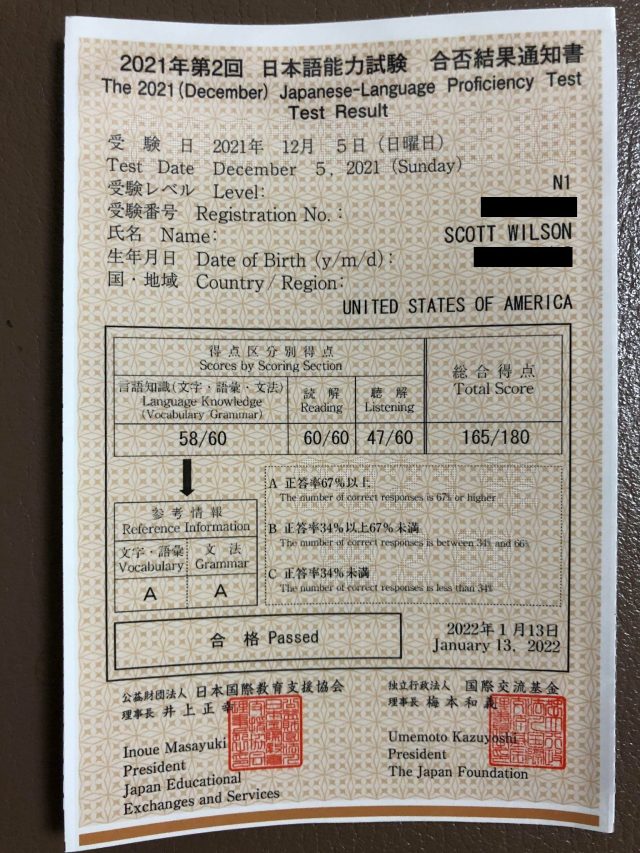
After six months of studying, a hectic test day, and waiting weeks for the results, this came in the mail.
▼ I’d passed! Crushing the reading comprehension section with a perfect score, knocking out vocabulary/grammar, and… well, passing listening.
There are a multitude of JLPT strategy guides out there, but I’d like to share my experience in how I prepared for the test, since I feel like I did a few things differently.
I’ll go over each section of the test individually (vocabulary, grammar, reading and listening) and outline what I did to practice. Feel free to try them out for yourself or experiment with other methods. There’s no one correct way to pass the JLPT — finding whatever method works best for you is best!
One note before we start: for those unfamiliar with the JLPT, it has five levels, ranging from N5 (the easiest) to N1 (the hardest). If you’re not sure which level you should take, the official JLPT website has some sample questions to try out.
As a general rule of thumb though, if you don’t regularly interact with native Japanese materials (such as reading articles in Japanese, or watching media in Japanese without subtitles) then I would recommend not going for N1 right away.
So let’s get started!
Part 0: Anki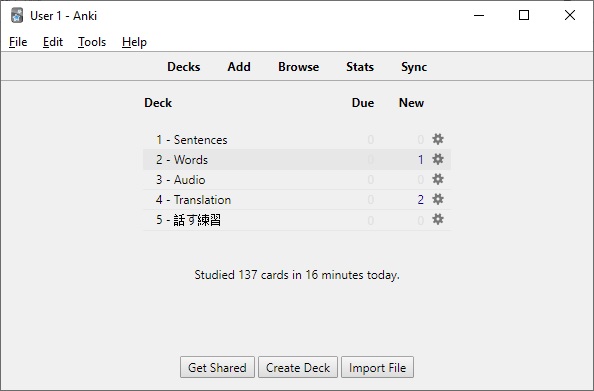
Right off the bat, Anki is the reason I passed the JLPT. It’s a digital flashcard program that automatically spaces out cards for you to do each day so that you get maximum memory strengthening with minimum effort.
Maybe some people can study tons of vocabulary and grammar points and just remember them easily, but for me unless I make flashcards, I forget them after a few days. As long as I just reviewed whatever cards Anki had prepared for me each day, even if it took a while to get through them, everything eventually stuck and I couldn’t forget the info if I tried.
You can download Anki here. And remember, there’s no need to sit down for an hour straight and do all your cards at once if you don’t want to. You can get Anki for your mobile device, or sync your deck to Ankiweb, and spread out your cards throughout the day.
Personally I divided my different types of Anki cards into different decks, as you can see in the screenshot, but feel free to use whatever organization you’d like.
I’ll be referencing how to make Anki cards for each specific section of this article. Of course you can ignore those parts if you’re not interested… but do so at your own risk!
Part 1: Vocabulary
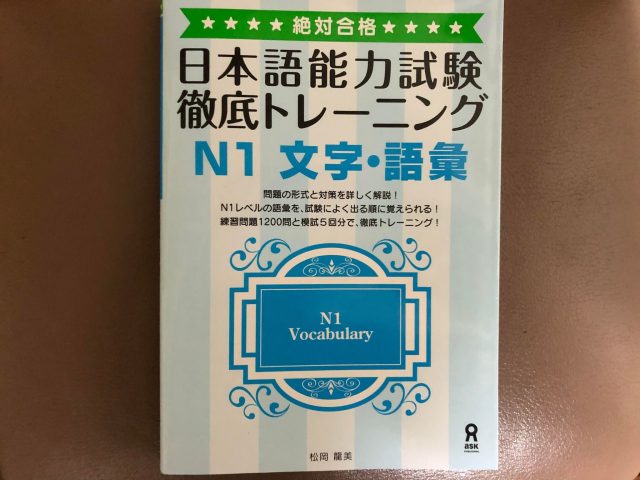
For vocabulary, I used the textbook in the photo above: Zettai Goukaku! Tettei Toreeningu Nihongo Noryoku Shiken N1 Moji Goi (Amazon Japan).
True to its name, it is extremely tettei (“thorough”). It has 92 lessons with dozens of vocabulary and 12 sample questions each, three “mini” tests with 60+ sample questions, and five “full” tests of 25 questions that are the same format as the real N1 test.
Not only that, but all the vocabulary words are divided into one, two, and three star sections. Three-star words have appeared on previous tests (highest priority), two-star words are part of the old JLPT Level 1 vocabulary list (high priority but may not appear on the current N1 test), and one-stars are high-level words that might appear and are generally good to know (medium priority).
For me, I did one lesson or test each day, inputting into Anki every word I didn’t know and every question I got wrong. Some days it was a lot, but the star system helped: I always put in the three and two-star words, but if I was mentally exhausted then I’d skip some of the one-star ones.
I used two ways of putting vocabulary cards into Anki.
▼ For the kanji section, just the kanji on the front and the reading/meaning on the back.
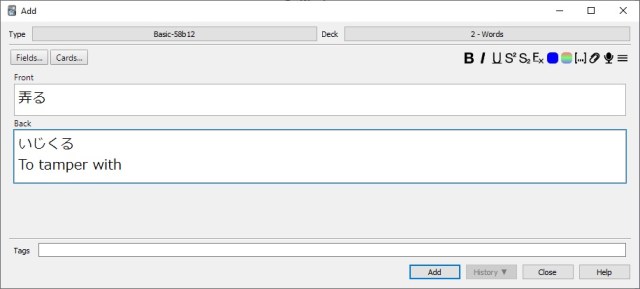
▼ But for other sections, where the words are similar and depend on context, I put the sentence on the front and the correct answer on the back with some wrong answer reminders.
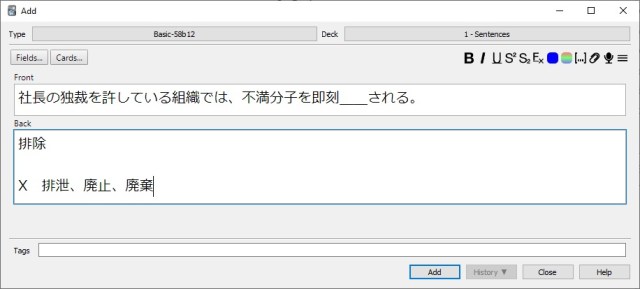
This might seem like a lot, and it is, but the vocabulary section is specifically designed to be tricky.
You might be able to figure out an unfamiliar word like 割り切る in regular context, but when a JLPT question is specifically written to try and trip you up, suddenly it’s going to be very hard to remember the difference between 割り切る and 割り込む and 打ち込む and 打ち切る.
But if you put them into Anki and drill them every day, then you’ll be able to breeze through the vocabulary section no problem!
Part 2: Grammar
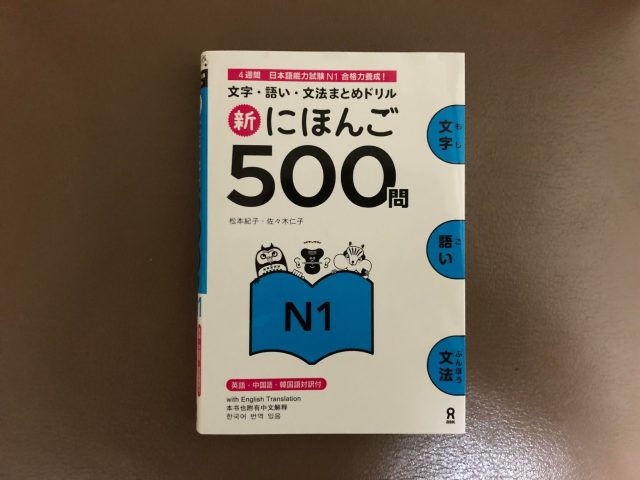
For grammar, I used the quiz book in the picture above: Shin Nihongo 500 Mon N1 (Amazon Japan link).
The quiz book was okay. I like how it comes pre-divided into questions to do each day/week, and that it tests kanji/vocabulary in addition to grammar, but from my experience the kanji/vocabulary questions were laughably easy. The grammar questions were fine, but they’re only 1/3 of the book, so it’s more like 170 or so questions and not the full 500.
The book has good explanations for each question though, plus it gives extra example sentences, so lots of fodder to put into Anki for sure.
Instead, what was much more helpful for me was the N1 grammar YouTube series by Deguchi Sensei.
▼ Check out the N1 grammar playlist here.
Each video he goes over the grammar point in detail, gives lots of examples of how it’s used, then ends with a sample question. It may seem like he goes into too much detail, but knowing what specific situations you can/can’t use certain grammar points is crucial to doing well on this part of the test.
For example, what verb tenses come before/after using が速いか? And what specific nouns can be used with まみれ versus だらけ?
Best of all, it’s all in Japanese, and there’s tons of Anki-fodder in every video.
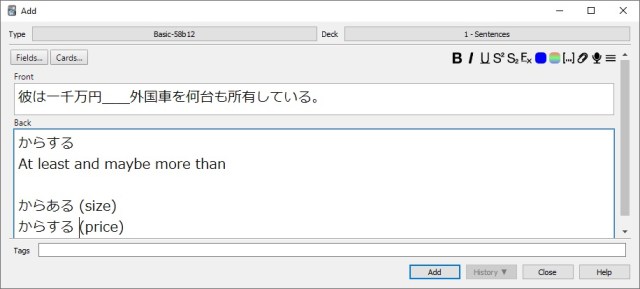
▼ A grammar card for からする. I put a reminder of how it’s different from からある on the back, but don’t put too much info or you won’t bother to read it.
I went through two videos per day, putting in at least two sentences per grammar point. When I finished the N1 playlist, I also went through his N2 playlist too, since a lot of those grammar points can come up on N1, especially in the listening section.
For example, do you know the difference between 次第 and 次第に and 次第で and 次第では? That’s N2 level and definitely good to brush up on!
Part 3: Reading Comprehension
For reading comprehension, I didn’t really use any special tricks: I just read a lot to practice.
I think a lot of Japanese learners often skim over words they don’t know or sentences they don’t understand when reading, but to practice for N1 you have to make sure you understand everything.
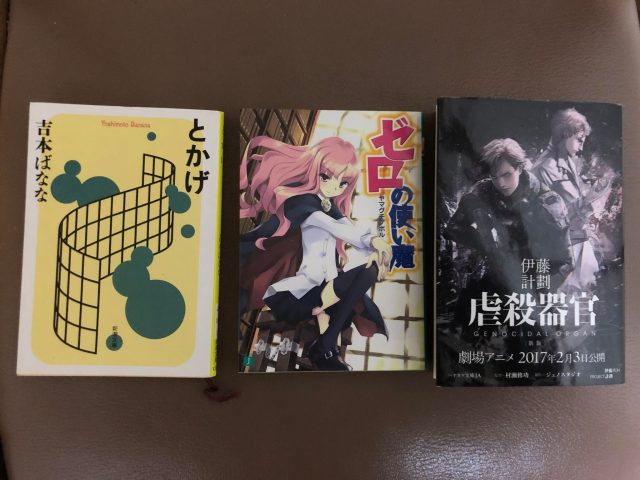
To that end, it doesn’t really matter what you read to practice, so long as you’re reading something native, difficult, and making sure you’re understanding it thoroughly. If you’re looking for something that’s a little fun to take the edge off though, I recommend these three books that I personally read:
- Tokage by Banana Yoshimoto. Easy-ish stories about relationships and a pinch of magic.
- Zero no Tsukaima by Noboru Yamaguchi. A medium-level-difficulty isekai novel.
- Gyakusatsu Kikan by Project Itoh. A difficult sci-fi novel about the morality of killing.
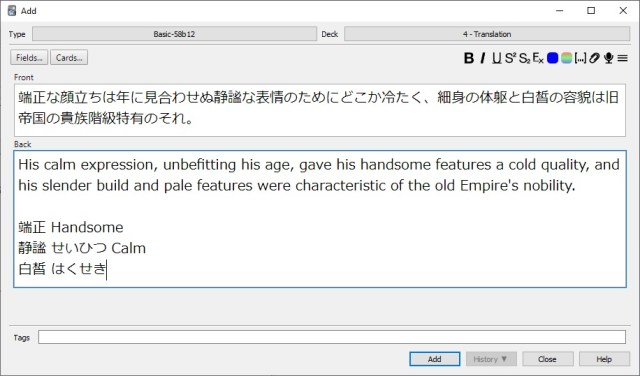
Again, those are just some that I’ve personally read, feel free to pick up whatever you’d like. The important part is putting sentences you don’t understand into Anki, like this:
▼ A sentence from another novel, Eighty-Six. Referencing the English translation can be a great help if you get really stuck on a sentence.
Making an account on a website like HiNative or Tandem is also great to ask native speakers when you don’t understand something. Just be sure to give back to them too.
One last thing to keep in mind: if you’re reading something in Japanese and you’re not enjoying it, try to push a little further ahead. The dry readings on the test are likely not going to be much more interesting, so having some practice overcoming boredom and deducing what’s going on anyway can be very beneficial.
That’s what helped me get a perfect score on this section, since I had so much experience pushing through and forcing myself to understand texts that initially seemed frustratingly cryptic.
Part 4: Listening Comprehension
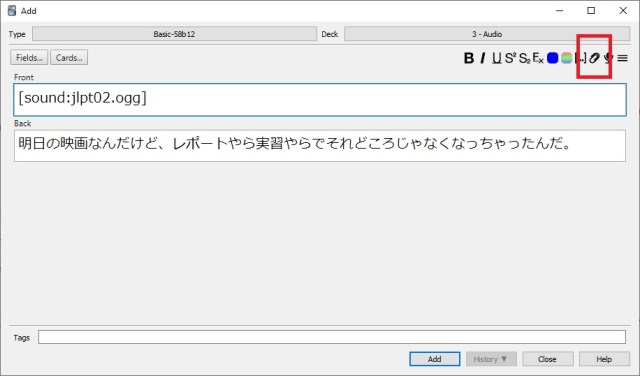
For listening comprehension, you can put audio files into Anki the same as any other card. Like in the screenshot above, just click the paperclip to put any sort of media such as audio, images, or video into Anki.
For my audio cards, I put the audio file on the front, the transcription/hard words on the back, and reviewed them that way. Mainly I focused on putting in audio files from practice JLPT tests, but pretty much any Japanese audio that you want to hear over and over again until you master can work fine.
As for the actual listening comprehension part of the test itself, pretty much anything can come up content-wise, but the test follows the same format every time, so if you do some practice tests you can get a feel for common patterns.
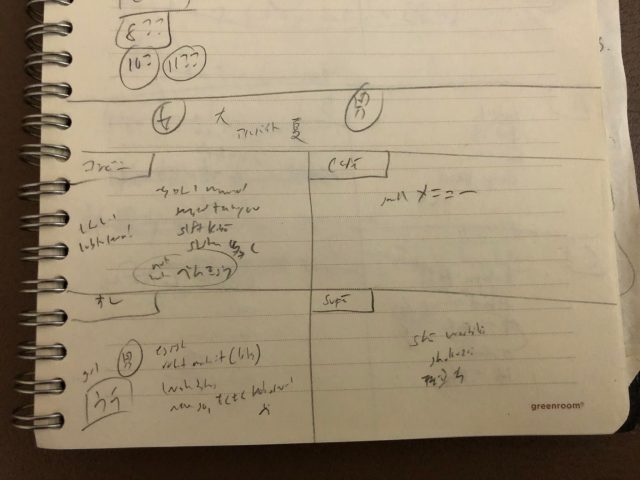
For example, the last two listening questions are almost always long conversations about four different things (like four different types of vacuum cleaners). Then at the end, you have to pick which of the four items the people are interested in.
If you have experience taking the test multiple times, you’ll know to just divide your paper into four squares, label each one with the item they’re talking about, write down every little thing they mention about that item, then simply cross out/circle the item when someone talks about not wanting/wanting it.
Other test takers who didn’t practice as much might not know that, and they’ll be left trying to remember if it was vacuum number two or three that was yellow, since they didn’t think that would be important until the woman said she wants a vacuum that matches her yellow curtains.
▼ Here’s what that last section from a practice test looked like for me. It’s a mishmash of English/Japanese, and I can’t read it now, but it worked great at the time.
Part 5: Practice Tests
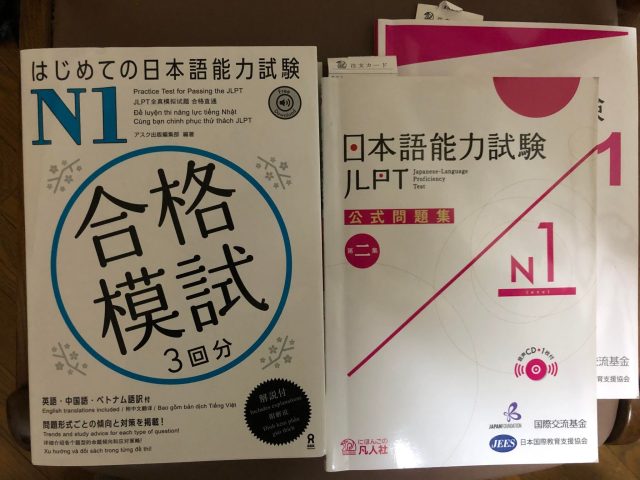
Speaking of practice tests, far and away the most important part of preparing for the JLPT is to take as many practice tests as you possibly can.
I personally used the materials in the picture above: official reprints of previous years’ JLPT tests (Amazon Japan, Amazon Japan), shown on the right, and the textbook Hajimete no Nihongo Noryoku Shiken Gokaku Mogi N1 (Amazon Japan), on the left. The two official test reprints had one test each and no explanations, whereas the textbook had three tests and lots of detailed explanations.
Additionally, I also took four one-hour mock JLPT N1 exams put out by Language Plus One, which were excellent. This semester they’re offering an N1 training course that includes three one-hour mock tests, and if you’re interested you can send them a message at the e-mail address there.
The more practice tests you can do, the better. And of course, put every question you get wrong into Anki, and do whatever reviews it tells you to do every day.
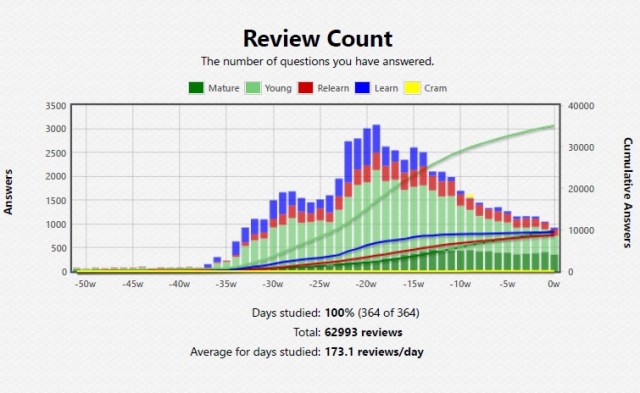
▼ My Anki stats. From 30 weeks ago to 10 weeks ago was when I was studying a lot, doing hundreds of cards per day. If I can hit 100 percent days studied, so can you!
And that’s about it! The JLPT N1 might seem crazy difficult, and in some ways it is, but it’s far from impossible. It’s just a matter of practicing enough, building up your confidence, and getting a good night’s sleep the day before.
Oh, and also, just be sure not to get kicked out on of the classroom on test day because you wore your mask wrong.
Photos: ©SoraNews24
Top image: Pakutaso (Edited by SoraNews24)
● Want to hear about SoraNews24’s latest articles as soon as they’re published? Follow us on Facebook and Twitter!
]]> https://soranews24.com/2022/02/11/passing-the-jlpt-n1-heres-how-i-did-it-so-you-can-too/feed/ 0 576562 jlpt top Tokyo hot spring allows guests with tattoos to bathe… with some very odd restrictions https://soranews24.com/2022/02/06/tokyo-hot-spring-allows-guests-with-tattoos-to-bathe-with-some-very-odd-restrictions/ https://soranews24.com/2022/02/06/tokyo-hot-spring-allows-guests-with-tattoos-to-bathe-with-some-very-odd-restrictions/#comments Sun, 06 Feb 2022 13:00:55 +0000 https://soranews24.com/?p=576204 
Progress! …kind of?
People with tattoos not being allowed to bathe inside of Japanese onsen (hot springs) is a well known and controversial issue.
On the one hand people want to feel comfortable while bathing naked and not like they’re surrounded by yakuza members covered in gang tattoos, while on the other hand most people with tattoos these days are not yakuza members and just regular people expressing themselves through body art.
While some hot springs have made small allowances for tattooed customers to enter, they’re still in the minority. However, Twitter user Simran recently posted this tweet showing that progress is being made… albeit in some strange ways.
▼ A sign at Thermae Yu, an onsen complex in Shinjuku, Tokyo, a bathhouse we’ve visited recently.
At thermae yu today and they’re relaxing their policy on tattoos, apparently women with “fashion tattoos” can enter pic.twitter.com/QgQ1tFJYnV
— Sim (@sim_nagra) February 5, 2022
The English bottom half of the sign reads:
As the Japan Tourism Agency is relaxing its polices, Thermae Yu is initiating an experimental policy of allowing entry to female guests with fashion tattoos.
Note: we ask that tattoos larger than 30cm x 30cm (11.8in x 11.8in) be covered by a bandage.
For men who came from abroad for tourism in Japan, if you present your passport and purchase a bandage to cover your tattoo, you can use the bath. You may be unable to enter the bath depending on the size of your tattoo, so we ask for your understanding. You can purchase bandages at the reception desk of this facility.
Bandage S size — 80mm x 100mm (3.1in x 3.9 in)
Bandage L size — 100mm x 145mm (3.9in x 5.7in)
310 yen (US$2.69) / pieceNote: we must refuse service to anyone with body art or tattoos besides the type described above.
So first, to break things down, it seem as if all women, Japanese and non-Japanese, are allowed in if they have a small “fashion tattoo,” though they might have to cover it up depending on size.
For men, non-Japanese men might be allowed in if they prove they’re foreign with a passport and can cover it up with a bandage. However, it seems like Japanese men with tattoos are out of luck and don’t get any sort of option to enter.
It’s all a bit… complicated. Aside from the unfortunate sexism, what exactly classifies as a “fashion tattoo?” Is it the size only, or does the content of the tattoo count as well?
▼ Like, what about this tattoo? Is the Little Mermaid a “fashion tattoo?” It’s not very clear.

Others were confused about the choice of words on the sign, such as this being an “experimental” policy. Is it going to end sometime soon, or change in some way?
Also, even though the Japanese and English halves of the sign are nearly identical, the English half makes it seem like this is a change that Thermae Yu is happy to make, whereas the Japanese half reads more like “this change is being forced upon us by the Japan Tourism Agency.”
Still, it is progress being made, however small and confusing. We’ll have to see where things go from here.
And in the meantime, there’s still at least one other hot spring in nearby Shizuoka that allows for tattooed customers and has really killer views.
Source, top image: Twitter/@sim_nagra
Insert image: GAHAG
● Want to hear about SoraNews24’s latest articles as soon as they’re published? Follow us on Facebook and Twitter!
]]> https://soranews24.com/2022/02/06/tokyo-hot-spring-allows-guests-with-tattoos-to-bathe-with-some-very-odd-restrictions/feed/ 0 576204 onsen tattoo top Japanese elementary school teacher under fire after selling students’ personal info online https://soranews24.com/2022/01/30/japanese-elementary-school-teacher-under-fire-after-selling-students-personal-info-online/ https://soranews24.com/2022/01/30/japanese-elementary-school-teacher-under-fire-after-selling-students-personal-info-online/#comments Sun, 30 Jan 2022 13:00:49 +0000 https://soranews24.com/?p=575389 
“I want to know how much they offered him.”
Coming off the heels of last month, when a Tokyo middle school had students write down and turn in their social media passwords, recently there was another incident involving young students’ personal information getting leaked.
On January 29, the board of education in the town of Ichikawamisato, Yamanashi Prefecture announced that a male teacher in his 20s at a public elementary school gave away the personal information of 29 of the school’s 3rd and 4th grade students online. The information included students’ names, addresses, phone numbers, and more.
▼ A video reporting on the incident.
According to the board of education, the teacher posted on Twitter on January 24 that he was “having money problems.” He then received a message from a “peer-to-peer lending” account that asked to purchase the personal information of students.
The teacher downloaded the student register from his computer, printed it, photographed it, then sent it as a message to the account. Three days later, the account posted the register publicly on Twitter, with all the information censored aside from the students’ seating numbers. The post also included the teacher’s name, a photo of his face, and the message, “The teacher who tried to sell personal information.”
While it hasn’t been yet confirmed if the leaked information has been used for anything nefarious, the teacher has admitted to not receiving any money in the exchange. He has been reported as saying, “I was having money problems, and I got suckered in by their offer. I’ve done something inexcusable to both the children and their parents and guardians.”
The teacher has been put under house arrest starting on January 31 as the board of education determines what to do from here.
Japanese netizens were uniformly shocked by what happened:
“Disgusting….”
“Talk about luck of the draw with who your teacher is.”
“I want to know how much they offered him.”
“If a teacher is hard up enough to do this, I can’t imagine what people with access to more sensitive info might do.”
“Yeah, that’s almost the worst thing here. That a teacher’s salary is so low that they’d stoop to doing this.”
“I think this kind of thing is just more and more likely to happen from here on.”
“Don’t ‘determine what to do’ with him. Fire him. Revoke his teaching license.”
There are still many mysteries here, such as who exactly was running the account that contacted him, and what their goal was in this whole situation. It doesn’t seem like it was anything perverted or dangerous for now, but we’ll see how the story unfolds from here.
Source: Mainichi Shimbun via My Game News Flash
Top image: Unsplash
● Want to hear about SoraNews24’s latest articles as soon as they’re published? Follow us on Facebook and Twitter!
]]> https://soranews24.com/2022/01/30/japanese-elementary-school-teacher-under-fire-after-selling-students-personal-info-online/feed/ 0 575389 sell info top Snow in Japan turns vending machine into ice-cold gacha game https://soranews24.com/2022/01/22/snow-in-japan-turns-vending-machine-into-ice-cold-gacha-game/ https://soranews24.com/2022/01/22/snow-in-japan-turns-vending-machine-into-ice-cold-gacha-game/#comments Sat, 22 Jan 2022 13:00:32 +0000 https://soranews24.com/?p=574210 
Pick a button, any button!
Vending machines are everywhere in Japan, offering all of life’s essentials such as bottles of Sriracha hot sauce and fresh, crunchy bugs.
In the winter though, they can be hard to trek to when snow piles up around them, since unlike regular stores they don’t have people shoveling or plowing the spaces around them.
But at least once you’ve finally walked out the vending machine in your boots and jacket, ready to get your hot drink, you should be all set… right?
That’s what we thought, until Japanese Twitter user @hotateyasan shared this photo:
▼ “Vending machine gacha.”
自販機ガチャ pic.twitter.com/mt7aLHj24M
— アヴェマナヴ (@hotateyasan) January 19, 2022
Gacha games are ones where you put in money and you’re given a random prize, so you’re never quite certain what you’ll get. And that basically sums up what’s going on here!
Thanks to the frost, it’s impossible to tell which drinks are which in the vending machine. Despite that though, it’s still working as you can see with the green text on the small display screen. So you’re welcome to insert a random amount of money, press a random button, and see what surprise comes out!
Some might claim that you could just wipe the snow off, but depending on how icy it is, brushing away the frost might not be possible. If it’s solidified, than nothing less than an ice scraper and a lot of elbow grease will let you see what prizes lie inside. And why go through all that effort just to have all the fun sucked away anyway?
Japanese netizens mostly delighted in seeing the real-life gacha game:
“I would trust my instincts and drink whatever came out.”
“How is it even still running? lol”
“If it’s one you’ve used often, you could just remember which button to press.”
“Hopefully the drink isn’t too cold, haha.”
“Looks like fun!”
“What a hardworking Vending Machine-Kun, persevering despite the cold!”
▼ Of course all of this depends on whether or not the money slot is even working.
Lol pic.twitter.com/WrDxDaAYWT
— error._..b0y (@Devildarkbi) January 19, 2022
I don’t know about you, but I think the only item worth getting out of a frozen machine like that would be a piping hot roasted sweet potato.
Either way, we just hope that this is a regular, automatic vending machine and not one with a freezing cold old woman inside of it, operating it manually with her puppet.
Source: Twitter/@hotateyasan via My Game News Flash
Top image: Twitter/@hotateyasan
● Want to hear about SoraNews24’s latest articles as soon as they’re published? Follow us on Facebook and Twitter!
]]> https://soranews24.com/2022/01/22/snow-in-japan-turns-vending-machine-into-ice-cold-gacha-game/feed/ 0 574210 frozen vending top Mother of Sanrio character My Melody gets flak online for dispensing horrible love/life advice https://soranews24.com/2022/01/15/mother-of-sanrio-character-my-melody-gets-flak-online-for-dispensing-horrible-love-life-advice/ https://soranews24.com/2022/01/15/mother-of-sanrio-character-my-melody-gets-flak-online-for-dispensing-horrible-love-life-advice/#comments Sat, 15 Jan 2022 13:00:48 +0000 https://soranews24.com/?p=573384 
Excuse me, what did you say?!
The Sanrio character My Melody is incredibly popular, getting everything from her own hotel room to eye-color-changing contacts.
And back in the mid 2000s, there was also an anime based on the character, Onegai My Melody, in which her mother occasionally dispensed life advice.
Now, Japanese fashion and lifestyle brand Its’Demo is releasing some designs based on My Melody’s mother’s sayings, and since it’s been a while since people have heard them, they’re shocked to see that she was actually giving out some pretty awful love/life advice.
▼ “On sale Jan 18, 2022: ‘My Melody Valentine.’ A design featuring the wise sayings from My Melody’s mom that appeared in Onegai My Melody*.”*
https://twitter.com/ITSDEMO_jp/status/1473107433673596929
Here’s the translations of the sayings that appear on “My Melody’s Mom and the Lessons of Love.” (Top to bottom, right to left.)
- “Getting a man who mopes after one or two failures will leave you with a lifetime of regret.”
- “When a boy talks to you about other girls, it’s just his clumsy way of getting you to pay attention to him.”
- “The enemy of women is always other women.”
- “People always have things to complain about others’ relationships.”
- “The more a man talks about the past, the less hope he has for the future.”
- “The best Band-Aid for a broken heart is finding a new love.”
- “The worse a man is, the more women can’t leave him alone.”
- “Those not in relationships always worry about others’ relationships the most.”
- “A woman’s heart is more fickle than the autumn sky.”
- “Never believe a boy when he says ‘I’m gonna do that someday,’ because he won’t.”
- “Nothing affects a man more than when his pride takes a hit.”
- “If you’re testing out someone new, meet them over lunch, never dinner.”
To be fair to My Melody’s mom, some of those sayings aren’t so bad. Ignoring haters (#4 and #8) is always good advice, and having a first date over lunch (#12) is kind of cute.
But then it falls off a cliff.
Saying things like “The enemy of women is always other women.” (#3) and “The worse a man is, the more women can’t leave him alone.” (#7) is kind of terrible to women.
And then “The more a man talks about the past, the less hope he has for the future.” (#5) and “Never believe a boy when he says ‘I’m gonna do that someday,’ because he won’t.” (#10) are kind of terrible to men.
Not to mention her recommending rebounding with “The best Band-Aid for a broken heart is finding a new love.” (#6) and perpetuating stereotypes with “A woman’s heart is more fickle than the autumn sky.” (#9).
▼ Come on, My Melody mama! It’s 2022.
Don’t give weird advice like that anymore. Get with the times.

Japanese netizens were mostly shocked to see such bizarre phrases on an otherwise cute design:
“I hope they realize that ‘The enemy of women is other women’ is misogynistic and potentially harmful.”
“At first I was like why is My Melody so toxic?! Then I saw it was her mom. I’m still shook.”
“These all feel like phrases a bunch of old men came up with.”
“I don’t understand why they’d write ‘the enemy of women is other women’ on a product aimed at women.”
“And the part about ‘a man who mopes after one or two failures’ is harmful to men. How did this happen?”
“Oh… this is bad. For both men and women. It’s cute on the outside, but on the inside it’s an old boomer dude.”
The way it’s looking, maybe My Melody would be better off avoiding her mother on Valentine’s Day and sticking to cute chocolates instead.
Source: Twitter/@ITSDEMO_jp via Hachima Kiko
Top image: Pixabay
● Want to hear about SoraNews24’s latest articles as soon as they’re published? Follow us on Facebook and Twitter!
]]> https://soranews24.com/2022/01/15/mother-of-sanrio-character-my-melody-gets-flak-online-for-dispensing-horrible-love-life-advice/feed/ 0 573384 my melody top Married Japanese men and women rank the things they miss most about single life https://soranews24.com/2022/01/09/married-japanese-men-and-women-rank-the-things-they-miss-most-about-single-life/ https://soranews24.com/2022/01/09/married-japanese-men-and-women-rank-the-things-they-miss-most-about-single-life/#comments Sat, 08 Jan 2022 16:00:41 +0000 https://soranews24.com/?p=572488 
Interesting overlaps and differences between genders.
For most people anywhere in the world, marriage is a life changing decision. No matter how many people you dated before you found “the one,” marriage brings with it lots of new adventures and experiences, but it’s also not without its challenges.
And sometimes, those challenges make people look back fondly on their life when they were single.
Recently the Japanese web management service WebStar Marketing reported the results of a survey filled out by 500 married Japanese men and women asking them exactly that: what they missed most about their lives before getting married.
▼ Shockingly, “being able to shave my legs alone” didn’t make the list.

Here are the results, first off with how many people overall ever missed single life:
Often miss it: 14.8 percent
Sometimes miss it: 56.4 percent
Don’t really miss it: 24.4 percent
Don’t miss it at all: 4.4 percent
When broken down by gender, 23.8 percent of men “often miss it” while only 11.2 percent of women do, and 27.5 percent of women “don’t really miss it” while only 16.8 percent of men do. So it seems as though there is a significant difference in men missing single life more than women on average.
Here are the top five specific reasons why they miss single life compared to married life, separated by gender:
Men
- No free time
- Can’t use my money how I want
- Activities are limited
- Frustrated with my spouse
- Want more romance
Women
- No free time
- Activities are limited
- Housework/childcare is difficult
- Can’t use my money how I want
- Dealing with relatives is difficult
Both men and women having “no free time” as their number one is understandable, though likely less due to marriage itself and more due to natural life progression. At some point, bills piling up means that we have to go to work every day, meaning less time for hobbies or friends, and doubly so if children are involved too.
Here’s some responses from those who said having “no free time” made them miss single life:
“My amount of personal time plummeted, and I can’t do what I want.” (Man, 20s)
“At night in bed I think to myself, ‘All day today, I didn’t have a minute to myself.'” (Woman, 30s)
“Ever since having kids I’ve had no time to myself, and I’ve missed single life.” (Woman, 40s)
“Activities are limited” also came in high for both men and women, with more detailed reasons including “having to consider the whole family whenever they want to do something,” and “can’t just spontaneously go on a trip.”
Other reasons include:
“I can’t go out with friends or travel with them on a whim, so it’s made me sometimes miss being single.” (Woman, 20s)
“It’s limited my personal relationships. I can’t hang out with my friends who are women.” (Man, 40s)
Overall, Japanese netizens seemed to agree with the responses:
“Single people want to get married. Married people want to be single again. The grass is always greener on the other side.”
“I mean, all of these are obvious things that happen when you get married. You give up some freedom for other things.”
“Personally I’ve never missed being single. And I’m a senior.”
“I’ve sometimes wished I didn’t get married, but overall I’m glad I did… although, maybe I wish it was with a different person.”
“But will they still miss single life when they’re old enough to be grandparents?”
“Always wanting more, never satisfied. That is what it means to be human.”
Good points all around, but one other thing to consider is how corona has affected these numbers. Would people think differently if they hadn’t been cooped up with their spouse for over two years?
We’ll just have to run the survey again once the pandemic has gone away. That shouldn’t be too much longer… right?
Source: IT Media via My Game News Flash
Top image: Pakutaso
Insert image: Pakutaso
● Want to hear about SoraNews24’s latest articles as soon as they’re published? Follow us on Facebook and Twitter!
]]> https://soranews24.com/2022/01/09/married-japanese-men-and-women-rank-the-things-they-miss-most-about-single-life/feed/ 0 572488 YUSEI9V9A7485_TP_V Hidden Easter Egg in Akira shows animator’s hilarious passive-aggressive frustrations https://soranews24.com/2021/12/26/hidden-easter-egg-in-akira-shows-animators-frustrations-in-hilarious-way/ https://soranews24.com/2021/12/26/hidden-easter-egg-in-akira-shows-animators-frustrations-in-hilarious-way/#comments Sun, 26 Dec 2021 13:00:19 +0000 https://soranews24.com/?p=570725 
When you hate your boss but you’re also on a deadline.
Since anime is not currently being generated by artificial intelligence, and still has to be created by human hands, quite often you get to see the personalities and thoughts of the person those hands are attached to manifest in the animation.
You can see it in the animation style. You can see it in the choice of colors. Or, in the case of frustrated animators who want to get revenge on their boss in an inconspicuous way, you can see it in little hidden messages.
Such a message was recently brought to the attention of the Internet by Japanese Twitter user @HikozaTwi, who posted this screenshot from the anime movie Akira.
▼ “During the scene for the prediction from the 25th ESPer, there’s a hidden cry of pain from the animation staff. (I just found out.)”
AKIRAの25号予言シーンに作画スタッフの悲痛な叫びが隠されていました(いま知った pic.twitter.com/ScogXd89oN
— ひこざ (@HikozaTwi) December 24, 2021
Here’s how the text appears in the animation:
DO SHITE
CONNA TO COM
ADEKA KA NA
KIYANAN NAI
NO!
IKAGEN NI
SEAY! MOU
Here’s the Japanese it corresponds to:
どうして
こんなとこ
まで描かな
きゃなんない
の!
いい加減に
せい!もう
And here’s the translation:
Why
do I
have to even
draw this
part!
Give me a
break! Geez
You have to hand it to that stealthy animator: Akira came out in 1988, and their sneaky message hasn’t been publicly uncovered until now. Talk about playing the long con!
What’s best about it is how nonchalantly the text fits into the background. Ninety-nine percent of viewers would just assume that it’s nonsense English, or scribbles, but those who are willing to pause their videos — and who are watching in high enough quality to read it — get to see a hilarious little bit to remind them that someone drew everything they’re seeing.
▼ And since Akira is currently and officially available to watch for free on YouTube, you can check it out for yourself here!
Japanese netizens all delighted in seeing the all-too-human message:
“That animator knew what they were doing, cutting off the text to look like English.”
“Yeah, it starting with ‘DO’ made me think it was English.”
“This happened a lot in older Shojo manga, messages like ‘I can’t believe you found this message.'”
“Seeing this is probably only possible thanks to finally watching in HD and 4K.”
“Oh god, how overworked were those poor animators?”
“There’s something similar from Mobile Suit Zeta Gundam I think.”
▼ Someone else found that Gundam scene too, where the text on the right translates to: “Hooray! I’m done. Now I can move onto something else.”
これかな? pic.twitter.com/qPsUFa1bL1
— ハル@はのことかわいいbot (@haru__G7) December 25, 2021
Since Akira supposedly predicted the coronavirus outbreak, we have to wonder… is this also a harbinger of things to come? Will we start discovering messages in our world that prove we’re living in a simulation, that we’re nothing more than drawings created for the entertainment of higher beings?
Well, as long as it’s a dating simulation!
Source, top image: Twitter/@HikozaTwi
● Want to hear about SoraNews24’s latest articles as soon as they’re published? Follow us on Facebook and Twitter!
]]> https://soranews24.com/2021/12/26/hidden-easter-egg-in-akira-shows-animators-frustrations-in-hilarious-way/feed/ 0 570725 akira top These dozens of AI-generated Pokémon look more official than some actual official ones【Pics】 https://soranews24.com/2021/12/18/these-dozens-of-ai-generated-pokemon-look-more-official-than-some-actual-official-ones%e3%80%90pics%e3%80%91/ https://soranews24.com/2021/12/18/these-dozens-of-ai-generated-pokemon-look-more-official-than-some-actual-official-ones%e3%80%90pics%e3%80%91/#comments Sat, 18 Dec 2021 13:00:53 +0000 https://soranews24.com/?p=569766 
“I’d believe it if someone told me they were real Pokémon.”
In recent years artificial intelligence has become better and better, able to produce human models and SoraNews24 articles that are nearly indistinguishable from “real” ones.
But to be fair, human faces are all fairly similar, and SoraNews24 articles are only text and images. There’s no way AI could possibly create something that’s multicolored, has wild amounts of variations, and requires the finesses of a human hand.
Something like, oh I don’t know, its own legit-looking Pokémon, right?
…right?
I forced a bot to look at every Pokémon and told it to generate its own. Here are the results.
(this isn't a joke, that's actually how I made these) pic.twitter.com/MfJUWJHZoB
— Max Woolf (@minimaxir) December 15, 2021
Max Woolf (@minimaxir) is a data scientist who’s created AI generation tools, and now he’s put them to use to see what sort of Pokémon an algorithm could come up with.
Personally, I woud’ve expected AI-generated Pokémon to have a lot more random lines sticking out of them, mismatched colors, and having their heads mixed up with their tails, but these are all pretty legit-looking.
▼ Here’s just one batch of the AI-generated Pokémon.
The ones in the top row almost look like water, fire, and grass starters!

▼ Due to their popularity, Max posted another batch of AI Pokémon…
(Click the images to see more)
Bonus batch! pic.twitter.com/qdr7SoesUj
— Max Woolf (@minimaxir) December 15, 2021
▼ …and then did it again! I suppose when they’re all being generated by a computer, tons of them can be pumped out no problem.
Wow, you all really, really like these AI-Generated Pokémon!
As a thanks for all your support, how about ANOTHER BONUS BATCH?!
pic.twitter.com/kM3Kc8bBe6
— Max Woolf (@minimaxir) December 15, 2021
▼ He even tried with different inputs,
here using only Pokémon from the first generation.
By popular demand: here's more AI-generated Pokémon, but this time the model is trained on *only* Gen 1 Pokémon (the 1995-era Sugimori art of the original 151).
Those who thought this would make the generated Pokémon less bizarre were very wrong. pic.twitter.com/FS5GIweKUc
— Max Woolf (@minimaxir) December 17, 2021
The reaction to the AI-generated Pokémon was incredible, with most people expressing how blown away they were by the designs. Many tried to figure out what types each of the new Pokémon would be, while others were already creating fanart for some of their favorites:
i drew two lads from the first batch pic.twitter.com/71mm3xzuun
— elenore
pre-debut envtuber (@vixenele) December 15, 2021
I love this little guy so much I had to draw my version of him pic.twitter.com/5FOedKt3s3
—
COMMS CLOSED
ummm i love them pic.twitter.com/pGHsP9hDFa
— pippington (@pippipchirio) December 15, 2021
Japanese netizens similarly expressed their awe and fear of the AI that created these:
“I’d believe it if someone told me they were real Pokémon.”
“Feel like some of them are monsters I’d see in a fever dream.”
“You really can’t tell they’re AI-generated unless you look closely.”
“They’re giving me goosebumps. Something’s just off about them.”
“There’s a few that look like they were created by someone mentally unstable lol.”
“Science has gone too far.”
This isn’t the first time we’ve seen AI-generated Pokémon, but it’s such an improvement over last time that it is a little bit scary. What will they look like next time? Will AI create actual Pokémon that can walk, talk, and shoot lightning?
Well, about time to start investing in some real-life Poké Balls.
Source: Twitter/@minimaxir via Hachima Kiko
Top image: Twitter/@minimaxir
● Want to hear about SoraNews24’s latest articles as soon as they’re published? Follow us on Facebook and Twitter!
]]> https://soranews24.com/2021/12/18/these-dozens-of-ai-generated-pokemon-look-more-official-than-some-actual-official-ones%e3%80%90pics%e3%80%91/feed/ 0 569766 ai pokemon top Amigara Fault for cars?! Tunnel in Okayama just barely big enough for vehicles to fit through https://soranews24.com/2021/12/11/amigara-fault-for-cars-tunnel-in-okayama-just-barely-big-enough-for-vehicles-to-fit-through/ https://soranews24.com/2021/12/11/amigara-fault-for-cars-tunnel-in-okayama-just-barely-big-enough-for-vehicles-to-fit-through/#comments Sat, 11 Dec 2021 13:00:29 +0000 https://soranews24.com/?p=569066 
It was made for me… and my car.
Our Japanese writer Haruka Takagi is no stranger to exploring claustrophobic spaces, but typically they’re not locations intended for cars to travel.
However, the Hayama 2nd Tunnel in Okayama Prefecture’s Takahashi City is just about as tight a squeeze as it can get while still remaining open for vehicles. Considering Okayama is known for its bad drivers, that makes it potentially even more terrifying.
As soon as Haruka heard about it, she had to check it out.
▼ About 15 minutes out from Takahashi City, she knew she was getting close when she saw this warning sign: “Up ahead, large vehicles CANNOT PASS.”

Haruka felt that the road was already a little narrow for any large vehicles anyway, so she had a hard time imagining things getting much worse.
Until five minutes later, when things got worse.
▼ Wait… that’s a tunnel? It looks more like a cave!

The sign in front of the opening warns that it’s only 2.5 meters (8.2 feet) tall. Considering most cars are somewhere around just under two meters tall, and slightly-shorter overpasses don’t even allow cars at all, that doesn’t leave a lot of wiggle room.
The tunnel was only 32 meters (105 feet) long, but it felt at least twice that long to Haruka. Probably because the inside was pitch black, and she was concentrating so hard on driving safely through it.
▼ It’s not any more spacious coming out the other end either.

▼ Thankful for the brightness, and to be out of the tunnel, she parked to take in the view.
While most tunnels are carved to have a square or circle shape, this one just felt like it was a crack through the limestone mountain. Just looking at it, Haruka felt like the whole thing could crumble down at any moment.
The whole thing was so bizarre, like something out of The Enigma of Amigara Fault by horror manga artist Junji Ito. In the story, a bunch of people find “tunnels” in a mountainside that are shaped like them and that they barely fit into, and they are compelled to walk through them. Just like how this tunnel barely fits the cars going through it.
Oddly enough, there were people drawn to this location too, though for a different reason. The tunnel is actually a popular rock climbing location, and there were plenty of people out having fun.
▼ Although watching people rock climb right above a regular prefectural road, and not far away in some remote location, definitely felt weird.

▼ There was also this totally not creepy map that showed the paths through the limestone caverns inside the mountain…

▼ …but going inside the cavern was so dark that Haruka couldn’t take more than a few steps. Let’s leave that place to the pros!

▼ While investigating the cavern, a few more cars drove past behind her, and she was always shocked at how little room they had to pass through.

According to Takahashi City Hall’s website, the tunnel’s construction began in 1914 and didn’t finish until 1928. It was all carved out by hand, using chisels and pickaxes, leaving behind marks that you can still see on the walls inside.

And because Haruka apparently hadn’t had her fill of creepy tunnels, she went a little bit further north to check out the “Hayama 1st Tunnel” too.
▼ It was a tad more spacious but potentially even more terrifying looking.

▼ …did we say potentially? We meant definitely more terrifying.
The inside is allegedly concrete, but it looks more like an alien intestine.

Well at least there were no boarded-up doors with signs saying “No Tresspassing” on them or anything. That would just be so cliched and ridiculous and—
▼ Oh. Would you look at that.
No, Haruka! Stop! Don’t go inside…!

▼ Too late. There was a canal behind it.
Water flowing into the darkness. Forever.

And now, we flow with it. Flowing to the same final destination as the night train.
Photos: ©SoraNews24
● Want to hear about SoraNews24’s latest articles as soon as they’re published? Follow us on Facebook and Twitter!
]]> https://soranews24.com/2021/12/11/amigara-fault-for-cars-tunnel-in-okayama-just-barely-big-enough-for-vehicles-to-fit-through/feed/ 0 569066 haneyama3 Tokyo middle school leaflet asks students to write down, turn in their social media passwords https://soranews24.com/2021/12/04/tokyo-middle-school-leaflet-asks-students-to-write-down-turn-in-their-social-media-passwords/ https://soranews24.com/2021/12/04/tokyo-middle-school-leaflet-asks-students-to-write-down-turn-in-their-social-media-passwords/#comments Sat, 04 Dec 2021 13:00:30 +0000 https://soranews24.com/?p=568067 
The board of education’s excuse doesn’t really hold up.
It’s important for everyone in today’s world, especially kids, to be aware of the dangers of scams and giving out private information.
But what do you do when the one asking for that private information is an official document from your school?
That’s what happened recently at a middle school in Tokyo’s Nerima Ward, which reached the attention of the Internet from this tweet:
▼ (Translation below)
ちょっと、アホすぎて人権侵害すぎて言葉がないんだけど
中学校からのプリントで、「我が家のSNSルールを保護者と話し合ってかけ」「終わったら学校に提出しろ」ってやつに、
「SNSパスワードを書け」って欄があるんだけど。なに考えてんだ!?
私的領域への越権行為も甚だしい!— ıɥsnɯoʇnqɐʞ (@kabukabubaby) November 30, 2021


“Excuse me what? This is so stupid and such a violation of rights that I have no words.
On a leaflet that was sent home with middle schoolers that they were told to use “to discuss house rules for social media,” and “to turn in to their school when finished,” there’s a section for them to fill in their “social media password.”
What are they thinking?!
This is an extreme abuse of authority and an invasion of personal space.”
Many online have posted images of the leaflet in question, showing that this wasn’t some simple typo or anything, it’s pretty blatant:
▼ The line in question is the fourth blank down.
(Translation below)
おいおいおいおい、パスワード記入欄がある上に、「家族で共有」て記述まであんのに、「ミス」とはちゃうやろが
こういうこと犯っといて、問題になったら「ミスでした」て逃げんの、あまりに汚らしいんちゃうか
まじで教師て屑ばっかりか— 多田 将 (@sho_tada) December 4, 2021
Our House Rules for Social Media
Easy Fill-In SheetUsage Time
I will use my smartphone and social media for _____ hour(s) each day.
I will use my smartphone and social media until _____ o’clock each day.Storage Place
After then, I will put it away in _____.How Its Managed
The password to my social media is _____.
I share this password with _____ (ie: my family).
The Nerima Ward Board of Education has since responded to the controversy, saying that they passed out the leaflets to students for households to create rules for social media, and asked the students to turn them back in to the school to check that they were filled in.
However, the Board of Education notified each school in Nerima Ward saying that students should turn in the leaflet without filling in the password section. Unfortunately one school did not receive that explanation, resulting in 276 students turning it in as-is. There were no reports of such a mistake happening in the other schools.
The Board of Education has said that they will prevent such incidents in the future by deleting the password section, storing the leaflets that were already turned in inside a “locked up location,” and returning them directly to each family. So far they claim that no passwords have been leaked.
Of course that’s a very strange explanation. If students were meant to turn in the leaflet without filling in that blank… then why was it there in the first place? If students were supposed to bring it back home again and then fill it in, there’s no mention of that. And even if that was the case, writing down your password is what you learn never to do in Internet Safety 101 no matter what anyway!
Japanese netizens were similarly confused and shocked:
“I don’t understand why they asked the kids to turn it in in the first place. Their Internet literacy is lower than the kids’ is.”
“Do not fill that in, do not turn that in, do not share it.”
“We’re taught not to leak our passwords, but as soon as you turn it in to the school, it’s leaked….”
“Did Internet literacy just stop progressing 10 years ago???”
“The only correct answer is writing ‘Our house rule for social media is not writing my password here’ in the blank.”
“Schools are trying to control their private lives. Just like Kanagawa trying to limit kids’ time playing games.”
“The only way I can see this being okay is if it’s a trick question, and when the students turn in the leaflets with their passwords on it, the teacher admonishes them, saying, ‘Didn’t we teach you not to tell anyone your password?’ (Obviously not what happened)”
Hopefully no irreparable damage comes from this incident, and the Nerima Ward Board of Education learns from their mistake.
However, considering Nerima was also where ten students fainted from heat stroke during a non-air-conditioned assembly about avoiding scams, we’ll just have to wait and see.
Source: Bengo4.com via Hachima Kiko
Top image: Pakutaso (1, 2) (Edited by SoraNews24)
● Want to hear about SoraNews24’s latest articles as soon as they’re published? Follow us on Facebook and Twitter!
]]> https://soranews24.com/2021/12/04/tokyo-middle-school-leaflet-asks-students-to-write-down-turn-in-their-social-media-passwords/feed/ 0 568067 social media top Japanese police officer comes up with cute reminder to help people not get scammed over the phone https://soranews24.com/2021/11/28/japanese-police-officer-leaves-cute-reminder-to-help-people-not-get-scammed-over-the-phone/ https://soranews24.com/2021/11/28/japanese-police-officer-leaves-cute-reminder-to-help-people-not-get-scammed-over-the-phone/#comments Sun, 28 Nov 2021 13:00:52 +0000 https://soranews24.com/?p=567250 
His pun-game is almost as strong as his origami-game.
Scams are as prevalent in Japan as anywhere else in the world, especially over the phone where scammers pretend to be relatives asking for money.
Thanks to government efforts to spread awareness of the scams, people are much more wary of them now and can avoid them, but that doesn’t mean they’ve gone away.
Recently Japanese Twitter user @DynamiteNaoki received such a phone call, and when he informed the police, he got this unexpected, adorable response:
▼ How does an origami bunny help to prevent scams?? Well….
(Translation below)
先日の振り込め詐欺の事で110番したら、近くの派出所から警察が来てくれた。
帰りに「何かいらないチラシありますか?」と言われたので渡すと、ウサギを折ってくれた。
これを電話の近くに置いて「うっ、詐欺!?」と思い出して気を付けて下さいとの事
千葉県警に提案しているけど採用されないとの事pic.twitter.com/Z2iSFRdAt3
— ダイナマイト☆ナオキ (@DynamiteNaoki) November 25, 2021
When I called the police about a phone scam the other day, an officer from a nearby station came to my home.
As he was leaving he asked, “Do you have any paper you don’t need?” So I gave him some and he made an origami bunny.
He placed it near my phone and said that it would act as a reminder to be careful, since whenever I saw it I’d remember: “Uu, sagi?!”
(Note: Uu means “Oh no,” sagi means “scam,” and all together Usagi means “bunny”)
The officer also said he’s suggested this idea to the Chiba Police but for some reason it hasn’t caught on
We have to say, that’s a pretty cute idea. And while we hope that the officers do their due diligence in tracking down the scammers, a little mnemonic-bunny by the phone could genuinely be a decent preventative measure for some vulnerable people.
The victim might not remember all of the details about what to do in that kind of situation, but the “Uu, Sagi” mascot could remind them to just hang up right then and there!
In fact, it’s such a good idea, that one commenter already made fanart of the scam-stopping pun bunny!
▼ “I made ‘Uu, Sagi’ into a character. When you press his tummy, his eyes light up.”
https://twitter.com/sky03126/status/1464268581093273600
▼ Someone else showed a sign from Tokyo that used herons (sagi in Japanese) on an anti-scam sign, but they’re not quite as cute and the text doesn’t specifically call out the animals.
https://twitter.com/save_the_cat/status/1464190214604148736
Most Japanese netizens were enamored by the “Uu, Sagi” and were flabbergasted why it hasn’t been officially adopted yet:
“What why is that so cute??”
“That’s an amazing idea.”
“I love it. I want to marry it.”
“That officer missed his call in marketing.”
“Such creativity.”
“This needs to be adopted on a national level.”
Considering Japan’s penchant for even terrifying mascots, it’s kind of amazing that “Uu, Sagi” isn’t a real thing yet. Maybe it’s because it’s winter and the police officers are too busy making police-cruiser ice-sculptures.
Source: Twitter/@DynamiteNaoki via Hachima Kiko
Top image: Twitter/@DynamiteNaoki
● Want to hear about SoraNews24’s latest articles as soon as they’re published? Follow us on Facebook and Twitter!
]]> https://soranews24.com/2021/11/28/japanese-police-officer-leaves-cute-reminder-to-help-people-not-get-scammed-over-the-phone/feed/ 0 567250 FFB45MrakAEnslz 14-year-old Japanese girl tosses cart from roof of Don Quijote, arrested for attempted murder https://soranews24.com/2021/11/27/14-year-old-japanese-girl-tosses-cart-from-roof-of-don-quijote-arrested-for-attempted-murder/ https://soranews24.com/2021/11/27/14-year-old-japanese-girl-tosses-cart-from-roof-of-don-quijote-arrested-for-attempted-murder/#comments Sat, 27 Nov 2021 13:00:07 +0000 https://soranews24.com/?p=567155 
“Horrifying….”
Don Quijote is a chain of department stores throughout Japan, offering a wide variety of discount goods. The buildings for Don Quijote are typically several stories tall, with each floor offering different types of merchandise.
Customers don’t usually go to the roof of the building, since there’s nothing up there and it’s dangerous, so when someone is up there, it’s typically not a good thing.
That’s what happened on the afternoon of November 26, when a 14-year-old middle school girl tossed a shopping cart off the roof of a Don Quijote building in Osaka’s Suminoe Ward.
▼ A photo of the Don Quixote at Suminoe Park.
大阪市の「ドン・キホーテ住之江公園店」の屋上駐車場から買い物用カート1台を落としたとして、中学2年の少女(14)を殺人未遂容疑で逮捕 「遊び半分でやった。人に当たったら死ぬことは分かっていた」と供述 =ネットの反応「オッサン狙って落とすとかやべーな」 https://t.co/n7HxK7iisv
— 拡散新聞 |時事ニュースとネットの反応 (@anonymous_post2) November 27, 2021
The girl dropped a shopping cart from the roof of the building into the parking lot 21.5 meters (70.5 feet) below, narrowly missing hitting a 53-year-old man by 2 to 3 meters (6 to 10 feet). He was not injured.
Two 13-year-old female classmates accompanied the girl, and while police have taken them into protective custody and notified the children’s welfare center, the girl herself was arrested on November 27 for attempted murder.
She has admitted to her actions, saying: “I did it mostly for fun. I knew that if I hit someone, they’d die.”
Japanese netizens were shocked by the incident:
“Horrifying….”
“How can you do something like that for fun?”
“Way too far for a prank.”
“That’s a psychopath in the making.”
“I hope she doesn’t get the 100,000 yen for young people.”
“That store needs to make sure this never happens again.”
“I feel like this kind of thing has been happening more among young people.”
While we’re not sure on the data for that last commenter, it’s important to remember that young people are just as often victims of unfortunate crimes too. We’re just glad that this one ended with no one getting hurt.
Source: The Sankei News via My Game News Flash
Top image: Pakutaso
● Want to hear about SoraNews24’s latest articles as soon as they’re published? Follow us on Facebook and Twitter!
]]> https://soranews24.com/2021/11/27/14-year-old-japanese-girl-tosses-cart-from-roof-of-don-quijote-arrested-for-attempted-murder/feed/ 0 567155 kazukihiroA65DSCF0104_TP_V Come camp with us on Mt. Jinbagata, the best view you can get without breaking a sweat【SoraCamp】 https://soranews24.com/2021/11/17/come-camp-with-us-on-mt-jinbagata-the-best-view-you-can-get-without-breaking-a-sweat%e3%80%90soracamp%e3%80%91/ https://soranews24.com/2021/11/17/come-camp-with-us-on-mt-jinbagata-the-best-view-you-can-get-without-breaking-a-sweat%e3%80%90soracamp%e3%80%91/#comments Wed, 17 Nov 2021 01:00:10 +0000 https://soranews24.com/?p=564566 
You bring the marshmallows, we’ll bring the pics.
Camping has been having a bit of a renaissance in Japan recently, with people challenging themselves to go camping with only 100-yen-store goods, or cooking awesome festival food over the campfire.
And my wife Abbey is no exception! She’s been an avid camper in Japan for over two years, going to dozens of different camping locations.
A recent place that stole her nature-loving heart was Mt. Jinbagata, and here we’ll share her experience so that, while Japan’s borders still remain mostly closed to tourists, we can all take part in some outdoor adventure together.
▼ Here’s the view from the top of Mt. Jinbagata… that you don’t even have to hike to!
Usually to get a view like this you’d have to walk for hours.
Mt. Jinbagata is located in Nagano Prefecture, 2.5 hours north of Nagoya or 3.5 hours west of Tokyo by car. Standing at 1,445 meters (4,741 feet) above sea level, it boasts a panoramic 360 degree view of the valleys and Minami Alps that surround it.
The view is breathtaking, and has even been featured in movies, anime and manga, such as Laid-Back Camp.
▼ Here’s Shimarin from the manga camping at the same place.

Mt. Jinbagata has a very exclusive campground at the top with a limited amount of 18 camp sites. They get snapped up pretty quickly, but Abbey was lucky enough to snag a site from a last-minute cancellation.
Like many campgrounds in Japan, Mt. Jinbagata utilizes an online reservation system on their website. You can make a reservation directly there if there’s an opening available, or you can do like Abbey did and sign up at Nap-Camp and get notified of when cancellations happen.
▼ Abbey packed up her trusty scooter and made her way there!

It took about four hours for Abbey to get from our home in central Gifu Prefecture to Mt. Jinbagata via her scooter. Renting a car is the best way to get there, but if you’re brave you could also take a train via the JR Iida Line to Ijima Station, then ride a 45-minute taxi to the campground from there. Just be prepared to pay about 9,000 yen (US$79) or more to be driven the 20 or so kilometers (12.5 miles) up the mountain.
When Abbey arrived, she checked in (check-in is from 1:00 p.m. to 5:00 p.m.) at the lodge with the campground manager Ichise-san, who was very excited about having an American stay at the campground. He told her all the details about the best viewing times, and also mentioned the local fruit juices and American craft beers that they carried in stock.
It cost 3,500 yen (US$31) total to stay one night: 2,500 yen for the site, and 1,000 yen for one-person’s utility usage. Prices vary depending on which site you choose, how many people you’re camping with, and when you go during the the open season of April 20 to the end of November.
▼ Abbey set up her tent right next to the lodge, mostly because the other spots were taken… and she likes being close to the bathroom in case of nighttime emergencies.

▼ She used a Visionpeaks two-to-three-person cotton polyester tent. Expecting it to be cold, she brought her tent made with thicker/warmer material than nylon or just polyester.

The Mt. Jinbagata campgrounds are evenly divided into three different groups: Mori (“Forest”) aimed at family camping with large sites near the forest, Kuu (“Air”) aimed at solo campers like Abbey with smaller sites, and San Roku Maru (“360”) the most expensive and highest up area with the best 360-degree view.
Even though she was camping in the Kuu area, anyone could still walk freely around the campground, so it was time for her to see the legendary view for herself.
▼ Keep an eye on that weather tower!
Because it was only about a five-minute walk to get to…

▼ …this majestic scenery!
You’re seeing Iida City, Komagane City, and a bunch of other small towns from here.

▼ Here’s the 360-degree panoramic shots from the peak.
See how close the weather tower is? It was only about a five minute walk.

▼ Be sure to right-click these panorama shots and open them in a new tab for their full glory.

▼ Here’s the Minami Alps, with just a dusting of snow as they stretch toward the horizon.

▼ The path up and down from the peak is paved with wooden stairs. It’s the most you’ll have to exert yourself to get to the top of the world… or just the top of Nagano.

▼ The perfect place for selfies!

With her hunger for beautiful views satiated, it was time to feed Abbey’s other appetite: camp food. Even though campground lodges in Japan typically carry a variety of instant ramen, rice, and other foods, this one sold only sold drinks, so you have to bring your own food.
Back at the tent, for dinner she cooked up some kimchi udon on a gas stove, along with some hot black tea.
▼ Once it was cooked outside, she brought everything inside and feasted at her Laid-Back Camp fold up table. Who says you can’t camp with anime goods?

After the sun had set and the stars had come out, it was time a real campfire. In the absence of sunlight, the air had cooled off significantly to about 3ºC (37ºF), and Abbey began to feel the biting cold of the mountain winds nipping at her.
▼ Thankfully some baked Nagano apples warmed her belly and hit the spot!

Finally, it was time to sleep. In preparation for the trip, she’d brought two sleeping bags for double warmth, plus a fuzzy fleece blanket to keep warm. She’d also dressed in layers to brace against the Nagano cold: Uniqlo heat-tech leggings, hiking pants, heat-tech top, T-shirt, sweater, and fleece jacket.
But even that was not enough. As the heat the fire began to fade into dark, chilly shivers, she had to crack open 20 kairo — adhesive hand warmers — and made a hot water bottle to put under her covers.
Thankfully that did the trick, and she slept like a baby until dawn.
▼ Waking up is always hard when it’s freezing cold, but having a spectacular sunrise to catch makes it a lot easier.

For Abbey, watching the sunrise while boiling water for more kimchi udon for breakfast and coffee was surreal. Not having a hike up to this spot gave the whole experience a dream-like quality to it, as if she’d entered a cheat code into the game of life.
Getting here should have been hard and left her aching, but there she was, no aches or pains, just a once-in-lifetime view of Japan below her and a delicious hot breakfast in front of her.
Check-out for Mt. Jinbagata campground was at noon, so she packed up after breakfast and headed out. As she rode down the mountain on her scooter, she found herself smiling, completely smitten and wishing she could’ve called out of work the next day and stayed longer. Perhaps she can return in the winter, when the mountain is covered in a big blanket of snow.
Although if she does that, she may have to ask Go Hatori for advice on how to best wear 100 kairo heating pads at once!
Campground Information
Jinbagata Kyanpujo / 陣馬形キャンプ場
Address: Nagano-ken, Kamiina-gun, Nagagawa-mura, Ogusa 1636
長野県上伊那郡中川大草1636
Camp Season: April 20 to end of November, peak viewing area open year round
Website
Images: ©SoraNews24
● Want to hear about SoraNews24’s latest articles as soon as they’re published? Follow us on Facebook and Twitter!
]]> https://soranews24.com/2021/11/17/come-camp-with-us-on-mt-jinbagata-the-best-view-you-can-get-without-breaking-a-sweat%e3%80%90soracamp%e3%80%91/feed/ 0 564566 254250765_3102179346771271_7176956804873025838_n