Abenomics – SoraNews24 —Japan News— https://soranews24.com Bringing you yesterday's news from Japan and Asia, today. Thu, 17 Nov 2016 01:14:12 +0000 en-US hourly 1 https://wordpress.org/?v=7.1.4 https://soranews24.com/wp-content/uploads/sites/3/2020/05/en_rocket_1024.png?w=32 Abenomics – SoraNews24 —Japan News— https://soranews24.com 32 32 176746664 Why aren’t there more female entrepreneurs in Japan? Pull up a chair… 【Women in Japan Series】 https://soranews24.com/2014/12/18/why-arent-there-more-women-entrepreneurs-in-japan-pull-up-a-chair/ https://soranews24.com/2014/12/18/why-arent-there-more-women-entrepreneurs-in-japan-pull-up-a-chair/#comments Thu, 18 Dec 2014 01:00:41 +0000 http://en.rocketnews24.com/?p=203364 
According to the Global Entrepreneur Development Index (GEDI) that measures favorable conditions for women entrepreneurs, the US and Australia are ranked first and second respectively, while Japan places fifteenth, just behind Peru. Yet Japan fulfills many of the requirements to create a successful female entrepreneurial environment such as education, skills and access to capital.
In addition, women in Japan can overcome obstacles such as low salaries, long work hours and scant child-rearing options by owning their own businesses and calling the shots. So, what’s holding Japanese women back? It turns out that a large part of it may be Japanese women themselves.
The GEDI measures high-profile women entrepreneurs who “own and operate businesses that are innovative, market expanding and export-oriented.” This is in contrast to small business owners who are running the corner store or supporting only their family on their income. While Japan is nowhere near competitive in the area of high-profile women entrepreneurs, what the country needs is a grass-roots level entrepreneur-driven change, led by women. More small business entrepreneurs will naturally lead to higher profile entrepreneurs as women succeed and build upon these foundations. In addition to big start-ups, a society needs many small entrepreneurs to create a fresh business environment that will move the country forward. Japanese women are the best candidates to lead the drive because they are innovative, talented and–presuming they’re not already in companies slaving away like salarymen–have time to develop their businesses. Besides, I’ve met few Japanese women who don’t enjoy a challenge.
In a previous article in our Women in Japan Series we met three Japanese business women who’ve beaten the system and successfully forged ahead in the business world by defining their own terms through entrepreneurship. With their ability to support themselves financially, live more freely, have time for their children and families, and work fewer hours than they’d have to in the corporate world, it’s a wonder why more Japanese women don’t choose this path.
So first, let’s take a look at some reasons there aren’t more female entrepreneurs in Japan:
1. Japan not an entrepreneurial country
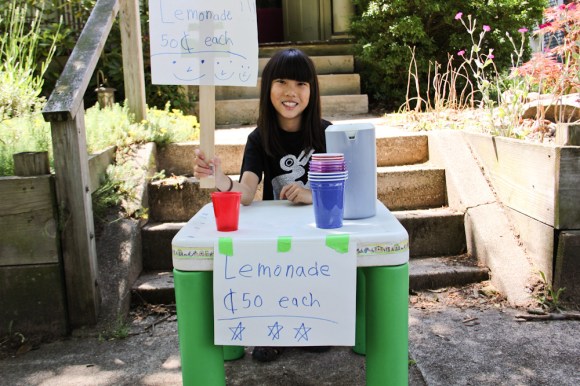
Historically, Japan has not been a country of start-ups, venture capitalists or innovators. Although we can all think of exceptions, the fact remains that Japan is best known for its ability to adapt and improve upon what has already been developed. The automotive, electronics, and technology industries are examples of Japan’s ability to refine concepts. The truth is that Japan has a dismal record when it comes to entrepreneurship. Japan needs more people like Fusajiro Yamauchi (Nintendo) Takafumi Horie (Livedoor), Joi Ito (Digital Garage, and Infoseek Japan), Yoshikazu Tanaka (Gree Inc) and Tomoko Namba (DeNA Co) whether they be men or women.
2. Entrepreneurship isn’t actively encouraged

Path of Life Flickr (William Murphy)
The ideal for university graduates, male or female, has historically been to get hired by a major company where they will have a secure job and a regular salary for their entire working life. This recruiting process starts while students are in their final year of university and continues throughout Japan’s “hiring season” in April. Even a few years ago when jobs were hard to come by, few graduates turned to entrepreneurship. Instead, they chose part-time jobs while continuing to look for that big break at a Japanese company. While this may be changing with Abenomics, most young Japanese never consider starting up something on their own even if they have access to resources.
3. Aversion to risk


Security and stability are the goals in Japan, promoted in most all aspects of Japanese life. A full-time job, marriage and children are all seen as the sure way happiness. Alternatives, such as reaching for the stars and possibly failing, or compromising the stability of your family (real or perceived) so that you can fulfill your dreams, is avoided as much as possible. But risk is necessary for entrepreneurship to thrive, and with few people challenging the status quo, Japan lacks the initiative to innovate and change.
4. Propensity to Protect

Japan is all about protecting its business owners rather than encouraging them to change and stay competitive. Local government is the worst offender of this mentality. Potentially progressive small communities are stifled because no one is allowed to challenge previous ways of doing things. While new growth in the form of cafes, restaurants, stores, and entertainment could provide growth and even job opportunities to a local area, and providing perfect entry-level businesses for budding entrepreneurs, these ventures are often discouraged by local government because of the threat to other shops that have been there longer and may be put out of business. Other times it is deemed that new growth will threaten a certain lifestyle of the locals (usually elders).
5. Few resources for entrepreneurs

Instead of pouring resources into individual start-ups, venture capital, and promising individual talent, Japan encourages development from non-profit and organizations. But these NPOs are often ineffective because those involved don’t have to take financial responsibility for their endeavors. Whereas entrepreneurs create business where they see an opportunity, or an unmet demand, governmental organizations provide only a framework for people to work within. Such structures are rigid and often don’t take into consideration the true needs of each community and it’s unique problems.
Women living in such targeted communities should be offered incentives for opening their own businesses and promoting their local areas. Women could be offered tax breaks, incentives, or seed money. This is exactly what South American countries such as Brazil, Chile and Columbia are doing right now. Chile, for example, doles out US$40,000 of equity-free funding to those who qualify and are selected to take part in their “Start-Up Chile” program aimed at encouraging high-potential startups, especially among women. Japan could encourage women entrepreneurs through such programs rather than letting their education and talent go to waste.
There is hope, however, in Japan-specific crowd-funding sites such as Green Funding Lab, READYFOR? and Shooting Star.
6. Cultural barriers and living stereotypes
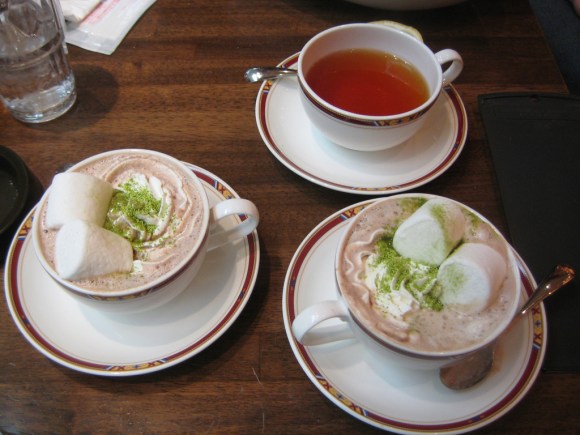
▼Fancy-schmancy hot chocolate sprinkled with macha may be next best thing, but I’m happy with plain old tea.
The GEDI report also recognizes that attitudes play a heavy role in forming a culture of entrepreneurship. In an environment hampered by cultural barriers or stereotypes, people will not see entrepreneurship as an opportunity. This appears to be the biggest barrier to women entrepreneurship in Japan.
Gender-based and non-gender-based entrepreneurship is also measured by the GEDI report. And guess what? While the U.S. and Australia saw little difference between these two figures as regards to overall ranking, the lack of women entrepreneurs in Japan caused their nation’s ranking to plummet a whopping six places.
As we noted in 5 Powerful Reasons to be a Woman in Japan, many women are quite happy in stereotypical roles. A surprising number voice their satisfaction with being housewives and rearing children and feel this in itself is a position of power. It’s possible that Japanese women may simply feel no advantage to becoming entrepreneurs. They’re pretty much running their own show anyway: the household.
Jana Charles, a consultant and social business entrepreneur living in Fukuoka who gives speeches on women entrepreneurs, confirms this. “I lost almost all my business contacts and clients just because I was pregnant. Most of them were women who said I needed to rest and focus on my baby, even though I was totally able to do my job.”
So there you have it. If Prime Minister Abe thinks he’s going to get women into the workforce, he’s going to have to make it more pleasant for women to join it. And they’re going to have to be able to join on their own terms. Convincing corporations to hire more female managers is like trying to fit a square peg into a round hole. In other words, until basic changes in work ethic, hours and child-care needs are met, women will never be able to join the full-time workforce. After all, someone has to take care of the family (aging parents as well as children).
The point isn’t to discourage women from being housewives, nor is it to encourage women to seek non-traditional female roles. It’s to encourage women to be the best they can be in whatever they choose to do. So if change is needed, it has to be passionate change from women themselves, because they want it.
Feature image: The Next Women

]]> https://soranews24.com/2014/12/18/why-arent-there-more-women-entrepreneurs-in-japan-pull-up-a-chair/feed/ 0 203364 image top lemonade stand 3764172732_feec485e2e_b First_flight2 6847945067_642585a569_b Start Up 3134143883_f761dd3587_b The West can only dream of Japan’s level of ‘failure’ https://soranews24.com/2014/11/19/the-west-can-only-dream-of-japans-level-of-failure/ https://soranews24.com/2014/11/19/the-west-can-only-dream-of-japans-level-of-failure/#comments Tue, 18 Nov 2014 22:00:20 +0000 http://en.rocketnews24.com/?p=197828 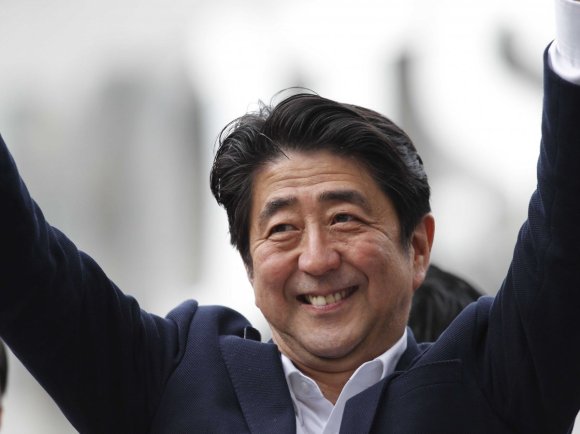
Shinzo Abe’s critics have their knives out on Tuesday: The Japanese prime minister has called a snap election for the country’s lower house.
The decision comes pretty much straight after some dreadful GDP figures for Japan. So there’s been no shortage of people declaring that Abenomics has failed.
Here’s why they’re wrong.
For one thing, people seem to forget that unemployment in Japan is only 3.6%, 0.1 percentage points from a 16-year low. That doesn’t exactly scream “recession.” In the UK and the US it’s about 6%, and in Europe it’s above 10%. On that metric, the West can only dream of the Japanese level of “failure” (more on that later).
Forecasts for the Japanese economy in Q3 were absolutely awful, as the Financial Times’ Ben McLannahan noted. Even the most bearish forecasters missed the drop by miles. Japan’s sales tax was raised from 5% to 8% this April, something that wasn’t expected to have such a debilitating effect on the economy.
However, one group did get it pretty much bang on. Now-Casting, developed by Lucrezia Reichlin at the London School of Economics, called the slump. And it sees a “dramatic improvement” on the way in November and December. The effects of the tax hike won’t last forever, and the Bank of Japan jump-started its already large QE program at the end of October.
It’s also a big mistake to think the sales tax hike was an important part of Abe’s overall plan. The tax hikes were planned under former prime minister Yoshihiko Noda and passed as a cross-party move. In Abe’s first five quarters, before the tax rise came into effect, average quarterly growth was 3.26% annualized. That’s strong, especially for Japan, where an aging population makes the natural rate of growth pretty slow.
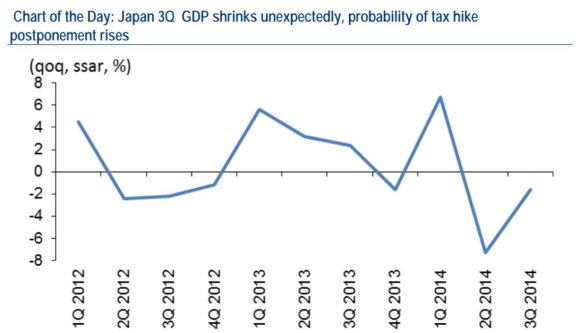 BofA Merrill Lynch Global Research, Cabinet Office
Abe deliberated over whether to delay or scrap the increases, and ultimately it looks as if he made the wrong decision. But the plan for the second part of the hike is out of the window for at least 18 months, so long as Abe wins the election. Fudging your recovery and changing course is better than not having a plan for recovery.
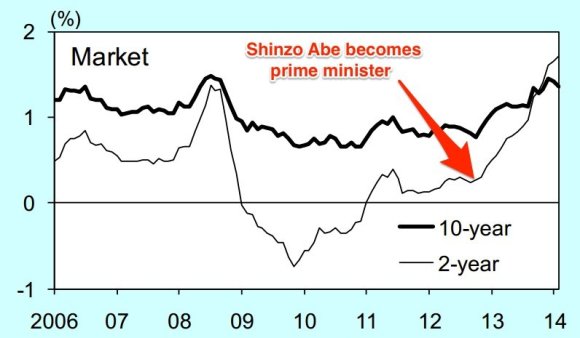
The most important part of Abenomics was always about raising Japanese inflation and ending the country’s deflationary decades. So far, it has done pretty well. Inflation (after stripping out the tax increase) has been at or above 1% for more than a year. It has slipped a little since the summer but is still way above what Abe inherited. Japan hasn’t had another period of year-long inflation over 1% in the 21st century.
Here’s what inflation markets expect two and five years ahead:
 Bank of Japan
Why is that important? Japan’s lack of any inflation has kept the economy nominally the same size or shrinking for decades. This means that economic growth and inflation combined have not been enough to raise the amount of money in the economy (in terms of yen), so public debt grows and grows relative to the size of the economy — debt was 100% of GDP in the late 1990s; it’s now an eye-watering 227%.
The Bank of Japan’s (so far) credible promise to raise inflation to 2% and keep it there is the absolute crux of Abe’s plan. Matt O’Brien offered a great explanation just before Abe’s election of why Japan needed more inflation (or rather, more nominal economic growth).
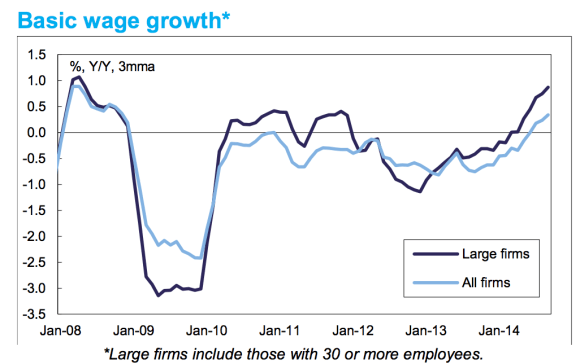
Another common criticism is that Japan’s wage growth has been low. That’s undoubtedly true, but it is rising as unemployment falls (and forces employers to hike wages in an effort to hold onto their staff). Wages are rising at the fastest pace in six years (with the first growth for small firms since the financial crisis), an effect that should be even more obvious as the temporary effects of the sales tax increase cool:
 Daiwa Capital Markets Europe, MIC
There’s one element on which the Abenomics program can be criticized: the “third arrow” of structural reforms has been slow. The government has undoubtedly made some slow achievements, but in reality, elements like raising the female participation rate will take years and decades to achieve. It’s a little far-fetched to suggest that they have failed less than two years after the program began.
In short, in the only major areas on which Abenomics can be reasonably judged so far, it’s doing well. Reform could be pushed through the pipeline a little quicker (though this is true just about everywhere), and Abe deserves at least a smidgen of credit for going back to Japan’s electorate to scrap a stupid set of plans that he inherited. In the years to come, people may feel less sure that judging Abenomics on the back of a couple of quarters was wise.
Featured image: AP Photo/Koji Sasahara

More from Business Insider:
- Apple Gives A Big Win To Samsung
- Microsoft Is Sick Of PowerPoint, Too
- Buffalo Is About To Get Slammed With 6 Feet Of Snow And The Photos Are Already Wild
- Here’s What It Costs To Open A McDonald’s Restaurant
- A Wall Streeter Explains What Elizabeth Warren Doesn’t Get About The Treasury In 2 Sentences
]]> https://soranews24.com/2014/11/19/the-west-can-only-dream-of-japans-level-of-failure/feed/ 0 197828 The West Can Only Dream Of Japan's Level Of 'Failure' The West Can Only Dream Of Japan's Level Of 'Failure' The West Can Only Dream Of Japan's Level Of 'Failure' The West Can Only Dream Of Japan's Level Of 'Failure'2 The West Can Only Dream Of Japan's Level Of 'Failure'3 Business_Insider Average savings of Japanese households revealed, netizens reel in shock https://soranews24.com/2014/06/02/average-savings-of-japanese-households-revealed-netizens-reel-in-shock/ https://soranews24.com/2014/06/02/average-savings-of-japanese-households-revealed-netizens-reel-in-shock/#comments Mon, 02 Jun 2014 03:30:30 +0000 http://en.rocketnews24.com/?p=153043 
Our mothers always told us that it’s not polite to talk about money. And while we usually listen to what our mother’s tell us, this one time we’re going to ignore their advice. Sorry, mom!
But, really, it’s not a big deal, because we’re not talking about our money. Instead, we’re talking about Japanese people’s money–specifically, how much they have saved up on average. And the number might surprise you.
Since 2002, the Japanese government–specifically the Ministry of Internal Affairs and Communications–has conducted a national survey to determine the average amount saved per household. In this case, household is any two family members living together, so it looks like none of the bachelors and bachelorettes were counted.
The survey for 2013 came back with some pleasantly surprising results: The average amount in saving held by Japanese household had risen 4.9 percent over the previous year. Which brought the yen amount to 17,390,000 yen or about US$171,013.26 based on the exchange rate today.
It looks like Abenomics might actually be working, since a large part of this increase is believed to be a result of rising stock prices–though we can’t help wondering if a devalued yen is also helping. Or maybe Mario’s just been sharing some of the wealth he’s made from his car commercials.
Regardless of the why, Japanese netizens had a lot to say about the results.
“I wonder if this just means that the average and the median are horribly far apart now.”
“Well, those that have money, really have money.”
“Without seeing this broken down by income, it means nothing!”
“I’m minus 500,000 yen (about $5,000), so what should I do??”
“Does everyone really actually have this much? Certainly none of my friends do. No matter how you think about it, the middle class definitely doesn’t have that kind of money. And if you included loans, I bet it would be a lot less, but do people really have almost 20,000,000 yen (about $196,700)?? I really feel depressed now.”
(In response to the above comment) “If you bought some stocks, even just doing regular trading, under Abenomics, you’d almost double your money. The Nikkei stock average has almost doubled.”
“Well, this why the ‘ore ore‘ scams are so popular, isn’t it?”
“Hell, my house isn’t even worth 10,000,000 yen (roughly $98,400)!”
“Gah! I only have 800,000 yen (around $8,000) at 35!”
“It’s just 1,000 people who’ve increased their savings by 1 billion yen (about $9,834,000).”
Cynicism and frustration aside, it does seem like an awfully high number. And as one commenter pointed out, the median and the average are likely very different. It could be that the rising tide has lifted all ships–or it could be that a few of the ultra-wealthy have just become extra-ultra-wealthy. Though hopefully it means a few hem lines will be rising as well.
So now we just have to figure out: Is this a good time to buy some Japanese stocks or are the prices about to plummet? We suppose if we knew that, we’d be writing this from the RocketNew24 Space Station One, instead of sitting in Tokyo.
Sources: Jiji, Kopipe Jouhoukyoku
Images: Wikipedia (Monaneko)

]]> https://soranews24.com/2014/06/02/average-savings-of-japanese-households-revealed-netizens-reel-in-shock/feed/ 0 153043 nikkei Bored with hotels? Abenomics bringing new lodging options for foreign tourists in Japan https://soranews24.com/2014/05/25/bored-with-hotels-abenomics-bringing-new-lodging-options-for-foreign-tourists-in-japan/ https://soranews24.com/2014/05/25/bored-with-hotels-abenomics-bringing-new-lodging-options-for-foreign-tourists-in-japan/#comments Sun, 25 May 2014 09:00:47 +0000 http://en.rocketnews24.com/?p=151145 
With Japan’s population steadily decreasing, the country is finding itself with a bigger and bigger surplus of vacant houses—7.75 million of them, according to a 2008 survey. That makes more than 10% of all housing units in Japan unoccupied and that is set to increase to 30% by 2030.
But Japanese Prime Minister Shinzo Abe’s economic reforms, lovingly dubbed “Abenomics,” hopes to turn this vacancy problem into a cash cow for property owners by changing hotel laws and loosening restrictions on renting out your home to tourists planning their ultimate Japanese vacation. And to jumpstart the initiative, a Japanese real estate giant has teamed up with a home rental website to match up homeowners to prospective overseas tourists who want to experience a more authentic Japan.
Japanese real estate giant Able Inc., which manages about 120,000 properties, announced last week that it will begin working with the vacation home rental website Tomareru to start this new vacation home rental service. The new site will launch this fall and unlike the American website Airbnb, where people can rent out extra rooms for just one night, this new venture will focus on foreign tourists wanting to rent out whole houses for about a week at a time.
▼ What better way to “feel local” than living in a stranger’s home for a week?
 Image: Tomareru
The key to this new venture are the special economic zones where certain businesses can skip some regulations that normal hotels or Japanese inns must follow. For example, under current law a hotel must have a physical reception desk where customers can pay for the room, but obviously a private home wouldn’t ever be able to abide by such rules.
However, there will still be some regulations on what kind of homes can participate. The rentable homes will have to be at least 25 square meters (269 square feet), available for stays of 7-10 days and have an air conditioner and a bathroom. It also seems like only foreign tourists would be able to take advantage of the private hotels.
According to Tomareru, the Japanese government set up the special economic zones on May 1. Major cities in the Kanto and Kansai regions of Japan, such as Tokyo, Osaka and Kyoto, and other places like Okinawa Prefecture qualified for the classification. The company hopes to have 3,000 homes registered on the site by March 2015.
While there might be cheaper (and sketchier) options out there, it’s expected that this new kind of “private home” hotel will be a good budget option for tourists who can’t afford a week’s stay in a nice hotel in Tokyo. Another big advantage is the opportunity to experience a part of Japan that you would never see staying at a hotel. And since some in the tourism industry have voiced their concerns about a lack of hotel rooms as they prepare for the 2020 Tokyo Olympics, this seems like a win-win for all sides.
Video: Vimeo (TOMARERU.Inc)
Beyond helping out property owners in the special economic zones, opening up the hotel industry might give a little boost to the local economy when the new “hotels” have to be furnished, cleaned and decorated. Also, with an influx of foreign tourists using Japanese homes, the company will probably need to set up some kind of hot line for visitors needing help adjusting to their temporary Japanese life.
Most Japanese netizens were pretty thrilled with the idea of renting out real homes to tourists, giving a more authentic view into life in Japan. Although many were left a little jealous that this program is only open to foreigners. One concern brought up was the possibility that older homes, which should be protected and preserved, will just get turned into cheap hotels by owners who value money over tradition.
Would you forego the typical hotel experience to try out a Japanese home for a week? Let us know what you think in the comments below!
Source: Naver Matome
Feature Image: Flickr (Lynn Friedman)
]]> https://soranews24.com/2014/05/25/bored-with-hotels-abenomics-bringing-new-lodging-options-for-foreign-tourists-in-japan/feed/ 5 151145 2014.05.25 hotels 2014.05.25 hotels 2014.05.24 tomareru eng