hydrogen fuel cell – SoraNews24 —Japan News— https://soranews24.com Bringing you yesterday's news from Japan and Asia, today. Fri, 21 Mar 2025 03:00:16 +0000 en-US hourly 1 https://wordpress.org/?v=7.1.4 https://soranews24.com/wp-content/uploads/sites/3/2020/05/en_rocket_1024.png?w=32 hydrogen fuel cell – SoraNews24 —Japan News— https://soranews24.com 32 32 176746664 World’s first hydrogen powered vending machine unveiled by Coca-Cola at Osaka-Kansai Expo https://soranews24.com/2025/03/21/worlds-first-hydrogen-powered-vending-machine-unveiled-by-coca-cola-at-osaka-kansai-expo/ https://soranews24.com/2025/03/21/worlds-first-hydrogen-powered-vending-machine-unveiled-by-coca-cola-at-osaka-kansai-expo/#comments Fri, 21 Mar 2025 03:00:08 +0000 https://soranews24.com/?p=693976 
Coca-Cola unplugged.
We all know that Japan is the land of vending machines, with automated retail terminals selling everything from hot sauce to potential marriages. They’re also sources of technological innovation as ways of serving their communities with foot-operated controls during the COVID-19 pandemic and machines that absorb CO2 from the surrounding air much like a tree does.
This thriving vending machine industry in Japan can be traced back to Expo ’70 in Osaka Japan. Vending machines existed in Japan for decades prior but were generally considered a novelty and hadn’t yet caught on with the general public.
▼ Replica of a postal vending machine that existed in Japan in the early 1900s
 Image: Wikipedia/Momotarou2012

Interest in the machines started to pick up in the late ’60s after the modern 100-yen and 50-yen coins went into circulation, but it was the drink machines developed by Fuji Electric for the Expo that really helped put the technology into the national spotlight. These machines served drinks that helped keep visitors cool during the blazing hot summer months of the event and showcased the convenience and reliability that they provided.
And now, as the 2025 World Expo in Osaka approaches, we may see another evolution in this ingrained feature of Japanese infrastructure. Fuji Electric is returning yet again, this time with beverage giant Coca-Cola, to set up the world’s first vending machine powered by a hydrogen cartridge, which is a hydrogen fuel cell that can be easily replaced as needed.
▼ Look ma, no wires!
 Image: PR Times
One drawback of conventional vending machines is that they need to be plugged in at all times. Even those machines you can find in the most remote parts of Japan need to be wired into the grid or some other reliable power source to be usable.
▼ Although there are power lines running to the summit of Mt. Fuji, they’re very limited. These Coca-Cola vending machines are carried up there in July and taken down in August, so they are likely unique in that they run on some sort of battery or generator.
But with hydrogen cartridges, vending machines no longer need an outlet and can be placed anywhere they’ll fit. This is just me spitballing here, but with some size modifications this could even conceivably give way to mobile vending machines that walk among us in the city streets for maximum coverage.
But for now we have a stationary hydrogen vending machine and it will be on display at this year’s Expo on the north side of the Grand Ring, the large wooden structure that serves as the architectural highlight of the event.
There will also be 58 regular Coca-Cola machines there, all of which can be used the Coke ON app that’s popular in Japan. With this app drinks can be bought cashlessly and remotely, allowing people with visual or other impairments to order more easily on their own smartphones. So, no matter how you look at it, the future continues to look bright for vending machines in Japan.
Source: PR Times, Fuji Electric, Coca-Cola
Featured image: PR Times
● Want to hear about SoraNews24’s latest articles as soon as they’re published? Follow us on Facebook and Twitter!
]]> https://soranews24.com/2025/03/21/worlds-first-hydrogen-powered-vending-machine-unveiled-by-coca-cola-at-osaka-kansai-expo/feed/ 0 693976 Real Fullmetal Alchemists: Kyoto University team fuses all 8 precious metals into single alloy https://soranews24.com/2022/04/04/real-fullmetal-alchemists-kyoto-university-team-fuses-all-8-precious-metals-into-single-alloy/ https://soranews24.com/2022/04/04/real-fullmetal-alchemists-kyoto-university-team-fuses-all-8-precious-metals-into-single-alloy/#comments Sun, 03 Apr 2022 15:00:17 +0000 https://soranews24.com/?p=582561 
Giving them a gold medal for it would probably be rude.
Most people are probably aware of the precious metals gold, silver, and platinum, but in fact there are eight in the world which are considered worth of the title “precious” because of their rarity, brilliance, and practical use. The other five are palladium, rhodium, iridium, ruthenium, and osmium.
The properties of these metals are often enhanced by creating alloys, in which they are mixed with other metals or substances to create materials like white gold and sterling silver.
But now, a team of researchers at Kyoto University have made an alloy that no one has ever accomplished in human history by combining all eight precious metals into a single alloy.
▼ A lot of people just kind of gave up on that and started using precious metals as food toppings instead.

It’s a extremely difficult task, and comparable to attempting to mix water, oil, yogurt, tabasco sauce, orange juice, vodka, maple syrup, grape Kool-Aid, and green tea in to a unified substance. You might be able to get a couple of those ingredients to mix, but not all of them at once.
To accomplish this unprecedented alloy, the researchers created a solution with ions of all eight metals in equal measure and added them to a reducing agent at a temperature of 200 degrees Celsius (392 degrees Fahrenheit). The reducing agent donates the necessary electrons for the different ions to bond and the alloy can be successfully made.
That is of course way easier said than done, and something that humankind has dreamed of but been unable to do in the past 5,000 years since the Bronze Age began. Needless to say, readers of the news in Japan were quite jazzed about it.
“Does this mean we can finally make a Gundam?”
“This could mean a Nobel Prize!”
“Wow! A real chogokin (super alloy)!”
“Is this alchemy?”
“Time to make a legendary sword!”
“Is it the gundanium alloy?”
“What color will it be if you mix them all together? I want to see it!”
Unfortunately there isn’t much to see at the moment. The successful experiment has yielded an amount only measurable in nano-meters which is around the scale of DNA strands. However, with the technique they developed, the team says that mass production of this alloy is possible with the right funding.
That’s great because even though the feat itself is impressive, it also has the potential for life-changing applications. Up until now, platinum has been the go-to catalyst for hydrogen fuel cells, but in 2020 this team discovered that an alloy of platinum and five precious metals was twice as efficient. Now, the eight-metal alloy showed a 10-fold increase in catalytic activity in hydrogen fuel cells.
This was also achieved only when making an alloy of the eight metals in equal amount. By adjusting the relative quantities in different ways, an even more efficient catalyst could be found to help power hydrogen fuel cells, making their widespread use more of a realistic alternative to current energy sources.
And if we can do that, then maybe we finally can get that Gundam we’ve always wanted.
Source: Mainichi Shimbun, My Game News Flash
Top image: Pakutaso
Insert image: ©SoraNews24
● Want to hear about SoraNews24’s latest articles as soon as they’re published? Follow us on Facebook and Twitter!
]]> https://soranews24.com/2022/04/04/real-fullmetal-alchemists-kyoto-university-team-fuses-all-8-precious-metals-into-single-alloy/feed/ 0 582561 Japanese professor develops device to allow cars to cleanly run on hydrogen from ammonia https://soranews24.com/2017/04/07/japanese-professor-develops-device-to-allow-cars-to-cleanly-run-on-hydrogen-from-ammonia/ https://soranews24.com/2017/04/07/japanese-professor-develops-device-to-allow-cars-to-cleanly-run-on-hydrogen-from-ammonia/#comments Thu, 06 Apr 2017 15:00:08 +0000 http://en.rocketnews24.com/?p=371472 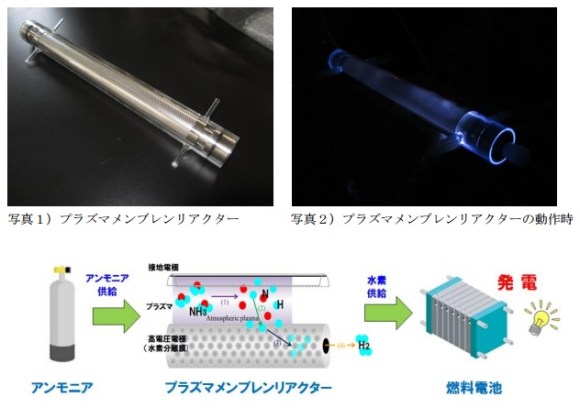
The Plasma Membrane Reactor can take a jug of ammonia and convert it into pure hydrogen cleanly and cheaply to power anything from portable generators to cars.
● What ever happened to Hydrogen?
Remember a few years back when everyone was talking about the advent of hydrogen fuel cell vehicles (FCV)? Toyota even jumped the gun and released a hydrogen car, the Mirai, to go along with Japan’s first ever hydrogen fueling station. But in the three years since then things have been relatively quiet on the FCV front.
Sure there are the superficial problems: there aren’t hydrogen stations on every street corner to fill up with and people are probably still a little skeptical about its safety after that whole Hindenberg disaster. Sure it’s been 80 years, but that’s no reason to let hydrogen get off easy.
 Image: Wikipedia/US Navy

More importantly, there have been deeper challenges, including storing the hydrogen. Calamity aside, the Hindenburg used hydrogen in the first place because it was extremely light. The problem with that is condensing it all together into a fuel tank so you can have a usable amount. Doing that will take a fair bit of pressure – 700 atm (10,000 psi) to be exact or about three times that of a typical scuba diving tank. Another way is to cool it enough so that it becomes a liquid, which would take temperatures of about -259℃ (-434°F).
Needless to say, storing and transporting fuel at either 700 times earth’s atmosphere or near the lowest temperature known to humanity at all times isn’t very cost effective. Even worse are the complex ways to acquire the hydrogen. Current methods to extract hydrogen from other substances often require considerable amounts of energy, meaning widespread usage of it might not even prove to be an environmentally friendly energy source at all.
So we need a better way.
● Ammonia: so much more than just a mirror cleaner
Ammonia, which is made up of one nitrogen atom and three hydrogen atoms, has long been considered a potential way to get pure hydrogen safely. It’s liquid at room temperature and although it is rather toxic in its undiluted state, it is relatively stable and much less flammable.
▼ The molecule also looks like it could give a mean foot massage
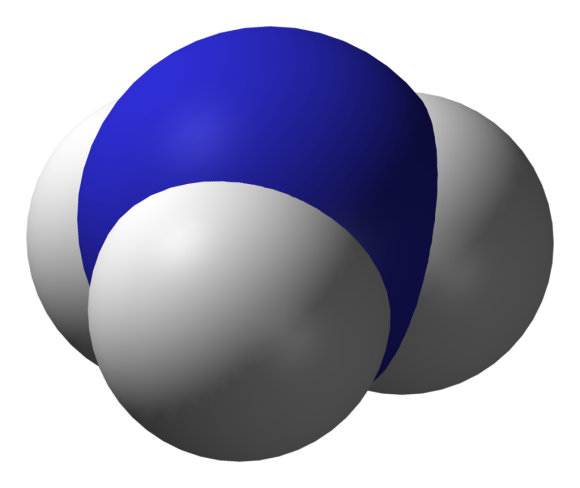 Image: Wikipedia/Benjah-bmm27

As desirable as it is, the problem is how to pull the hydrogen out of the ammonia. As I just mentioned, traditional methods are taxing and involve using temperatures of 400℃ to 800℃ (752°F to 1472°F) and rare materials like ruthenium as a catalyst. This brings us right back to the expensive environmental hazard of crazy temperatures and the possibility of making Canada really rich…you know, because they’re sitting on a lot of the ruthenium.
Luckily, Professor Shinji Kanbara of Gifu University and Sawafuji Electric have developed a way to easily, cheaply, cleanly, and compactly get the hydrogen out of ammonia without any extreme temperatures or pressures.
● The Plasma Membrane Reactor
This futuristic sounding device harnesses the often unsung hero of states of matter: plasma. Without getting too technical, plasma is a gas that has electricity passed through it and is split into positively and negatively charged components but still united as a single body of matter. Examples include fluorescent or neon lights and lightning.
▼ Those crazy lightning balls I used to love as a kid are a great example of plasma.
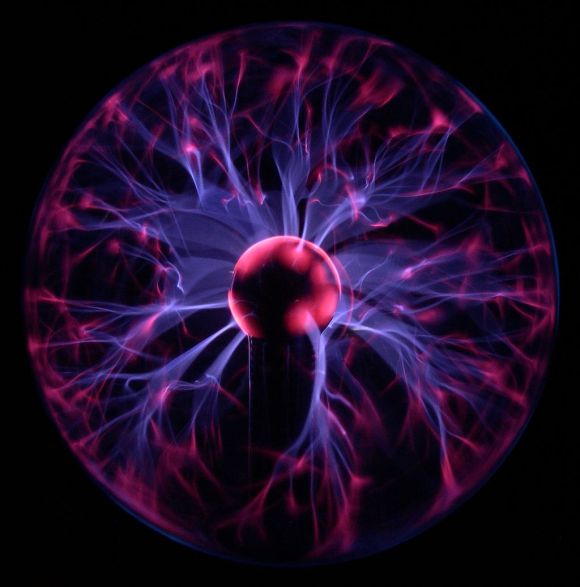 Image: Wikipedia/Luc Viatour/www.Lucnix.be

The design of the plasma membrane reactor is actually quite simple. It is made up of two tubes with one inside of the other. The outer tube is made of two-millimeter-thick quartz glass. Inside is a tube made of perforated iron wrapped in a thin film of palladium alloy.
Ammonia gas is passed through the small gap between the tubes while a high voltage current runs from the inner tube to the ground on the outer surface, thus creating ammonia plasma and separating the nitrogen and hydrogen atoms.
▼ As an added bonus, the plasma causes the reactor to emit a cool sci-fi glow
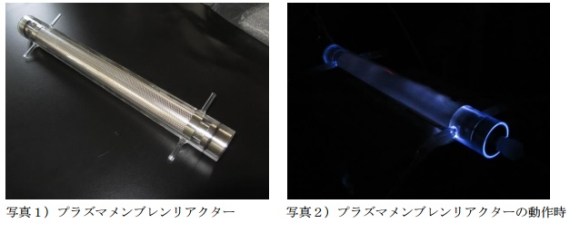 Image: Value Press
Only the single hydrogen atoms are able to pass through the palladium alloy and into the iron tube. On the other side they combine to form hydrogen gas which can then be fed directly into a hydrogen fuel cell.
▼ In this diagram showing how the Plasma Membrane reactor works, the red dots are nitrogen atoms and the blue dots are hydrogen atoms.
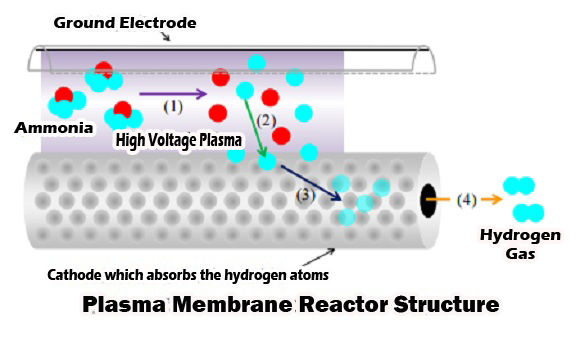 Image: Value Press (Edited by RocketNews24)
This process can be done at regular temperature and air pressure with considerably less energy and materials than other established methods. Not only that, a common problem with extracting hydrogen from ammonia had been that residual ammonia remains and corrodes the equipment over time. However, the Plasma Membrane Reactor produces hydrogen that is 99.999 percent pure.
● Big Deal?
It sure is. Ammonia to produce hydrogen is more cost-effective in pretty much every regard. Ammonia is relatively cheap and easier to transport and store as a fuel. It can be a great replacement for oil or diesel in generators without any of the harmful emissions providing clean power to rural areas or developing countries which don’t have access to gas or electricity.
With enough modifications it could also be incorporated into a hydrogen fuel cell powered vehicle. The device itself only measures about 4.2 by 40 centimeters (1.6 by 16 inches) and can produce enough hydrogen to reduce the fuel tank size from 120 Liters to 70 Liters (32 gallons to 18 gallons). With enough modification we may even have light enough gear to be able to have hydrogen fuel cell motorbikes as well.
▼ This video shows the inner workings of a Toyota Mirai with its two hydrogen tanks seen as yellow cylinders. Their size can be significantly reduced by the Plasma Membrane Reactor.
Granted, ammonia is rather toxic and therefore isn’t the safest material in the world, but we wouldn’t need any specialized and expensive facilities like hydrogen fuel stations to manage it. Anyone could sell ammonia with considerably fewer safety concerns than that of hydrogen or even gasoline.
The Plasma Membrane Reactor clears a major hurdle in hydrogen fuels cells by providing a cost-effective and environmentally friendly way of getting the hydrogen as well as a safer and more efficient way of storing it. It’s hard to imagine FCV and other hydrogen fuel cell manufacturers not wanting to utilize it.
And so, it certainly looks as if the future of cleaner energy is upon us, and it is very pungent smelling.
Source: Value Press
Feature image: Wikipedia/Benjah-bmm27
Top image: Value Press

]]> https://soranews24.com/2017/04/07/japanese-professor-develops-device-to-allow-cars-to-cleanly-run-on-hydrogen-from-ammonia/feed/ 0 371472 Japan’s hydrogen fuel cell stations begin to open, but are they worth the switch? https://soranews24.com/2015/01/05/japans-hydrogen-fuel-cell-stations-begin-to-open-but-are-they-worth-the-switch/ https://soranews24.com/2015/01/05/japans-hydrogen-fuel-cell-stations-begin-to-open-but-are-they-worth-the-switch/#comments Sun, 04 Jan 2015 23:30:33 +0000 http://en.rocketnews24.com/?p=207079 
With Toyota’s first hydrogen fuel cell vehicle (FCV), Mirai, now available, many wait to see if this revolutionary car with take off or fall flat in Japan. On 25 December, JX Nippon Oil & Energy began selling hydrogen for these new vehicles at a cost of 1,000 yen per kilogram (US$8/kg – $3.60/lb).
So is that worth giving up the pumps for…whatever hydrogen comes out of?
■ Hybrid vs Hydrogen
Obviously fuel economy is a tricky thing to compare as any number of factors can effect it, from the engine to the driver’s technique to the amount of air in the tires and so on. Since the Mirai is a Toyota let’s keep the comparison in-house and match it against the company’s best-selling car of 2013 in Japan, the Aqua (AKA the Prius c in other countries).
By Japanese test standards, the Prius c gets 35 km/L (82mpg). According to JX Nippon Oil & Energy rate for hydrogen filling up a Mirai would cost 4,300 yen (US$36) which would power it for 650km (404mi). Equating a kilogram of hydrogen to a litre of gasoline and adding in sales tax this would give us fuel economy of 140km/L (329mpg). That sounds great but we still have to factor in the cost of hydrogen compared to gasoline.
■ The bottom line
Putting these figures into monetary values a Mirai driven by hydrogen will get you 0.14km per one yen (14km/US$1 – 8.7mi/$1) whereas gasoline in a Prius c can carry you 0.25km/yen (25km/US$1 – 15.5mi/$1) based on the national average price of gas as of this writing (hydrogen’s price will be constant nationwide). It might be a little unfair to pit the Mirai against one of the most fuel-efficient cars out there, so for another comparison, a Honda Civic HF (non-hybrid) will go only 0.13km (0.08mi) on one yen.
▼ The Mirai’s fuel system, the yellow cylinders are the hydrogen tanks

■ And then there’s the price of the car…
So, the Mirai is sort of efficient in terms of money but gets beat out by hybrids rather easily. Added to that you have to consider the Mirai’s price tag of 7,236,000 yen ($60,500), mercifully down from the nine million-plus reported earlier. The fact that there is currently only one hydrogen filling station in the entire country that JX Nippon Oil & Energy supplies doesn’t help either. Their first hydrogen station opened in Ebina, Kanagawa on Christmas Day and ten more in other parts of Japan are expected to have popped up by next March.
■ Galapagos car?
Online, people are greeting the news with mixed feelings. Some are confident that the price of hydrogen and car will start to go down once the proper production and infrastructure is established. However, others feel this whole venture will prove to be a waste of time with one writing “They should call it the Japan-only Galapagos car,” referring to Japan’s once superior mobile phones and network which only allowed them to thrive inside their own country. These Galapagos phones, however, got swiftly taken down by the invasive species of smartphones.
Indeed it would seem the destiny of the Mirai and others like it rests in how well the infrastructure can get put into place. It would be a shame if the FCV didn’t catch on consider the benefits it has such as no CO2 emissions and no reliance on fossil fuels resulting in a (hopefully) more stable and (super-hopefully) lower fuel price.
Source: Itai News, Yahoo! Japan News, Toyota Japan, Gogo.gs (Japanese)
]]> https://soranews24.com/2015/01/05/japans-hydrogen-fuel-cell-stations-begin-to-open-but-are-they-worth-the-switch/feed/ 0 207079 Toyota’s hydrogen fuel cell powered car ready for sale this December https://soranews24.com/2014/06/05/toyotas-hydrogen-fuel-cell-powered-car-ready-for-sale-this-december/ https://soranews24.com/2014/06/05/toyotas-hydrogen-fuel-cell-powered-car-ready-for-sale-this-december/#comments Wed, 04 Jun 2014 21:00:41 +0000 http://en.rocketnews24.com/?p=154002 
Although the technology has been talked about for quite some time now, the concept of using oxygen and hydrogen to power an automobile seems poised to finally hit the market.
According to reports, the Toyota Motor Corporation has recently declared that their sedan-type Fuel Cell Vehicle (FCV) will begin production at the end of this year. At the moment Toyota claims this would make them the first automaker in the world to market such a vehicle to the public at large.
The FCV carries a stock of hydrogen on board and uses oxygen from the air to generate power. It’s said that a single 5kg (11lbs) supply of hydrogen can carry Toyota’s FCV over 500km (310mi). This is probably a good thing since at the time of its initial launch, stations where hydrogen can be purchased will be few and far between, found in only four of Japan’s major urban centers: Tokyo, Nagoya, Osaka, and Fukuoka.
It’s also been reported while that the establishments of around 100 of these stations have been expected to occur over this year, they are currently behind schedule. As such the Japanese government has been stepping in to encourage faster development.

Like many new technologies, the FCV will initially sell for a high price. Previously it was expected to cost 10,000,000 yen (US$97,500), but as of this writing has been marked down to an expected 9,900,000 yen ($96,500) with hopes that certain subsidies will kick in and lower the price further over the year.
Toyota is aware that these vehicles aren’t going to sell like hotcakes in the early days and will only produce 50 cars a month when ready. The company is mainly aiming at national and local governments as well as wealthy individuals or corporations with a particular interest in eco-friendly cars as potential buyers. As such someone should probably consider setting up hydrogen stands in the ritzier parts of Japan as well.

Readers of the news reacted with cautious optimism. Several asked the questions “Where does the hydrogen come from?” and “In what way do we get the hydrogen?” The first question is by far the most important, as the method that the pure hydrogen is produced may cause a substantial amount pollution as well thus negating the whole environmental aspect of the car.
With regards to the latter question, when I first heard about hydrogen fuel cells I always imagined/hoped it’d be like those glowing energon cubes from the Transformers series, but based on this promotional video from last year it looks like you just pump the hydrogen into a tank like you do with regular old gasoline. However, this also begs the question: How much will the hydrogen cost?
Indeed, it’ll be a hard road ahead for the FCV with challenges in infrastructure, pricing, and public attitude to contend with. However, if this is truly the start of a wave of automobiles producing a small fraction of the emissions of regular combustion engines, my grey boogers may one day vanish into nothing more than bedtime stories for my grandchildren.
Source: Tokyo Web via My Game News Flash (Japanese)
Images & Video: Toyota
]]> https://soranews24.com/2014/06/05/toyotas-hydrogen-fuel-cell-powered-car-ready-for-sale-this-december/feed/ 0 154002 vehicles_images_13