industry – SoraNews24 —Japan News— https://soranews24.com Bringing you yesterday's news from Japan and Asia, today. Fri, 18 Sep 2020 13:00:35 +0000 en-US hourly 1 https://wordpress.org/?v=7.1.4 https://soranews24.com/wp-content/uploads/sites/3/2020/05/en_rocket_1024.png?w=32 industry – SoraNews24 —Japan News— https://soranews24.com 32 32 176746664 Over 500 karaoke boxes close due to Covid-19, dealing historic blow to the industry https://soranews24.com/2020/09/18/over-500-karaoke-boxes-close-due-to-covid-19-dealing-historic-blow-to-the-industry/ https://soranews24.com/2020/09/18/over-500-karaoke-boxes-close-due-to-covid-19-dealing-historic-blow-to-the-industry/#comments Fri, 18 Sep 2020 13:00:23 +0000 https://soranews24.com/?p=516351 
Safety fears and an urge to social distance has rung a death knell for one of Japan’s most famous pastimes.
Spend enough time in Japan and you’ll find yourself in a karaoke booth, whether by your own will or otherwise. Karaoke is such a deeply beloved institution in Japan that it’s possible to find onsen baths equipped with their own machines and Tokyo Dome City even offered patrons the chance to belt out some classics while ascending a Ferris wheel.
Unfortunately, the spread of Covid-19 has put somewhat of a damper on karaoke’s fifty-year successful streak. Since the virus appears to be most easily spread by groups of people talking and yelling in close proximity, people are wisely steering clear of spaces where the entire point is to sit together in a small, questionably-ventilated room so you can all sing your lungs out together. The impact has been undeniable — the JKBA, or Japanese Karaoke Box Association, reports that over 500 karaoke outlets of the 6,000 registered across Japan have already closed due to lack of customers.
▼ Though solo-singing is popular, parties and group outings are where the industry makes its money.

Complicating matters is how businesses were ordered to close to stem the spread of the virus, but many karaoke boxes were still required to pay rent for the buildings they leased. And unlike other businesses that managed to operate within the lockdown, there’s doubt that customers even want to return to karaoke parlors now that they have the green-light to do so.
“This is the most dire situation we’ve faced since karaoke first started up in the 1970s,” one male karaoke box manager commented.
Not everyone is missing the siren call of the karaoke booth, however. Some netizens expressed relief that their friends will stop forcing them to sing in public, while others grumbled at how uncomfortable and inconvenient it is to sing from behind a face mask. Others suggested government funding to bail out existing karaoke boxes, or possibly using the soundproofed spaces for rentals to do less risky activities like watching concert DVDs or practicing musical instruments.
Karaoke is hardly the only cultural staple to have been put in a precarious position by the pandemic, but it’s definitely one of the most sorely felt. Die-hard karaoke fans can at least rest assured that if they really, really need to get their fix, there’s a safe and completely normal-looking way to do so.
Source: Yahoo!Japan News/Asahi Shimbun via Hachima Kikou
Top image: Pakutaso
Insert image: Pakutaso
● Want to hear about SoraNews24’s latest articles as soon as they’re published? Follow us on Facebook and Twitter
]]> https://soranews24.com/2020/09/18/over-500-karaoke-boxes-close-due-to-covid-19-dealing-historic-blow-to-the-industry/feed/ 0 516351 IRIS16011438-2_TP_V Japanese publishers team up for a “Stop! Pirated manga” online campaign https://soranews24.com/2018/08/07/japanese-publishers-team-up-for-a-stop-pirated-manga-online-campaign/ https://soranews24.com/2018/08/07/japanese-publishers-team-up-for-a-stop-pirated-manga-online-campaign/#comments Tue, 07 Aug 2018 14:00:38 +0000 http://soranews24.com/?p=421626 The fight against the illegal distribution of manga online is somewhat ironically led in part by a famous pirate character.
Weekly Shonen Jump and other staples of the manga industry have had enough with online pirating. Citing rapid growth in the illegal distribution of comics and manga anthologies since last year, Japan’s Shuppan Koho Center (“Publications PR Center”) is spearheading an effort to bring together several mainstay publishers such as Shogakukan (Weekly Shonen Sunday), Shueisha (Weekly Shonen Jump), Kodansha (Weekly Shonen Magazine), and Kadokawa (Young Ace) and promote awareness of the issue with the general public. Here’s one of the campaign ads that the editorial team of globally popular Weekly Shonen Jump (the home of Dragon Ball, One Piece, Naruto) shared earlier last week:
違法な海賊版サイトを見るのはやめよう!出版各社が参加する「STOP! 海賊版」キャンペーンのお知らせです。
クリエイターを守ることが、新たな作品を生み出す原動力につながります。
皆様のご協力をお願い致します。https://t.co/Y7suO7Ljmj
#STOP海賊版 pic.twitter.com/DGrLoz0UA0— 少年ジャンプ編集部 (@jump_henshubu) August 1, 2018
“Let’s stop looking at illegal sites of pirated manga! This is a notice for the ‘STOP! Pirated versions’ campaign that many publishing companies are participating in. It’s connected to empowering and protecting manga authors so that they can continue producing new content. We ask for your cooperation.”
▼ An expanded version of the image

The site explains that the illegal industry often collect high profits from ad revenue and website membership fees. For those who are unconvinced about the actual monetary losses on the side of the publishing companies, the following data are backed by several official reports on the subject:
- Estimated damage within Japan: 50 billion yen (US$448.9 million)
- Estimated damage within the U.S.: 1.3 trillion yen (US$11.7 billion)
- Estimated damage from Haruka Yume no Ato, the largest manga pirating ring in Japan: 73.1 billion yen
- Estimated damage from pirate site Manga Mura: 320 billion yen
The campaign website also describes in a paneled comic strip how the illegal distribution of manga affects the manga creation process, along with six of the most typical methods of illegal distribution that readers should be on the lookout for.
▼ “Manga is in trouble because of pirated versions. Protect it!! The cycle of creation!!”

“Panel 1: Manga artists
Sales have decreased due to the proliferation of pirated copies. Manga artists can’t survive. ‘I can’t eat!’
Panel 2: Editors
New talent can’t be cultivated in the manga industry full of hopes and dreams. ‘I can’t find any newbies!’
Panel 3: Bookstore staff
Due to declining sales and revenue, the status of bookstores is in trouble. ‘Manga’s really not selling anymore, huh.’
Panel 4: Readers
If the cycle of manga creation is broken, then ultimately the readers are the ones affected. ‘There’s no interesting manga!!!’
Let’s protect the cycle of creation. STOP! Pirated versions”
Six typical methods of illegal distribution with brief descriptions:
- Online reading sites–There are actually fewer Japanese sites of this nature and more unauthorized English and other translated versions. Internet users can easily access and read manga on their phones, tablets, or computers (Manga Mura is an example). Sites can also be dangerous for the reader because of easily transmitted viruses, automated redirecting to harmful sites, and other scams.
- Leech sites–The main type of site found in Japan. They house virtually no ads and most of their revenue is generated through affiliated cyberlockers (storage services). The legality here is a bit of a grey area so efforts are being made to made to address them at the moment.
- Video submission sites–More common in Japan than overseas. Manga chapters are copied into video-sharing services such as YouTube to create a kind of electronic slideshow of pages. It’s harder to detect and prevent pirated manga through this type of distribution than pirated anime.
- Spoiler sites–These sites often get their hands on new manga chapters before they’re even published in the official magazines, so they tend to attract the type of reader who wants to keep up with stories as soon as possible. Luckily, illegal distributions via this method have relatively leveled off since a large bust back in February 2017.
- P2P–Stands for “Peer to Peer,” or files shared directly by users/computers in a connected network. Examples in Japan include Winny, Share, PerfectDark, and Cabos; examples overseas include BitTorrent.
- Swindling sites–A classic credit card scam. These sites advertise free-to-read manga, but then readers still can’t read anything unless they register their credit card. After a time, they’ll probably notice they’ve been unwillingly charged.
In the words of the Shuppan Koho Center, “Manga is a part of Japanese culture that we are proud to share with the world. It’s a symbol of ‘Cool Japan‘.” For the sake of fans around the world, let’s support the artists and ensure their beloved stories can continue well into the future.
Source: Twitter/@jump_henshubu
Featured image: Shuppan Koho Center
Insert images: Shuppan Koho Center
]]> https://soranews24.com/2018/08/07/japanese-publishers-team-up-for-a-stop-pirated-manga-online-campaign/feed/ 0 421626 top_main_img What’s the highest-paying job in the anime industry?【Video】 https://soranews24.com/2016/11/16/whats-the-highest-paying-job-in-the-anime-industry%e3%80%90video%e3%80%91/ https://soranews24.com/2016/11/16/whats-the-highest-paying-job-in-the-anime-industry%e3%80%90video%e3%80%91/#comments Tue, 15 Nov 2016 15:00:07 +0000 http://en.rocketnews24.com/?p=354318 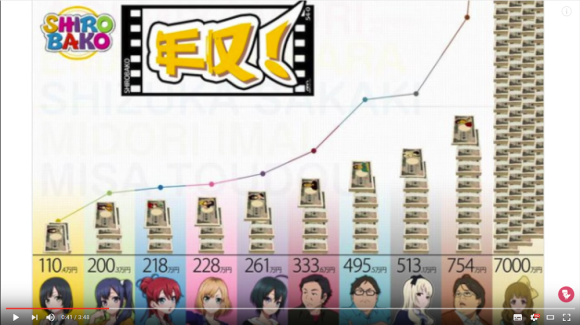
The answer may just surprise you! Or turn out to be exactly who you think it is.
Sometimes we take for granted who is producing our different forms of entertainment. Especially for those who skirt around the rules for legally consuming content (RocketNews24 honorable tip: Don’t do that), it can be easy to forget that people need to make a living from creating the shows we love. Thanks to the anime Shirobako, which follows the story of five friends who join different parts of the anime industry, we have a list of who is working behind the scenes as well as a general idea of how much they make. This list was updated recently to account for the exchange rate and other additional info since the initial release and thankfully, the YouTube channel Tokyosaurus gives us all this information in a handy video format!
According the list, animators are pretty much on the bottom rung of the salary ladder, with overseas animators (specifically those in the Philippines) making the least amount of money annually (US$8,500) and Japanese animators making not that much more at $10,000 a year.
People who do part-time work in the industry manage to scrounge together about $20,000 a year. This is likely due to their ability to pick up extra work along the way. This number, along with a few others, was pieced together thanks to some public tax records.
Ranging from $21,000 to $24,000 a year, production assistants, computer graphic animators and episode directors are the next highest. You will notice that none of these salaries are compelling reasons to jump into the anime industry.
A series director can rake in about $47,000 a year, while an executive producer who is often in charge of the overall vision of a show can take in $71,000. But not surprisingly, the job that holds the number one money-making spot in the anime industry is top-ranked voice actors, who can earn $666,000 a year.

This doesn’t mean that North American voice actors make around the same amount of money, as the anime industry in Japan generally provides a lot more ways to voice your character, like drama CDs, where voice actors essentially perform and record radio plays.
Japanese anime might be a tough industry to break into, but if you can make it to the top, your efforts may be well rewarded…we are talking mucho deniro, so keep practicing your epic voiceovers and never forget RocketNews24 when you get rich and famous.
Source, images: YouTube/Tokyosaurus
]]> https://soranews24.com/2016/11/16/whats-the-highest-paying-job-in-the-anime-industry%e3%80%90video%e3%80%91/feed/ 0 354318 voice-actor-2 voice-actor-2 voice-actor-1 China’s taste in cars is looking even more like America’s in one important way https://soranews24.com/2016/04/26/chinas-taste-in-cars-is-looking-even-more-like-americas-in-one-important-way/ https://soranews24.com/2016/04/26/chinas-taste-in-cars-is-looking-even-more-like-americas-in-one-important-way/#comments Tue, 26 Apr 2016 10:00:52 +0000 http://en.rocketnews24.com/?p=317317 It’s big, it’s bold, it’s brash, and it’s going to China.
 Ford
Ford announced late last week that it would introduce the Raptor super-truck in China, another example of a long developing trend: China’s taste in cars is looking more and more like the United States’.
Carmakers are enjoying huge sales of SUVs in China. Last week, a surprising earnings beat by GM was in large part thanks to the trend. At the Beijing Auto show this week, several other automakers introduced SUVs, some of them specific to the Chinese market.
While Ford missed projections, it has been rapidly expanding its Chinese operations, especially in SUVs.
It is no surprise that considering its success at selling the same big vehicles American consumers love, Ford should want to try its hand at selling that other great bastion of American automotive taste: the pickup truck.
It’s also the first vehicle from Ford’s “Performance Division” to make it to China, an attempt by the company to the introduce the “halo effect” to the fastest-growing car market in the world.
Exciting, range-topping vehicles like the Raptor truck — while only to sell in limited quantities — will attract buyers to the rest of the Ford lineup.
Ford Performance marketing manager Henry Ford III recently told AutoBlog that the Focus RS, the sporty hatchback also from the Performance lineup, would also make it to China in the near future, while there are currently no plans to bring the Performance Division variants of the Mustang over there.
But for now, the few lucky Chinese Ford Raptor customers will enjoy some serious off-roading capability mated to a 3.5-liter EcoBoost V6 and a brand-new 10-speed transmission.


More from Business Insider:
- This camera is going to change the world
- 17 useful things the Amazon Echo can do
- The 23 richest women in Britain
- 17 things every modern gentleman should have in his closet
- A new report signals disaster for American shopping malls
]]> https://soranews24.com/2016/04/26/chinas-taste-in-cars-is-looking-even-more-like-americas-in-one-important-way/feed/ 0 317317 raptor02_final raptor01_final Business_Insider 【TBT】The Lowdown on Japan’s Cosplay Industry https://soranews24.com/2014/09/18/%e3%80%90tbt%e3%80%91the-lowdown-on-japans-cosplay-industry/ https://soranews24.com/2014/09/18/%e3%80%90tbt%e3%80%91the-lowdown-on-japans-cosplay-industry/#comments Thu, 18 Sep 2014 08:00:01 +0000 http://en.rocketnews24.com/?p=181923 
These days, cosplay functions as a 40 billion yen (US$390 million) industry and has a large impact on Japan’s economy. Now, before moving on, please allow me to clarify that ‘cosplay’ to Japan does not only refer to people dressing up as anime and video game characters, but includes all manner of live action, Western, original characters, nurses, maids, and so on. Virtually any costume worn for fun is considered cosplay over here. So what kinds of special services are available to avid cosplayers in Japan? And how are cosplayers themselves making the most out of this bountiful, infinitely tolerant environment?
This is your Throwback Thursday article of the week, your peek into the archives of RocketNews24 featuring articles from back when we were just getting started. We’d hate for you to miss any of the quality quirky news from Asia and Japan just because you recently stumbled upon our site. And if you’re a devout RN24 reader, thanks for sticking around! Enjoy this blast from the past!
(Originally posted on May 16, 2013)
The cosplay sub-culture has been steadily growing for years.
Before the year 2000, the only place you might find cosplay costumes was at general costume shops and adult video stores. But then something changed. In order to appeal to a new demographic of teenage girls, Tokyo’s great and nerdy shopping district, Akihabara, opened a series of specialty shops devoted to cosplay. If cosplay was meant to be fun, then this seemed like the best way to support those who might be interested in giving it a try.
Soon following that came the establishment of stores that sell mass-produced outfits and accessories for popular anime characters as well as some shops that offer order-made costumes. The former specializes in reasonably-priced cosplay that average out at less than 10,000 yen (US$98) per costume. The latter can cost as much as five times that, but for a high-class, made-to-order item. In addition to those, countless online cosplay shops have also come into being.
If there was ever a must-have item for Japanese cosplayers, it’s meishi.
Meishi is another word for business cards, and Japan is absolutely obsessed with them. For cosplayers, exchanging meishi is important to help them remember those they’ve interacted with. However, highly active cosplayers looking to order meishi can find themselves in a bit of a bind. Ordinary manufacturers do not usually accept orders of less than 50 to 100 cards, so if a cosplayer wishes to have a different version of their meishi for every character that they cosplay, this requirement poses a bit of a challenge.
Thankfully, cosplay meishi manufacturers, such as the online design service, Proof, have come up with special order sets containing five designs and 20 cards for each, bringing the total to 100 meishi for (in Proof’s case) 2,625 yen ($25.70). Proof allows its users to submit their own cosplay photos and edit them into a selection of beautiful border designs, allowing even the most inept designers to create their own fabulous meishi.

Japan also provides special ways for finding the most suitable photo backgrounds.
This may come as a surprise to some people, but in Japan it is very bad juju to cosplay in public unless it’s part of your job or you are on location at a cosplay event. It’s not even acceptable to arrive at an event in costume; everyone must change together in designated changing rooms. They do this out of respect for all the normal people going about their daily lives, so as not to cause a disturbance. However, this can make it difficult for cosplayers to find scenery which matches the series that they are cosplaying from.
▼ Image taken from Soi Studio.

In response to this need, a large number of photo studios catering to just cosplayers have been popping up across Japan. There are currently more than 300 of these studios in the metropolitan areas alone! One of the more recent establishments, cosplay studio Booty, has a number of rooms, each with a different theme. Cosplayers must reserve a time slot weeks in advance, but once there they are free to move between all of the different areas and take pictures of themselves.
▼ Pictured here are Booty’s gothic and cyber areas.


Never backing down, cosplayers turn to the Internet.
An increasing number of anime, manga, and doujinshi (self-published comics) events are prohibiting cosplay. One of the most cited reasons for this is to eliminate indecent skin exposure by cosplayers, though compared to a lot of booth babes, that seems like a hard case to make. Nevertheless, cosplayers have found ways to interact with each other even outside of events, thanks to cosplay community websites such as Cure. Cure is especially nice in that there is an English version for international users, though it lacks many of the event planning features of its Japanese counterpart.

Cosplayers are going professional.
As cosplay becomes more widely recognized, its market scale also expands. There are many who pride themselves on donning only the finest brands of costumes and accessories. Of course, there are some who make cosplay for themselves and those who dedicate themselves to perfecting their craft, treating it like a profession. Some cosplayers even go so far as to mix cosplay with the entertainment industry by making videos and photobooks of themselves in costume to be sold at events, earning themselves some level of celebrity status within the cosplay community. And, let’s not forget that a new class of professional cosplay photographers is also emerging.
So, what do you think? How many of these cosplay-specific services are present where you live? And for those that aren’t, do you think they could stand a chance?
Source: Naver Matome (Japanese)
Images: Kenzyy at livedoor, VSmedia
]]> https://soranews24.com/2014/09/18/%e3%80%90tbt%e3%80%91the-lowdown-on-japans-cosplay-industry/feed/ 0 181923 cosplay04 cosplay01 image_bN®¬©{ cosplay04 cosplay05 cosplay06 cosplay07 Japan-designed New York City “Taxi of Tomorrow” put on display in Tokyo despite recent setback https://soranews24.com/2013/11/21/japan-designed-new-york-city-taxi-of-tomorrow-put-on-display-in-tokyo-despite-recent-setback/ https://soranews24.com/2013/11/21/japan-designed-new-york-city-taxi-of-tomorrow-put-on-display-in-tokyo-despite-recent-setback/#comments Thu, 21 Nov 2013 04:00:28 +0000 http://en.rocketnews24.com/?p=103609 
In May 2011, Japan’s Nissan Motor Company was awarded the rights to manufacture a line of new generation yellow taxis for New York City, with the aim of replacing the myriad varieties of cabs on the city’s streets with one uniform design by 2020. Dubbed the “Taxi of Tomorrow” by the contest organisers, Nissan’s car was to become a major part of New York City life, and naturally came as a boon to the Japanese company.
Sadly, the project has stalled following a number of legal disputes and issues over accessibility, but Nissan is nevertheless exceptionally proud of its modern take on the classic yellow cab, and recently exhibited it for all to see in a temporary showroom in Tokyo’s trendy Ginza shopping district.
JapanCulture•NYC, a website dedicated entirely to Japanese culture in the Big Apple, recently paid a visit to our fair city of Tokyo and was surprised to see the Nissan NV200 – the very cabs that were designed for their own streets – on display, not to mention pulling in the crowds.
Check out the video they shot here.
The shapely yellow cabs were due to begin rolling out across the city this year, but in mid October the Manhattan Supreme State Court put the brakes on the project, ruling that the New York City Taxi and Limousine Commission was operating beyond its authority in requiring all taxi operators to use this one type of vehicle. Others argued that Nissan’s design had many flaws, pointing to its lack of a hybrid engine and the fact that it was not fully wheelchair accessible. If the Japanese auto giant is to provide the entire city with identical vehicles, they should all come fitted with the same features and be accessible to anyone, it was argued, although Nissan had in fact met the established criteria when submitting its design, leading some to question why the contract should be granted only to be blocked years later.
However, seemingly undeterred, Nissan has updated its original design for the Taxi of Tomorrow, and is forging ahead despite this early – and costly, with an estimated US$50 million having been spent on the project so far – setback. As well as adding in a wheelchair ramp to make the vehicle more accessible, the company is also believed to be working on not just a hybrid by a fully electric version of the car, which will no doubt please New York’s greener thinkers.
▼ It may be Japanese, but Nissan’s design is unmistakably NYC


▼ Plenty of room inside!
▼ The cab is fitted with a display and even USB ports for charging mobile devices.


We at RocketNews24 are definitely with JapanCulture•NYC in hoping that Nissan’s fleet of shiny yellow taxis makes it onto the streets of New York in the near future. Heck, we wouldn’t mind if a few of these things were rolled out here in Tokyo!
Source: JapanCulture**•**NYC
Images/video published with permission of JapanCulture*•*NYC
]]> https://soranews24.com/2013/11/21/japan-designed-new-york-city-taxi-of-tomorrow-put-on-display-in-tokyo-despite-recent-setback/feed/ 0 103609 Screen Shot 2013-11-21 at 11.11.04 AM taxi 2 taxi 1 taxi 5 taxi 2 taxi 3 taxi 4 Measure Asia’s Air Pollution with a Map Based on the Length of Your Nasal Hair! https://soranews24.com/2013/01/23/as-asias-pollution-problem-is-on-the-rise-air-pollution-map-based-on-the-length-of-your-nasal-hair/ https://soranews24.com/2013/01/23/as-asias-pollution-problem-is-on-the-rise-air-pollution-map-based-on-the-length-of-your-nasal-hair/#comments Tue, 22 Jan 2013 16:00:45 +0000 http://en.rocketnews24.com/?p=36341 
In recent years along with many other developing Asian nations, China has been increasing its level of industrial manufacturing as it readies itself for remarkable industrial growth. However, neglecting its environment for the sake of industry has brought with it the problem of dense smog pollution, with microscopic smog particles with a diameter of 2.5 micrometres or less having been detected in overwhelming large amounts in China’s air in recent days.
The smog is the same as that found in factory exhausts, car fumes and the like. Measured per cubic meter, at one instance the observed value of pollution in Beijing reached levels 10 times the Chinese government’s recommended safety level. If one were to go by the Wealth Health Organization (WHO)’s recommended value, the figure rises to 40 times greater than normal. When it comes to pollution, it is thought that of the asian nations undergoing remarkable growth, 70% of nations are reaching a critical level. The toxic substances that seep out into the environment cause asthma, pneumonia and even in some cases death.
Of course, those living in highly polluted areas will surely want to know how their air compares, but measuring the levels each time can prove tiresome and expensive. With this in mind, one innovative company called Clean Air Asia has stumbled upon a way determine just how polluted your air is, and has designed an interactive map based on – wait for it – nostil hair.
The method relies on the principle that the length of the nasal hair is directly related to the level of air pollution. Colour-coded and integrated into Google Maps, nostril hair length is made available to those concerned about the cleanliness of the air they breathe. By judging the average nostril hair length in any particular area, users can find out just how hazardous their environment is.
When you find an area on the map that you’re interested in, with a simple click, a nose icon appears on the right hand side of the screen. Depending on the level of pollution, the nasal hair length changes accordingly.
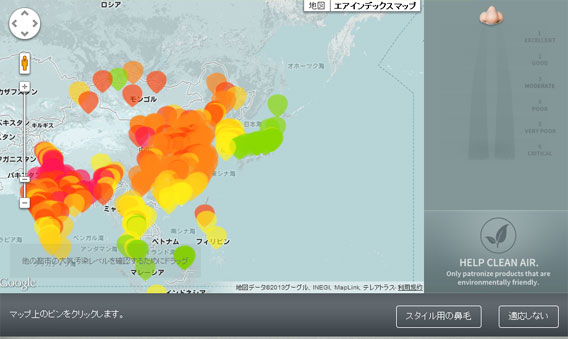
What do the different colors on the map mean?
If the colour is green, it means that you’re living in a clean area with no need for concern. Yellow means that the air around you is safe. When it comes to orange and red, the story is a little different: orange indicates the need for vigilance, while red, as I’m sure you have guessed by now, is the hazardous zone. I’m not quite sure just how fatal breathing in the air from the red zone would actually be, but it’s not something I’d like to try for experiment’s sake.
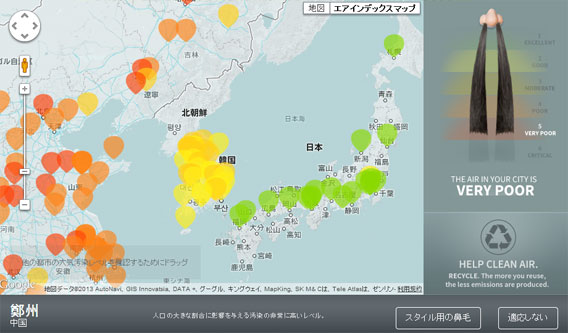
According to the World Health Organization (WHO), on a global scale, over 13 million people have died from air pollution-related illnesses; 8 Million of which being based in Asia.
Britain’s The Economist has made use of WHO’s findings on world air pollution by creating a worldwide “worst ten” polluted city ranking. Taking a peek below, India takes the lead, followed in second place by China, and then Mexico. To our readers out there, I urge to you to check out the graph below and let us know what you think about the idea that nostril hair length is related to air pollution. For those readers living in the worst 10, as bizarre a question as it is, do you feel that your nostril hair length has been affected? Feel free to leave a comment below.

Source: カラパイア
Inset images: カラパイア , The Economist
]]> https://soranews24.com/2013/01/23/as-asias-pollution-problem-is-on-the-rise-air-pollution-map-based-on-the-length-of-your-nasal-hair/feed/ 2 36341 鼻毛1 鼻毛表示 鼻毛表示2 20130119_woc790_3 Making it in the Japanese Videogame Industry: Exclusive Interview with Developer and Author James Kay https://soranews24.com/2013/01/05/making-it-in-the-japanese-videogame-industry-our-exclusive-interview-with-developer-and-author-james-kay/ https://soranews24.com/2013/01/05/making-it-in-the-japanese-videogame-industry-our-exclusive-interview-with-developer-and-author-james-kay/#comments Sat, 05 Jan 2013 11:00:39 +0000 http://en.rocketnews24.com/?p=34084 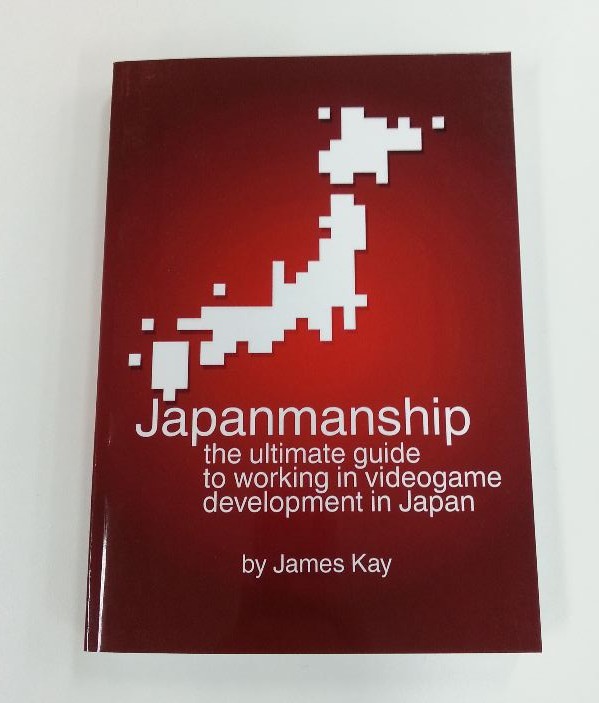
Dutch-British game developer James Kay found his way into the videogame industry after studying Audiovisual design at the Willem de Kooning Academy and moving to London to work at Intelligent Games and Criterion Software. He relocated to Japan in 2001 and, after picking up a wealth of experience at companies including Taito, Genki and Marvelous Entertainment, went on to co-found Score Studios, a company that has received critical acclaim and is fast becoming a big name in the industry.
Detailing the many hurdles that foreigners working in the Japanese videogame industry face, James’ book Japanmanship: the ultimate guide to working in videogame development in Japan may well prove to be an invaluable resource for those thinking of making the move to the spiritual home of videogames.
With the book coming off the presses just last December, RocketNews24 headed to Score Studios in Tokyo’s Yoyogi to meet with James and talk about his book, life in the videogame industry and which Nintendo Princess he’d rather rescue.
Entering Score Studios’ meeting-cum-playroom, I marvelled at the impressive collection of consoles, both old and new, and videogame memorabilia. It’s clear as soon as you walk into the room that Score is in the games business for its members’ love of games rather than just the money. Spotting a slightly worn copy of the original Super Mario Kart on a coffee table to my right and making a mental note to ask for a quick go of it later on, I sat down with coffee-sipping James Kay to talk about his own personal creation.
So what made you want to write a book in the first place?
I used to keep a blog on the subject of working in the games industry in Japan, mostly because I wanted to write and share my experiences, but it was also a lot of fun to do. I didn’t publicise it that much, but – perhaps mainly because of the subject matter – people liked it and my readership grew. As time went by I found myself too busy to provide regular updates and so brought it to a close, but at the same time I felt it was a shame, especially since I know that some people found it very useful; I’ve met people in Japan who made their own way here and who used to read the blog. So Japanmanship is more or less the informative stuff from the blog, collated and rewritten, in one handy set of pages.
Who is the book primarily aimed at?
Though I think it could be useful to a lesser extend to anyone who is thinking of working in Japan, it’s mainly aimed at people who want to work in videogame development here; mostly students or young professionals who feel strongly about Japan and the profession and could do with some extra information before setting out on their adventure.
James keeping it real with a glass of red

It’s often said that no matter how long a foreigner lives and works in Japan, they’ll forever be viewed as an outside or a visitor. Do you think there’s any truth to that?
That’s absolutely true, and it’s fine. If you intend to fully integrate you’re in for a shock and a lot of frustration. I’ve seen it happen, and those expats usually end up moving back home bitter and disappointed. You’ll never be Japanese so relax! In fact, not having to conform to some of the expectations Japanese people labour under is actually a blessing! It’d be nice if we’d be treated more as equals in some areas, but it’s hardly a burden. That is, for Westerners, of course; I gather Asian immigrants here have a much tougher time of it, but I’m not really qualified to comment on that.
You touch on the subject of otaku in your book. Is Japan really the nerd haven that many westerners believe it to be? Moreover, would you say that it’s easier to be “accepted” as an otaku over here?
Sure, within reason. All the toys, manga and games you could ever wish for are readily available here in Japan, and you won’t necessarily be looked down upon as a grown man engaging in these hobbies. But, like everywhere, you can take it to the extreme and have people look at you askance.
Before we learn a little more about how you got into the industry, could you indulge us in a little videogame prattle for a while?
By all means!
What’s your first videogame memory?
I’ve engaged in copying code from books and magazines from a young age as well as – probably mostly, even – drawing and doing art in my dad’s work copy of AutoCAD, but my first “proper” videogame memory is maybe Munch Man on the TI-99A. A nice, clunky cartridge! We also borrowed Parsec from a neighbour, and it just blew my mind.
And which gaming gems are tickling your fancy more recently?
A lot of things, and nothing! I find it hard to get into games for the long haul these days, so I skim a few and flutter from 3DS to PSVita to PS3 to iPad… The last game I sank too much time in was Skyrim, but I’ve really been enjoying Pushmo and Crashmo on the 3DS, Mark of the Ninja on PC, and Triple Town on my phone.
▼Klei Entertainment’s Mark of the Ninja proves that 2-D can still cut it

Any all-time favourite games?
It’d have to be Tetris.
If you have any high scores to brag about now’s your chance!
Game B, level 9 on the original Gameboy version was routinely cleared, and I once – in short bursts over several days – kept a single game going for over 24 hours total on my mobile phone. After Tetris, my next love is Super Puzzle Fighter 2 Turbo. I think there might be a bit of a pattern emerging here haha! That being said, The Legend of Zelda: A Link to the Past on the SNES is probably the game I’ve played and cleared most times in my life.
Oh, so you were more of a Nintendo kid than Sega?
A PC one, actually. Ultima, King’s Quest, Wolfenstein; they were the kind of things I was into.
Ah, see I was going to ask you which character you use in Mario Kart…
Oh, I can still answer that, don’t worry! It’s got to be Toad for me every time.
Who’d you rather rescue, Princess Peach or Princess Zelda?
Zelda. Again…
Even with those elfin ears?
At least she gets out of the house every now and again rather than sitting around waiting to be kidnapped…
Good point. Ryu or Ken?
I don’t really do fighting games to be honest. I always think that mastering fighting games is a lot like learning Dutch: it takes a lot of effort to acquire a very narrow skill that’s pretty much pointless outside of Holland/the game.
Haha
I’m half Dutch, so I’m allowed to say that!
Moving on! What was the first game you worked on professionally?
It was a realistic golf game for the PC and Playstation 1 that nobody ever heard of. I had to process and clean up digitised footage of all these real-life golf celebrities, some of whom I helped film, too. As a first development experience it was pretty great! The publisher was just on its way down at the time so there was almost no marketing budget, which meant that it languished in obscurity, sadly.
▼The boys at Score Studios do a little brainstorming

So when did Score Studios come into being?
Well, after working in the Japanese industry for quite a while I got a little frustrated at my inability to effect change. I met Paul Caristino and we figured we were both on the same page. We took the plunge and created Score Studios, to try and do things “our way”, inject a little Western chutzpah, so to speak. We put in our own cash, and worked hard, but slowly we managed to grow and make other people see that we had something special going on. In the early days we did a few iOS titles, because the bar to entry was nice and low for independent developers, and had some modest critical success with Piczle Lines, and a tool Paul wanted to make for his own D&D sessions, DM Tools, but these days we’re back doing console game development, something everybody at Score is pretty much at home in.
Piczle Lines has become a firm favourite with puzzle fans across the globe:
Any big names you can drop on us? Who has Score worked with to date?
We’ve worked with a few Japanese companies, like Valhalla Games Studios, for example, but are now pretty much entirely committed to a contract that is very exciting for us, but not anything we can really discuss, sorry.
Not even a tiny hint?
I’m sworn to secrecy, sorry!
Fair enough! Finally, then, do you have any advice for any of our readers who are interested in getting into the Japanese games industry?
Yeah, buy my book, haha! But seriously, I know it sounds a little far-fetched – the whole idea of moving to Japan to work in videogame development, I mean – but it’s not so crazy. In fact, I see more and more foreigners doing exactly that. So if it’s what you really want to do, then go for it!
For more on Score Studios and James’ book, head over to the official Japanmanship page on Score’s website.
Photos / video courtesy of James Kay / Score Studios
Mark of the Ninja (C) Klei Entertainment
]]> https://soranews24.com/2013/01/05/making-it-in-the-japanese-videogame-industry-our-exclusive-interview-with-developer-and-author-james-kay/feed/ 0 34084 Japanmanship James Kay mark of the ninja score studios team “What Happens to Japanese Porn Stars After They Retire?” Inside the Mind of an Adult Video Model https://soranews24.com/2012/10/05/what-happens-to-japanese-porn-stars-after-they-retire-inside-the-mind-of-an-adult-video-model/ https://soranews24.com/2012/10/05/what-happens-to-japanese-porn-stars-after-they-retire-inside-the-mind-of-an-adult-video-model/#comments Thu, 04 Oct 2012 21:00:46 +0000 http://en.rocketnews24.com/?p=21417 
Perhaps the reason that so much fuss is made over the Japanese sex industry is that, in almost every other aspect of its society and culture, Japan is considered to be such an immensely safe, polite and altogether nice place to be.
The country whose tourists are often reputed to be among the most polite and agreeable, and where your lost mobile phone or wallet usually finds its way back to you, Japan would not be anyone’s first guess when asked “Which country has a booming, recession-defying porn industry?”
Be that as it may, the Japanese AV (adult video) industry, whose revenue comprised more than 20% of worldwide sales according to a 2006 survey, continues to grow every year. And with that growth comes an increasing number of young women who aspire to work in the industry, as reported here on RocketNews24 just a couple of weeks ago.
But with so many girls taking a shot at being AV stars and entering into this seemingly glamorous but equally shady profession, how do they go about their daily lives unnoticed? And what becomes of AV stars who leave the industry?

In an interview with Atsuhiko Nakamura, author of books such as “The Nameless Women” and interviewer of literally hundreds of AV actresses, Shuplay News uncovered some startling facts about the sex industry in Japan, in particular the life of the women who become involved in making adult movies.
“Many girls enter the AV industry each year, but not necessarily all for the same reasons;” Nakamura comments, “some do it entirely for the money, while others are just comfortable with the idea of having sex in front of people and see it as any easy job. It just works for them.”
The Japanese AV industry reportedly sees an astounding 6,000 newcomers each year. But surely the risk of being seen on a video would be enough to dissuade any self-respecting young woman from doing such a thing?
“With the huge number of girls working in the industry, cases of AV actresses being recognised while going about their daily lives are quite rare,” says Nakamura, adding “there are plenty of cases of former AV girls who are now happily married and enjoying normal lives.”
In many cases, girls do a short spell making XXX videos, and then, perhaps having earned enough to support themselves financially, or simply deciding that they have had enough, choose to leave and pursue a more orthodox lifestyle. After all, few people actively working in the porn industry are seen out shopping with their kids or taking part in PTA meetings without those around them raising a few eyebrows…
But it is here that many retired AV models hit a wall, says Nakamura, describing what he calls the “AV-nō” (lit. Adult Video brain”); the “AV Mindset” that many girls find themselves unable to shake off.
“A lot of girls find themselves unable to return to regular jobs after working as an AV model;” explains Nakamura, “they have worked in an often lucrative business, some for many years, so to go back to a standard job for a much smaller salary is not easy”, he tells. “Around two thirds of retired AV models end up in the sex industry, working in hostess bars or even working as prostitutes in ‘soap-land’ bath houses.”

It would seem that, of those thousands of girls initially seeking an easy, well-paid life as a porn-star, literally thousands of them become trapped in the sex industry afterwards.
The “AV Mindset” that Nakamura speaks of has two distinct sides to it; while there are some retired AV models who lack the skills required to work in regular jobs, and who find themselves in the strange position of feeling more comfortable in environments like hostess bars, there are also women who, despite wanting to stop making sex tapes, are unwilling to return to an everyday lifestyle and lose all the trappings and relative glamour that came from their wealthy AV lifestyle.
Nakamura compares this way of thinking to writers who, at the peak of their game being paid hundreds of dollars for articles, suddenly have the rug pulled out from under them and are forced to work for just 20 or 30 dollars per piece.
“Some writers refuse to do it out of pride or shock. Some, on the other hand, simply can’t afford to go back to that and look for more lucrative work elsewhere.”
Just over two years ago, former AKB48 idol Rina Nakanishi was reported to have become an AV model (link Not Safe For Work) after her sudden departure from the popular group. While some suggested that, with such a huge existing fan-base, she would see incredible success, others- perhaps more reasonably- argued that, once the novelty of seeing a former pop star perform sexual acts had worn off, Nakanishi would be left out in the cold, disgraced and jobless.
The Japanese sex industry may well be one of the biggest in the world, but it’s clearly very dangerous ground to play in.
Stay in school, boys and girls.
Source: Shu Play News
]]> https://soranews24.com/2012/10/05/what-happens-to-japanese-porn-stars-after-they-retire-inside-the-mind-of-an-adult-video-model/feed/ 1 21417 AV article title AV article title 18 plus Kabuki cho