Mujirushi – SoraNews24 —Japan News— https://soranews24.com Bringing you yesterday's news from Japan and Asia, today. Sun, 20 Sep 2026 15:00:39 +0000 en-US hourly 1 https://wordpress.org/?v=7.1.4 https://soranews24.com/wp-content/uploads/sites/3/2020/05/en_rocket_1024.png?w=32 Mujirushi – SoraNews24 —Japan News— https://soranews24.com 32 32 176746664 Japanese sweet potato ice cream season! Häagen-Dazs and Muji take different paths to our hearts https://soranews24.com/2026/09/21/japanese-sweet-potato-ice-cream-season-haagen-dazs-and-muji-take-different-paths-to-our-hearts/ https://soranews24.com/2026/09/21/japanese-sweet-potato-ice-cream-season-haagen-dazs-and-muji-take-different-paths-to-our-hearts/#comments Sun, 20 Sep 2026 15:00:30 +0000 https://soranews24.com/?p=745211 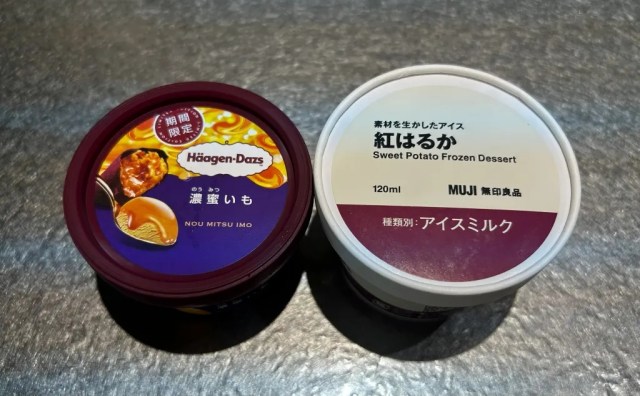
Two completely different ways to make a delicious Japanese autumn dessert.
Now that we’re into the back half of September, we’re ready to switch our sweets snacking into autumn mode. And just like how farmers are harvesting their sweet potatoes, so too is it time for us to start bringing in Japan’s sweet potato ice creams for taste testing.
Today we’re looking at two ice cream makers with very different approaches. First, we’ve got Häagen-Dazs, a premium brand that’s very comfortable with adding decadent opulence to its desserts. But we’re also trying the new sweet potato ice cream from Mujirushi Ryohin, a.k.a. Muji, the lifestyle chain whose ice cream tends to be simple and understated, much like its furniture and housewares.
So, without further ado, let’s get started.
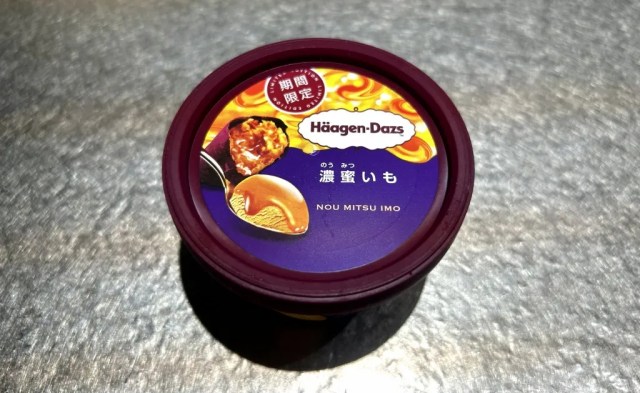
While Häagen-Dazs Japan brings out seasonal fall flavors on an annual basis, sweet potato isn’t always one of them. So we’d been getting a little anxious, but on September 15 they released their new Nou Mitsu Imo, or “Rich Sweet Potato,” flavor.
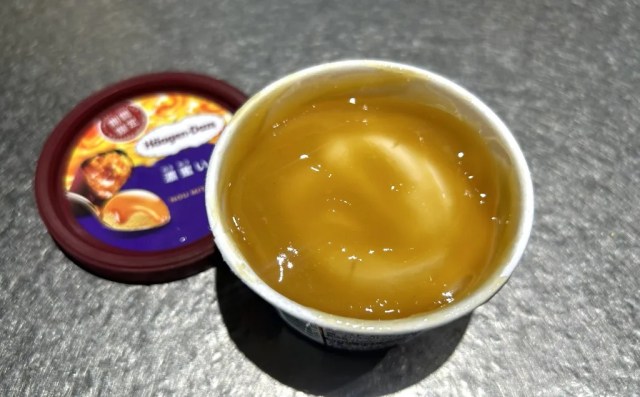
Pop the lid off, and you’re instantly greeted by a luxuriously lustrous glistening gold sweet potato sauce meant to evoke the sweet caramelized juices that ooze out of a freshly roasted sweet potato. The sauce is made with two of Japan’s most delicious sweet potato varieties, Beni Haruka (the sweetest variety in Japan) and anno imo.
Meanwhile, Mujirushi’s sweet potato ice cream flavor is just called Beni Haruka, and its English name, Sweet Potato Frozen Dessert, is starker still.
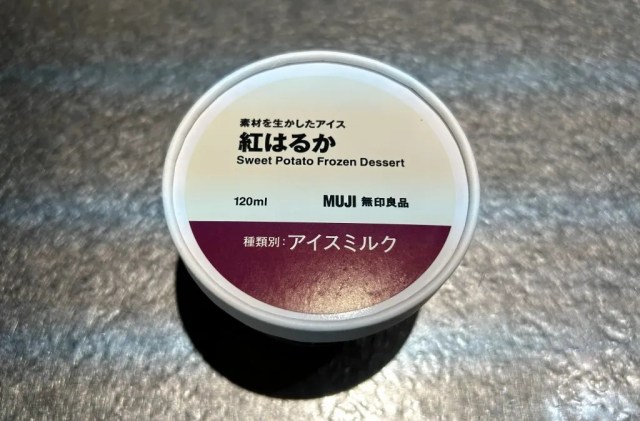
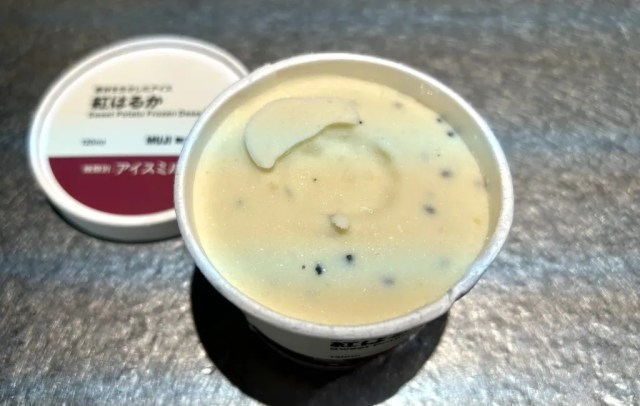
That name probably doesn’t have you expecting dazzling visuals, and sure enough, things are pretty plain under the lid.
▼ Hmm…those black dots do look intriguing, though…
In terms of visuals, there’s no denying that Häagen-Dazs is more attention-grabbing, and that’s where our spoon went first. True to its name, the Nou Mitsu Imo is rich and delicious. The sauce is thick but smooth, harmonizing excellently with the flavor and texture of the Beni Haruka ice cream, which has a bright yellow color to it.
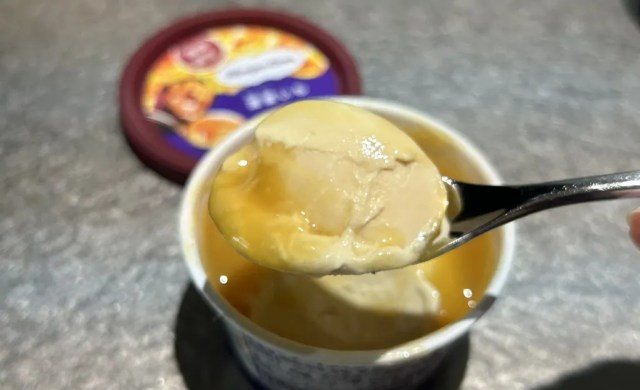
With desserts that use this much sauce, you might be tempted to think they’re trying to cover up something or beat your taste buds into submission, but that’s not the case here. For all of its visual extravagance, Häagen-Dazs’ Nou Mitsu Imo is actually pretty straightforward. There are no ill-advised hidden ingredients or too-clever-for-its-own-good tricks involved, just lots and lots of great sweet potato flavor.
So after all that, would Mujirushi’s sweet potato ice cream come up short? Not at all! Remember those black dots we mentioned? It turns out they’re black sesame, and they’re not the only surprise that was waiting for us. As we dug down below the surface, we started coming across bits of actual sweet potato mixed in among the cream.
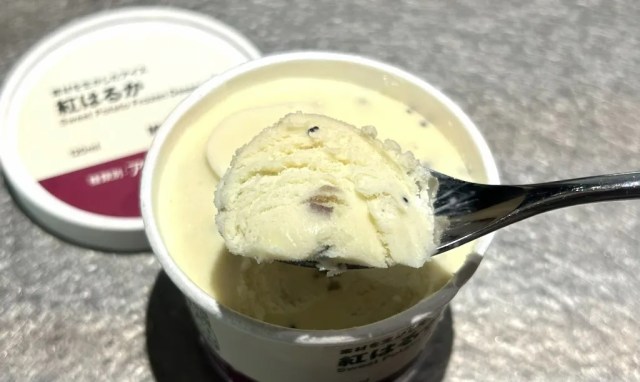
In addition to flavor, the sweet potato pieces added a lot of interesting texture, a crisp iciness with a fluffy chewiness waiting at the center. The black sesame imparted an elegantly enticing aroma, neither overpowering nor getting lost in the buttery notes of the sweet potato ice cream. All in all, it really delivers on the promise of “making the most of the ingredients’ flavors,” Mujirushi’s stated philosophy for its ice cream line.
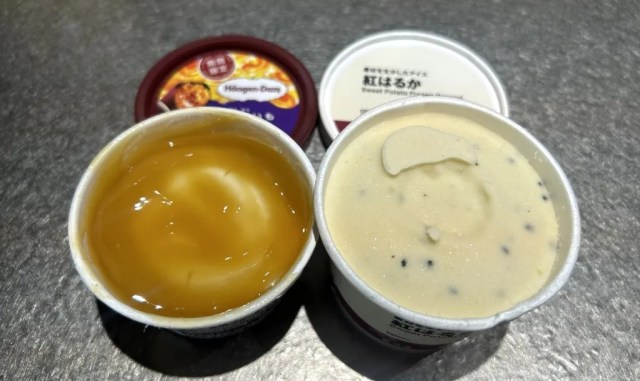
Price-wise, there’s not much difference between the two, with Häagen-Dazs Nou Mitsu Imo at 373 yen (US$2.35) being just a touch more expensive than the 350-yen Mujirushi Beni Haruka. Muji’s ice cream is about 30 percent bigger (120 milliliters [4.1 ounce] vs. 90 milliliters), so it is technically the better value, but we think we can find room for both of these in our budget and stomach this fall.
Photos ©SoraNews24
● Want to hear about SoraNews24’s latest articles as soon as they’re published? Follow us on Facebook and Twitter!
]]> https://soranews24.com/2026/09/21/japanese-sweet-potato-ice-cream-season-haagen-dazs-and-muji-take-different-paths-to-our-hearts/feed/ 0 745211 8_61b8d1 Mr. Sato takes on two of Muji’s most powerful Chocolate Mint ice creams* https://soranews24.com/2025/09/03/mr-sato-takes-on-two-of-mujis-most-powerful-chocolate-mint-ice-creams/ https://soranews24.com/2025/09/03/mr-sato-takes-on-two-of-mujis-most-powerful-chocolate-mint-ice-creams/#comments Tue, 02 Sep 2025 16:00:30 +0000 https://soranews24.com/?p=711178 
*One of them actually sacrificed the “ice cream” designation to be more powerfully minty.
Mint chocolate, or “choco mint” as it’s inversely known in Japan, is still a relatively new flavor on the mainstream snack scene. It’s only been able to seriously catch on in recent years among the younger generations, who don’t instantly liken it to the taste of toothpaste.
Meanwhile, our star reporter Mr. Sato, is no such youngster and has a hard time stomaching anything mint chocolate flavor, despite his incredible penchant for sweets.

It’s not so much that it tastes just like toothpaste to him; rather, it’s the lingering aftertaste of the mint that overstays its welcome on his palate, much like toothpaste sometimes does.
Despite this, when he heard of a new line of mint chocolate ice cream making waves on social media, he felt oddly compelled to try it. It was released last June by lifestyle brand Muji and is said to be so refreshingly minty it could be used as a bath salt.
This seemed way beyond what our mint-chocolate-novice report could handle, but with a description like that, morbid curiosity got the better of him, and he headed out to his nearest Muji to try some.
Despite its popularity, Muji was well-stocked with their two varieties of dessert, Mint Chocolate Chip Frozen Dessert and Cool Mint & Chocolate Chip Frozen Dessert for 320 yen (US$2) each.

And because Mr. Sato lacked experience in the mint chocolate game, he also got a standard Choco Mint Super Cup from the convenience store for 200 yen ($1.30).

Looking under the hood at each dessert, the Super Cup was decidedly pale-looking. It could have been frost from being over-frozen or just the lighting, but this was the color of mint chocolate that our writer was raised on.

Muji’s Mint Chocolate Chip was a decidedly deeper blue. This looked like a serious mint taste, but the chocolate chips mixed throughout looked like a good balance.

However, Muji’s Cool Mint & Chocolate Chip was on a whole other level from that! The deep blue tone signified a level of mint that Mr. Sato couldn’t even comprehend.

If this were a role-playing game, the Super Cup would be a low-level slime or other monster that offers rock-bottom XP, the Mint Chocolate Chip would be a dungeon boss, and the Cool Mint & Chocolate would be a monster so strong it wouldn’t even be a part of the main story and only challenged by those looking for 100-percent completion.
In terms of taste, the Super Cup had a tacked-on-feeling mint flavor that hung around way too long in our reporter’s mouth. It was the mint chocolate that he’s come to know thus far and never developed a liking to.

However, after eating the Mint Chocolate Chip from Muji, his impression of mint chocolate changed slightly. The mint taste was firmly there, but it washed away cleanly and didn’t pollute his mouth afterward. He felt that this was what mint chocolate should be like, and he could potentially get used to it after a while.

The Cool Mint & Chocolate Chip lived right up to its imposing appearance. Mr. Sato felt wave after wave of refreshing mint flavor wash over him. It was as if this mythical beast were casting whirlwind spells against his woefully under-leveled party.

That was far more mint than our writer was ever ready to handle. He had read that the flavor was a mixture of spearmint and peppermint, but that wasn’t the only thing that made it ultra-minty. Looking closely at the label on the cup, he noticed that Cool Mint & Chocolate Chip wasn’t even ice cream… It was ice milk!
▼ On the left, Mint Chocolate Chip Frozen Dessert is labeled as “ice cream” but on the right, Cool Mint & Chocolate Chip Frozen Dessert is classified as “ice milk.”

This meant that it had a lower fat content. The creamy sweetness of the fat would undoubtedly dilute the sheer power of the mint, so this dessert went as far as shedding its classification as an ice cream to deliver an even more potent blast of freshness.
It was far too much for Mr. Sato to handle, but he had to tip his straw hat to Muji for going all out. He’ll have to grind a lot more Super Cups to build up enough experience to try it again, but he highly recommends it to all the strong mint chocolate warriors out there.
Photos © SoraNews24
● Want to hear about SoraNews24’s latest articles as soon as they’re published? Follow us on Facebook and Twitter!
]]> https://soranews24.com/2025/09/03/mr-sato-takes-on-two-of-mujis-most-powerful-chocolate-mint-ice-creams/feed/ 0 711178 Muji releases ice creams with special ingredients for summer in Japan https://soranews24.com/2025/06/23/muji-releases-ice-creams-with-special-ingredients-for-summer-in-japan/ https://soranews24.com/2025/06/23/muji-releases-ice-creams-with-special-ingredients-for-summer-in-japan/#comments Mon, 23 Jun 2025 03:00:08 +0000 https://soranews24.com/?p=705574 
Muji is known for its high-quality products, but are its ice creams worth buying?
Mujirushi, or Muji as it’s commonly known, has been pushing the boat way, way out in recent years, exploring new terrains beyond reasonably priced, high-quality everyday goods to bring us some innovative products in the food world as well.
This summer, the chain is making waves with a trio of ice creams, all made with milk sourced from Hokkaido, Japan’s famed dairy heartland. Called “Hokkaido Milk Soft Ice Cream”, there are three varieties in the lineup — Caramel, Corn, and Salted Milk.
▼ The ice creams, available only at branches that stock frozen foods, are priced at 290 yen (US$2) each.

These flavours wave the flag for Hokkaido, which is also Japan’s leading corn-producing region, and are perfect for boosting salt levels in summer, when relentless high temperatures and humidity are so intense they’ve been known to cause heat stroke in high numbers.
While the flavours sound intriguing, Muji isn’t known for its ice creams, so we were curious to find out what they would taste like, starting first with the Salted Milk flavour.

This was so good we felt we might have hit the jackpot with the very first flavour — the perfect balance of milky richness and a distinct salty note made it flavourful yet refreshing.
It was hard to stop eating after just one bite, but next up was the Caramel.

This one was just as good, with a solid bitterness playing against the sweetness, making it a caramel flavor that even adults will love. It was reminiscent of salted caramel, only without the salt, so although it didn’t actually work to replenish our salt levels, it still felt like it did, giving us a much-needed boost on a hot day.
Still riding the wave of excitement, we tried the corn, which we were most curious about.

Yes, this one deserves applause too. The gentle sweetness of corn and the soft flavour of milk were a perfect match! The corn flavor wasn’t too strong, so it’s surprisingly light, despite being rich in texture.
So in the end, we were completely satisfied with every flavour — so much so that it was impossible for us to rank them. The only slight downside is that the cone is more on the soft side rather than crunchy, so preferences may vary there. For us, though, it wasn’t a dealbreaker, and we’ve already stocked up on more of them to keep us going all summer long.
Photos © SoraNews24
● Want to hear about SoraNews24’s latest articles as soon as they’re published? Follow us on Facebook and Twitter!
]]> https://soranews24.com/2025/06/23/muji-releases-ice-creams-with-special-ingredients-for-summer-in-japan/feed/ 0 705574 Muji Japan ice cream soft serve food Hokkaido Tokyo shop store news 1 How do Muji’s Chardonnay and Cabernet Sauvignon soft drinks compare to the wines? https://soranews24.com/2025/06/17/how-do-mujis-chardonnay-and-cabernet-sauvignon-soft-drinks-compare-to-the-wines/ https://soranews24.com/2025/06/17/how-do-mujis-chardonnay-and-cabernet-sauvignon-soft-drinks-compare-to-the-wines/#comments Tue, 17 Jun 2025 01:00:58 +0000 https://soranews24.com/?p=705112 
We dare to mix Chardonnay with Chardonnay.
Recently, generically marketed lifestyle goods producer Muji announced on social media that they were selling a unique pair of grape sodas. Unlike ordinary grape drinks, these were made with the grapes used in the beloved Cabernet red wine and Chardonnay white wine. It certainly looked tempting and with the buzz it was generating online, our writer Tasuku Egawa decided to hurry to his nearest Muji to try some before it sold out.
Luckily, that was not the case with these drinks and there were still plenty in stock by the time he arrived. He bought a 350-milliliter bottle of each for 190 yen (US$1.30). That was a little high since a 500-milliliter bottle of Grape Fanta would be significantly less. Still, this used 20 percent actual juice, and that juice was 100-percent Chardonnay and Cabernet grapes grown in Italy, so it was understandable.

On his way home he looked at the label more carefully. Tasuku found that they were sweetened further with sugar and also had grape extract, likely from a different kind of grape. He wasn’t sure how this might affect the taste so he decided to swing by grocery store Kaldi and buy an actual bottle of 2022 Cabernet Sauvignon from Redwoods Vineyard in California and a bottle of La Petite Gargotte Chardonnay from Cotes de Gascogne in France to take notes. Each bottle cost around 1,000 yen which seemed like a fair comparison for a couple of fizzy drinks.

Then came the time to taste. Tasuku cracked open the Muji Cabernet soda and poured a glass. He tried to waft the bouquet but didn’t detect much of a grape scent at all. It was more like a starchy sweetness that you might expect from any carbonated soft drink.

The color looked on point though, and the level of carbonation seemed just right.

He also poured a glass of the Cabernet wine for a better visual comparison.

Taking a sip of the Muji soda, Tasuku’s tongue was greeted with a pleasant sweetness but not much else. There weren’t any subtle notes of bitterness that one might find in pure grape juice, but the 20 percent inclusion of juice did give it a fresher and fuller taste than other grape sodas. It was more like a glass of Welch’s that was diluted with a syrupy sugar.
The sweetness of the Muji Cabernet makes it stand better on its own rather than pairing it with some meat like Tasuku would with a real Cabernet.
▼ Kaldi also had some prosciutto, but Tasuku saved it for the real wine.

Pouring a glass of the Muji Chardonnay was very similar to the Cabernet. It had the same plain smell but again captured the visual appearance of the white wine very well.

Our writer poured a glass of the real Chardonnay too for comparison’s sake.

Even though white wine can be quite tangy, the sweetness of the Muji soda blew away the French Chardonnay. Perhaps it was because Tasuku selected a relatively dry wine because that’s what he prefers.
Still, even though the Muji Chardonnay was way more on the sweet side of things, it had that same fresh quality that the Muji Cabernet had compared with other grape sodas, which made them more enjoyable to drink.
Looking at his half-full glasses, our writer got the urge to mix and match. First, he poured the Muji Cabernet into the Redwood Cabernet and was pleasantly surprised by the taste. It was like red wine mixed with ginger ale and gave off a sophisticated yet fun flavor that would be great for enjoying wine while keeping the alcohol consumption at bay.
Doing the same with the Muji Chardonnay and French Chardonnay, the real wine helped to tame the powerful sweetness of the soda for a more balanced taste. The combination reminded our writer of a sangria.

Speaking of sangria, many people probably don’t realize this but the simple act of letting fruit soak in wine to make the popular beverage at home without a license is technically illegal in Japan. However, simply adding something to wine and drinking it right away is permitted by law, which means blending Muji’s soda and real Chardonnay is a great way to get that sangria taste without worrying about the cops kicking in your door.
So, if you want a grape soda that’s a little more grapey than the rest or a tasty way to moderate your wine drinking, Muji’s sodas can really hit the spot.
Photos ©SoraNews24
● Want to hear about SoraNews24’s latest articles as soon as they’re published? Follow us on Facebook and Twitter!
]]> https://soranews24.com/2025/06/17/how-do-mujis-chardonnay-and-cabernet-sauvignon-soft-drinks-compare-to-the-wines/feed/ 0 705112 Muji’s locally sourced Yamatomaru pizzas are some of the best frozen pizzas we’ve ever had https://soranews24.com/2025/05/07/mujis-locally-sourced-yamatomaru-pizzas-are-some-of-the-best-frozen-pizzas-weve-ever-had/ https://soranews24.com/2025/05/07/mujis-locally-sourced-yamatomaru-pizzas-are-some-of-the-best-frozen-pizzas-weve-ever-had/#comments Wed, 07 May 2025 01:00:06 +0000 https://soranews24.com/?p=701244 
Regional produce makes for a very special pizza that you can only get in certain parts of Japan.
Mujirushi, a.k.a. Muji, has made a name for itself thanks to its high-quality, reasonably priced…well, everything. The Japanese lifestyle chain offers a staggering variety of products, from housewares and furniture to clothing and appliances, all of which tend to leave customers satisfied and wallets relatively full.
The Mujirushi catalog is so extensive that the exact product lineup can vary quite a bit from branch to branch, depending on the available amount of floorspace. The bigger the branch, the more unique the offerings, though, and on a recent visit to the largest Mujirushi in Japan, we found some very special pizzas.

Mujirushi’s food and beverage division has been looking for ways to shine a spotlight on locally raised produce, and so at certain stores in central and west Japan you can find what it calls “Local Pizzas,” which bear the message “Locally crafted pizza made with locally sourced ingredients.” Since Japan’s biggest Mujirushi is in Nara Prefecture, the star ingredient in their Local Pizzas is Yamatomaru eggplant.

Grown in Nara’s Yamato district, Yamatomaru eggplants are round with dark skin that has a dramatic sheen. They’re noticeably firmer than other varieties of eggplant, with slices retaining their texture and shape even after being grilled, baked, or steamed.
Mujirushi has two kinds of frozen Yamatomaru eggplant pizzas, one that also uses teriyaki chicken as a topping and the other that uses anchovies. We picked up one of each (the teriyaki chicken one costing 1,050 yen [US$7.25] and the anchovy 950 yen) and took them back home for taste-testing.

You can thaw the pizzas either in the fridge or in the microwave, and we opted for the latter, since we’re of the mind that “sooner is better than later” is pretty much always the appropriate philosophy for pizza.
We decided to try the Yamatomaru eggplant with anchovies version first. Taking the thawed but still uncooked pizza out after its stint in the microwave, we already knew we were going to be in for something good based on how good it looked and smelled even in this intermediary state, with luxuriously thick slices of eggplant stretching all across the top of the pie.

And after baking it…

…it looked even better!

They say that looks can be deceiving, but the operative word there is can. In the case of Mujirushi’s Yamatomaru pizza, the appearance is an honest declaration of how it’s going to taste. The eggplant slices are meaty and juicy, filled with delicious flavor that hits your taste buds the moment you bite into them.

The crust is outstanding as well, with just the right touch of outer-layer crispiness giving way to an invitingly soft bread texture underneath.

Moving on to the Yamatomaru teriyaki chicken pizza, we were just as impressed, and the extra proteins here make this an even better option if you’re feeling especially hungry.


Currently, the Yamatomaru eggplant pizza is only available at select Mujirushi branches, listed below:
● Osaka: Aeon Mall Sakai Kita Hanada
● Kyoto: Kyoto Yamashina, Coop Nijo Station, Aeon Mall Kyoto Katsuragawa, Matsui Yamate, Aeon Mall Kumiyama
● Nara: Aeon Mall Yamato Koriyama, Aeon Town Tomio Minami
● Wakayama: Forest Mall Iwade, Supercenter Okuwa Nanki,
● Shiga: Alplaza Kusatsu
● Hiroshima: Alpark Hiroshima

The “local” focus of the Local Pizzas mean that Mujirushi probably won’t be expanding the Yamatomaru eggplants ones’ availability all that widely or swiftly, but it’s definitely worth trying if you get a chance, and with how delicious they are, we’ll be keeping our eyes out for what sort of Local Pizzas might grace Mujirushi branches in other parts of Japan.
Reference: Mujirushi
Yamatomaru photo: Wikipedia/Uo3rt
All other photos © SoraNews24
● Want to hear about SoraNews24’s latest articles as soon as they’re published? Follow us on Facebook and Twitter!

]]> https://soranews24.com/2025/05/07/mujis-locally-sourced-yamatomaru-pizzas-are-some-of-the-best-frozen-pizzas-weve-ever-had/feed/ 0 701244 MP 2 Three reasons why these Muji waffles are the perfect size https://soranews24.com/2024/11/11/three-reasons-why-these-muji-waffles-are-the-perfect-size/ https://soranews24.com/2024/11/11/three-reasons-why-these-muji-waffles-are-the-perfect-size/#comments Mon, 11 Nov 2024 05:15:59 +0000 https://soranews24.com/?p=683457 
We’re ready to declare the start of stroopwafel season for our snack sessions.
Japanese housewares and lifestyle brand Mujirushi Ryohin, also known as Mujirushi, and also known as Muji, has a well-deserved reputation for providing good quality at affordable prices. That holds true for the chain’s food and beverage items too, and on our most recent Mujirushi run we came across another all-star snack.
Mujirushi is now selling stroopwafels, a kind of Dutch confectionary. Consisting of two crisp waffles with a layer of caramel sandwiched between them and seasoned with cinnamon, Mujirushi’s stroopwafel is flavorful and satisfying, and it’s also the perfect size, for three reasons.

First, it’s right in that magical not-too-small, not-too-big spot. It’ll fill you up enough to stop a mild case of growling stomach, but it won’t leave you feeling stuffed, bloated, or guilty for having gone overboard on your inter-meal snack session.
Secondly, the reasonable size means a reasonable price. At 190 yen, we don’t think we’re ever going to find ourselves in a situation where we say to ourselves, “Yeah, I want a Mujirushi stroopwafel, but I can’t really afford one to splurge on one right now.”
And the third reason the stroopwafel is the perfect size? This one might be the most important of all, because the stroopwafel fits nicely over the top of a coffee cup.

This is a deliberate choice by the bakers, so that after you pour yourself a hot cup of coffee you can let the steam rising off the liquid heat up your waffle. It won’t be enough heat and moisture to make the waffle singed or soggy, but hat it will do is get the caramel cream mouthwateringly melty, making it even more enjoyable to eat as it delivers comforting, warming sweetness to your taste buds.

Again, even without a cup of coffee (or tea or cocoa), the stroopwafel is plenty tasty at room temperature. When paired with and prepped by a hot beverage, it’s on a whole other level, a little slice of happiness that can be yours for just 190 yen.
Photos © SoraNews24
● Want to hear about SoraNews24’s latest articles as soon as they’re published? Follow us on Facebook and Twitter!
]]> https://soranews24.com/2024/11/11/three-reasons-why-these-muji-waffles-are-the-perfect-size/feed/ 0 683457 MW 1 Summer survival tip! Muji lets you fill water bottles for free, even if you didn’t buy them there https://soranews24.com/2024/08/01/summer-survival-tip-muji-lets-you-fill-water-bottles-for-free-even-if-you-didnt-buy-them-there/ https://soranews24.com/2024/08/01/summer-survival-tip-muji-lets-you-fill-water-bottles-for-free-even-if-you-didnt-buy-them-there/#comments Wed, 31 Jul 2024 17:30:35 +0000 https://soranews24.com/?p=674032 
Even most Japanese shoppers aren’t aware of this cool free service.
Mujirushi Ryohin, also known as Mujirushi for short, or Muji for even shorter, is a store that sells…well, just about everything. They’re best known for their affordable, high-quality furniture and clothing selections, but Mujirushi also offers a full range of housewares, travel goods, toiletries, and even food and drinks.

A particularly handy item to pick up at Mujirushi these days is one of their reusable water bottles. The models above are all reasonably priced, ranging from 190 to 990 yen (US$1.25 to US$6.40), and in a clever bit of marketing, they’re usually displayed next to an in-store water refill station. Since you can refill your Mujirushi water bottle for free, it’ll essentially pay for itself after a few uses, since it’s saving you the cost of having to buy regular bottled water from Mujirushi’s drink section.

But here’s something a lot of people aren’t aware of: free water refills aren’t a perk that Mujirushi offers to customers who’ve purchased one of the store’s water bottles. Free water is something that Mujirushi offers to everyone. As long as you’ve got a water bottle, you’re welcome to fill it up at Mujirushi’s refill station, regardless of where you purchased your container.
This is something that most shoppers in Japan aren’t aware of, but it’s actually been the case since 2020, when Mujirushi first started installing in-store water refill stations, under their goal of being kind to the environment by reducing plastic waste and to help customers stay healthily hydrated.
▼ Mujirushi’s water refill station announcement video
Many people assume, though, that the water refill stations are for use with Mujirushi-brand water bottles only. With a scorching heat wave bringing dangerously dehydrating conditions to Japan this summer, though, Mujirushi has put out a reminder through its official TikTok account, letting everyone know once and again that as long as you’ve got a bottle, there’s water waiting for you, with no charge, at the refill station.
誰でも自由に使える、お店の給水機 無印良品の一部の店舗では、プラスチックごみ削減の一環として「給水サービス」を実施しています。 マイボトルを持参すれば、誰でも自由に店内の給水機を使用可能。 お店ではくり返し使える『自分で詰める水のボトル』を販売しているほか、手持ちの水筒やマグの利用もできます。 給水機の取り扱い店舗数は430店舗以上で、随時拡大中。 店内に給水機を導入し、マイボトルを持参される方が増え、環境や健康について考えるきっかけとなることを目指しています。 プラスチックごみ削減の一歩として、まずは1日1本でも空のペットボトルを減らすことから始めてみませんか。 ※一部、給水機の設置がない店舗もあります。水プロジェクト特集ページ内で確認してください #無印良品 #MUJI #水分補給 #給水機 #お水 #水筒 #マイボトル
▼ Currently more than 430 Mujirushi branches in Japan have water refill stations, with a complete list here

The refill stations are easy to use, with multilingual signage walking you through the steps. Simply tap the button for chilled or room-temperature water, select how much water you want, and hit the button with a picture of a water drop to dispense it.


Oh, and if you want to pick up some of Mujirushi’s powdered tea packets for a few hundred yen and stir one into your free water refill, that’s OK too.


But if you’re fine with just water, Mujirushi is just fine with giving it to you for free.
Source: Muirushi Ryohin via IT Media
Top image ©SoraNews24
Insert images: Mujirushi Ryohin, YouTube/MUJI 無印良品, Mujirushi Ryohin (2)
● Want to hear about SoraNews24’s latest articles as soon as they’re published? Follow us on Facebook and Twitter!
]]> https://soranews24.com/2024/08/01/summer-survival-tip-muji-lets-you-fill-water-bottles-for-free-even-if-you-didnt-buy-them-there/feed/ 0 674032 MJ 1 Secret lunch spot in Tokyo’s Muji Hotel is a hidden gem that few people know about https://soranews24.com/2023/11/07/secret-lunch-spot-in-tokyos-muji-hotel-is-a-hidden-gem-that-few-people-know-about/ https://soranews24.com/2023/11/07/secret-lunch-spot-in-tokyos-muji-hotel-is-a-hidden-gem-that-few-people-know-about/#comments Tue, 07 Nov 2023 01:00:00 +0000 https://soranews24.com/?p=641301 
Get a taste of Muji that you can’t get anywhere else.
Muji has grown phenomenally from its humble beginnings as a minimalist brand in 1980, now becoming a household name with stores around the world and a gigantic flagship store and hotel in Tokyo’s ritzy Ginza district.

While the flagship store attracts visitors from around the world, there’s a secret hiding upstairs in the hotel area, known only to those in the know. Up on the sixth floor, where the hotel reception is located, you’ll find a restaurant serving lunch, and the best thing about it is it’s even open to those who aren’t staying in the hotel.
The Wa Restaurant, as it’s called (“Wa” means “Japanese”), usually only caters to hotel guests, but it’s open to the public during lunchtime.

There were two meal options on the menu when our reporter P.K. Sanjun visited — the Negima Nabe Ozen (Scallion Hotpot Set) for 1,800 yen (US$11.98) and the Omi Beef Sukiyaki Ozen (2,500 yen) — along with an udon set for children (1,100 yen) and single serves of shirasu (whitebait) for 210 yen and rice and miso together (200 yen).
The sets come with a salad, which you can serve yourself from the salad bar, and while there wasn’t a huge variety, what was available was fresh, simple and good quality, in keeping with Muji’s brand values.

As this is a hidden gem that few people know about, there were plenty of seats available, so P.K. took a seat, grabbed a salad and waited for his Negima Nabe Ozen to arrive.

When it did arrive, P.K. found that the Negima hotpot, which is often served with chicken, contained tuna, which was a very nice surprise. The set also came with a bowl of rice and miso soup to round out the meal.

After spooning a serving of the steaming hot mixture into the dish provided, P.K. took a sip and was immediately hit by a very Muji-like flavour. It was simple and perfectly well-balanced, with the main ingredients taking centre stage, and the portions of tuna were generous and filled with a good amount of fat and flavour.

The scallions were crunchy with a nice texture, giving the impression of a luxurious hotpot. It was hard to believe that a meal with just two main ingredients could be so flavourful, but it was a testament to Muji’s skill at being able to bring the best out of its products with minimal fuss.

For the swanky location and the quality of ingredients, P.K. reckons this lunch is a very good deal, especially when you factor in the quiet, laid-back feel of the restaurant with its beautiful wooden interiors.
While most people visit the Muji Diner downstairs to get a taste of Muji, a lunch at Wa Restaurant will really show you just how well the brand handles food. So next time you’re looking for a quiet oasis where you can enjoy a Japanese meal in the heart of Ginza, you might want to keep the Muji hotel in mind. And of course, if you choose to actually stay there, the hotel rooms will definitely impress you.
Store information
Muji Hotel Ginza Wa
Address: Tokyo-to, Chuo-ku, Ginza 3-3-5, 6F
東京都中央区銀座3-3-5 6F
Open 11 a.m.-9 p.m.
Website
Photos © SoraNews24
● Want to hear about SoraNews24’s latest articles as soon as they’re published? Follow us on Facebook and Twitter!
]]> https://soranews24.com/2023/11/07/secret-lunch-spot-in-tokyos-muji-hotel-is-a-hidden-gem-that-few-people-know-about/feed/ 0 641301 Muji Hotel Ginza Lunch restaurant food tokyo Japanese review photos 1 Is Muji’s most expensive instant curry worth its price?【Taste test】 https://soranews24.com/2023/10/12/is-mujis-most-expensive-instant-curry-worth-its-price%e3%80%90taste-test%e3%80%91/ https://soranews24.com/2023/10/12/is-mujis-most-expensive-instant-curry-worth-its-price%e3%80%90taste-test%e3%80%91/#comments Thu, 12 Oct 2023 13:00:46 +0000 https://soranews24.com/?p=638511 
Mujirushi Ginza item would be expensive even for non-instant curry.
The secret to Mujirushi’s success is cost performance. The home furnishings/fashion/foodstuff chain isn’t the absolute cheapest place to do your shopping, nor is it the most luxurious, but across an amazingly wide variety of products, pretty much everything Mujirushi sells represents good quality at a good price.

For example, Mujirushi (also known as Muji) sells a whole bunch of different instant curry mixes, most of which are priced at 390 or 490 yen (US$2.60/$3.25). That’s one or two hundred yen more than most of the cheaper brands you’ll find at the supermarket, but the Mujirushi curries make up for it by being extra tasty.
But then there’s Mujirushi’s Grilled Beef Cheek Curry with Demi-Glace Sauce, which costs a whopping 1,000 yen!

The Grilled Beef Cheek Curry with Demi-Glace Sauce is sold exclusively at Mujirushi’s recently renovated flagship store in Tokyo’s Ginza district, which even has a special display for it in the curry corner of its food section.
Curious to see if this high-price curry sold in a high-rent neighborhood was worth the extra outlay, we picked up a pack for taste-testing. Mujirushi’s instant curries are boil-in-the-bag style, and once ours was ready we tore open the pouch and poured the contents onto a plate of white rice we’d dished up from our rice cooker.

Right off the bat, we were happy to see visible pieces of meat. Oftentimes with instant curry, you only get a few tiny morsels that are more like the suggestion of meat than actual meat itself, but here we had some honest-to-goodness strips of beef cheek.
More importantly, Mujirushi’s premium curry tastes great. The meat is very tender, with an almost gelatin-like texture that melts in your mouth. The roux has a deep richness, and there’s a noticeable sweetness to the onion that’s brought out as it stews in the curry.

OK, so it’s good, but is it 1,000-yen good? That’s a trickier question to answer. Like we mentioned above, Mujirushi has all sorts of curries for half that price or less. If you’re in the mood for the rich-tasting, Western-cuisine touch that the demi-glace and beef cheek impart, you won’t be disappointed, but depending on what exactly you’re craving, you might be just as pleased with one of Muji’s cheaper curries, especially since you could buy two packs of that alternative for the price of one Grilled Beef Cheek Curry with Demi-Glace Sauce.
The other thing to consider is that, if you’re in Japan and in at least a moderate-sized town, odds are you can find a restaurant serving plates of curry for 1,000 yen that include the rice (which the Grilled Beef Cheek Curry with Demi-Glace Sauce pack does not), and the restaurant will handle the cooking and cleanup for you too.
So on the one hand, we could say that the Grilled Beef Cheek Curry with Demi-Glace Sauce is worth the cost in that it’s a very tasty curry that you can make with minimal cooking skills. On the other hand, the overall-high level of curry quality in Japan means there’s a lot of very stiff competition, and even if you like the Grilled Beef Cheek Curry with Demi-Glace Sauce, you might not like it two or three times as much as less-expensive instant curries, or as much as a plate of curry rice from a restaurant.
Maybe the best way to sum it up is that the Grilled Beef Cheek Curry with Demi-Glace Sauce feels like it’s worth its price the first time you eat it, but whether or not that holds for repeat eatings is going to depend on individual tastes.
Photos ©SoraNews24
● Want to hear about SoraNews24’s latest articles as soon as they’re published? Follow us on Facebook and Twitter!
]]> https://soranews24.com/2023/10/12/is-mujis-most-expensive-instant-curry-worth-its-price%e3%80%90taste-test%e3%80%91/feed/ 0 638511 MC 1 Muji flagship store in Tokyo’s Ginza reopens after renovation and puts the focus on food【Photos】 https://soranews24.com/2023/10/04/muji-flagship-store-in-tokyos-ginza-reopens-after-renovation-and-puts-the-focus-on-food%e3%80%90photos%e3%80%91/ https://soranews24.com/2023/10/04/muji-flagship-store-in-tokyos-ginza-reopens-after-renovation-and-puts-the-focus-on-food%e3%80%90photos%e3%80%91/#comments Tue, 03 Oct 2023 15:00:03 +0000 https://soranews24.com/?p=637848 
Coffee, fresh-baked bread, and a whole lot of curries and cakes.
Japan’s Mujirushi Ryohin, also known Mujirushi or just Muji, is a company that sells…well, pretty much everything. Furniture? Yep. Clothing? Sure. Appliances? That too, plus stationary, toiletries, and kitchenware.
But at Mujirushi’s flagship store in Tokyo’s Ginza neighborhood, the recent renovation has put the spotlight on food.

Yep, Mujirushi sells food too. At smaller branches, their offerings mainly consist of pre-packaged snacks, seasonings, and stock mixes. The Ginza branch has all those, but also its own Muji restaurants and stands selling freshly made takeout items and eat-in meals, like at the in-store Muji Bakery, pictured above.

We stopped by on September 29, the first day the store was open to the public following the renovation. On this day, the bakery was offering four different kinds of focaccia sandwiches and two types of croissants, with all the baked goods being cooked in the attached kitchen.

▼ Stewed chicken and tomato, seafood cream stew, stewed chicken with garlic and spinach, and tiramisu focaccia sandwiches (800 yen [US$5.40] each)

▼ Whole-grain croissants and sweet red bean paste croissants (330 yen)


We decided to try the stewed chicken and tomato sandwich, paired with a cup of Muji Coffee (you can also order coffee by itself). Like Mujirushi’s furniture and fashions, the sandwich had a straightforward flavor with no unnecessary flourishes, keeping things simple but tasty. The coffee, meanwhile, had strong acidic notes, reminding us of Starbucks’ cold brew. The Ginza Muji also has a big coffee section where you can buy an assortment of different types to take home and brew yourself.

Mujirushi makes a huge variety of instant curry packets, as you might remember from that time we tried mixing 53 of them together to see what would happen. The Ginza branch has a gigantic wall of curry, making it almost look like some sort of instant curry museum.

Even though we’ve eaten plenty of these before, Muji is always adding new curries to the lineup. Our discovery this time was a premium 1,000-yen Grilled Beef Cheek Curry with Demi-Glace Sauce.

1,000 yen is more than double what most varieties of instant curry cost in Japan, but the classy aura drew us in and we picked up a pack, which is now in our taste-testing queue.
▼ If it tastes as good as it looks, we’re in for a treat.

It’s not all instant foods at Mujirushi Ginza, though, as it also has a whole slew of fresh produce.


Usually the most you’ll find in the way of fresh fruit or vegetables at a Mujirushi is maybe some apples or lemons. Here, though, were grapes, pears, and enough veggies to make several different types of salads.

For those more in the mood for dessert, the store has an amazingly extensive selection of Muji’s ultra-popular Baumkuchen cake slices.

▼ We’re quite fond of the banana Baumkuchen, ever since our 23-flavor comparison taste test.

If you want something less sweet and with more crunch, the snack section also has a variety of senbei rice crackers.

The Ginza frozen food corner is also much bigger than it usually is at other Muji locations.


▼ Mujirushi’s gimbap. Korean seaweed rolls with rice and other fillings, are big sellers these days.

There’s also a well-stocked Italian food section, with all sorts of pastas (both dry and fresh) and sauces to mix and match I your kitchen.


And if browsing through so many different foodstuffs has your stomach growling, and you want something more substantial than one of the bakery’s sandwiches? Head to the store’s Muji Diner.

During lunch, there are two multi-course set meals to choose from, a 2,200-yen one and a 2,800-yen one. We opted for the more expensive, and tacked on a desert for another 600 yen too.

We started with a kale and mushroom salad, with the kale nicely crisp and astringent. This was followed by a delicious cup of minestrone soup with the acidic and sweet notes of the tomato expertly balanced. A simple but pleasant pasta pomodoro came next, and then a pork spare rib with basil sauce, which was outstanding too. Finally, dessert was a nice mixed pasty and tiramisu plate with a cup of coffee.

At 3,400 yen, it definitely felt a little pricy, considering that part of what makes Mujirushi a popular brand is that its products are good quality and affordably priced. Still, everything was tasty, and considering that Ginza is one of the most expensive neighborhoods in Tokyo, a 3,400-yen lunch in this part of town isn’t unthinkable.
Speaking of prices, there’s also a less expensive restaurant option in the building. The Mujirushi Bakery and Mujirushi Coffee stands are on the first floor, as are the other food sections, and the Muji Diner on basement level one. Floors 2 to 5 have fashion and houseware items, but the sixth floor is where the Muji Hotel is located, and its restaurant, called Wa, is open to non-hotel guests too, with Japanese-style hot pot lunches from 1,800 yen.

Having already had two meals since we arrived, we unfortunately didn’t have space in our stomach to try out Wa, so we’ll have to save that for another day, one after we try our pack of beef cheek demi-glace curry.
Store information
Mujirushi Ryohin (Ginza branch) / 無印良品(銀座店)
Address: Tokyo-to, Chuo-ku, Ginza 3-3-5
東京都中央区銀座3丁目3番5号
Open 11 a.m.-9 p.m.
Website
Photos © SoraNews24
● Want to hear about SoraNews24’s latest articles as soon as they’re published? Follow us on Facebook and Twitter!
]]> https://soranews24.com/2023/10/04/muji-flagship-store-in-tokyos-ginza-reopens-after-renovation-and-puts-the-focus-on-food%e3%80%90photos%e3%80%91/feed/ 0 637848 MJ 0 We visit a Muji in South Korea to search for some uniquely Korean products https://soranews24.com/2022/10/04/we-visit-a-muji-in-south-korea-to-search-for-some-uniquely-korean-products/ https://soranews24.com/2022/10/04/we-visit-a-muji-in-south-korea-to-search-for-some-uniquely-korean-products/#comments Tue, 04 Oct 2022 01:00:57 +0000 https://soranews24.com/?p=602984 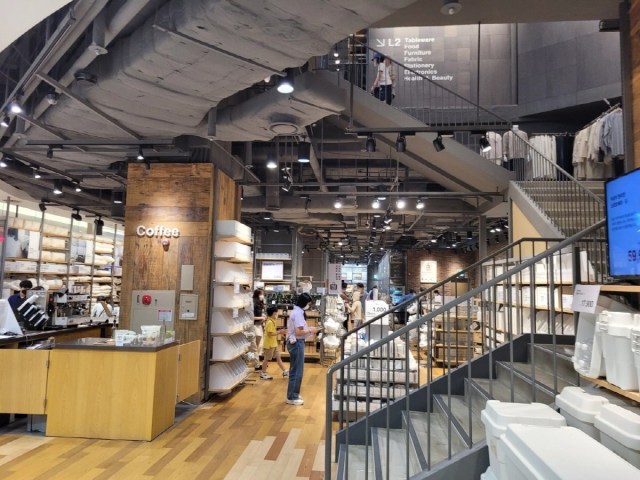
Will the South Korean version of Muji have anything on sale that you can’t get anywhere else?
Japanese homeware chain Muji currently has branches in 31 countries around the world, and is known and loved for its minimalistic “less is more” attitude to their products.
One country that Muji is particularly popular in is South Korea, where there are currently 39 branches of the store throughout the country. Our South Korea based reporter Soon Pyon’s is a fan of Muji, having frequented it during his time studying in Japan. But what does a South Korean Muji look like? Does the South Korean consumer base mean the kind of products on sale there are different? There was only one way to find out, so Soon Pyon’s headed to his nearest branch of Muji, located in Seoul’s IFC Mall.
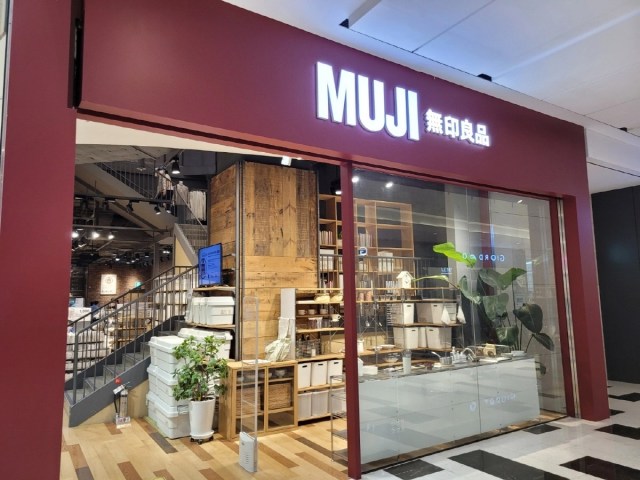
The design and interior seemed to be exactly the same of that as Japan, and as he entered the store, he was met with the familiar scent and sounds of Muji.
Soon Pyon’s knew the products on offer at Muji differed from country to country, so he decided to start hunting for something uniquely South Korean.
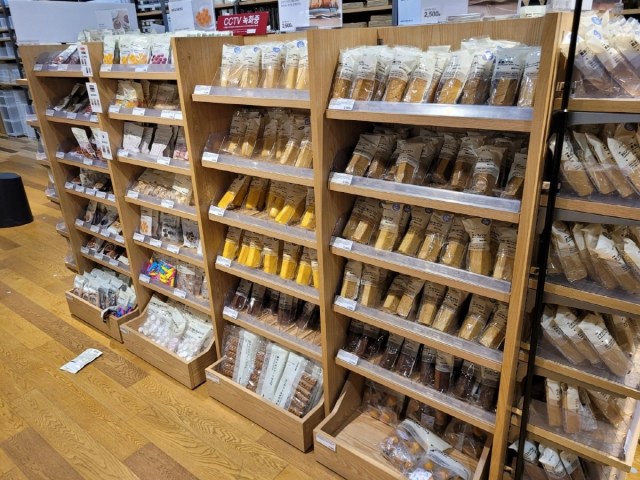
Muji’s most popular products in Japan, like their curry and baumkuchen, had crossed the Sea of Japan and made it onto the shelves of this South Korean Muji.
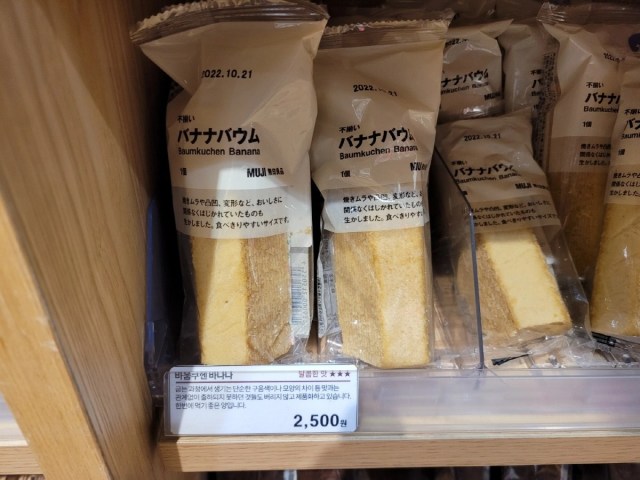
Soon Pyon’s was happy to see Muji’s Banana Baumkuchen on the shelves as he is particularly fond of it, and though it’s slightly more expensive in South Korea than back in Japan (roughly 250 yen in South Korea vs. 150 yen in Japan), banana baumkuchen is kind of difficult to find in South Korea, so he was just grateful to be able to buy it at all.
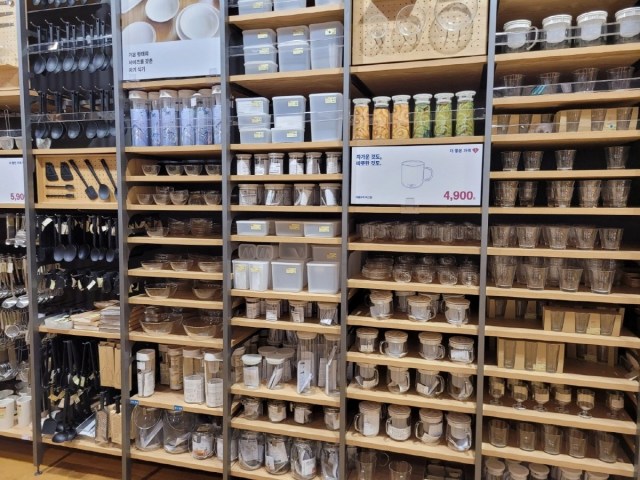
The Japanese writing on all of the product labels wasn’t changed or covered up at all, so simply browsing the shelves made Soon Pyon’s feel like he was back in Japan.
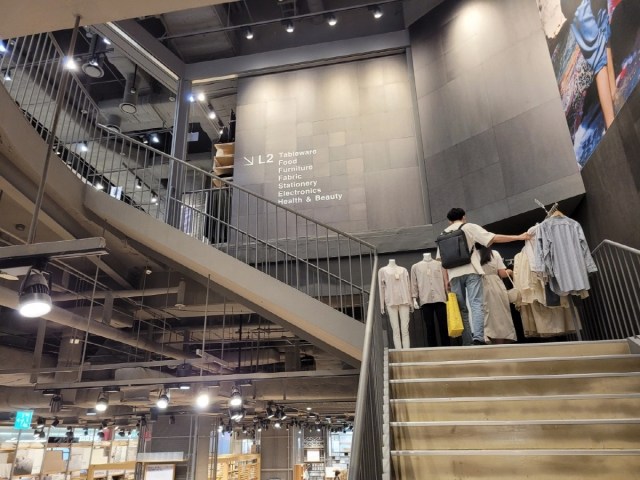
This Muji had two floors, so he went to have a look what was available on the second floor.
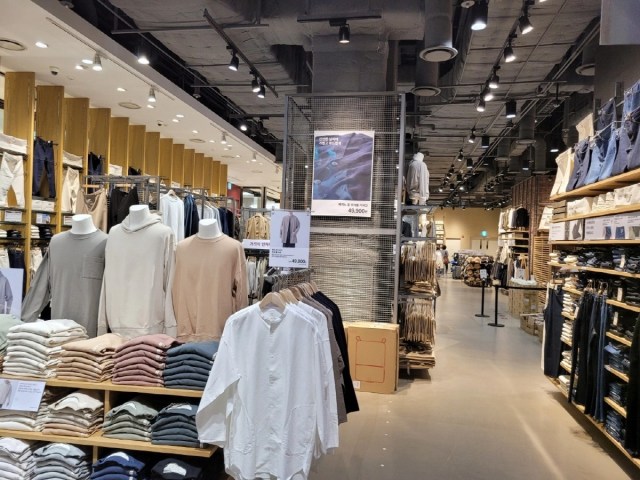
It was the fashion corner! All of the same clothes that are sold in Japan were available here, but interestingly the clothing sizes went up as far as XXL, whereas back in Japan clothes tend to only get sold up to XL size.

Muji’s famous socks were also on sale, which was all well and good, but Soon Pyon’s still hadn’t found a product that was exclusively for the South Korean consumer base…
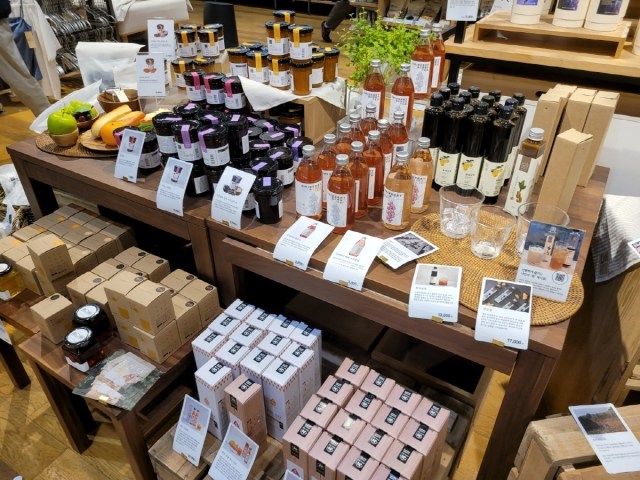
… until he came across the local produce corner, which is available in every Muji store in South Korea. The products here aren’t Muji products; rather, they are made by small companies from each region of the country chosen by Muji, and their products are sold at the stores. It’s like a mini exhibition of local produce, and very unique to South Korea!
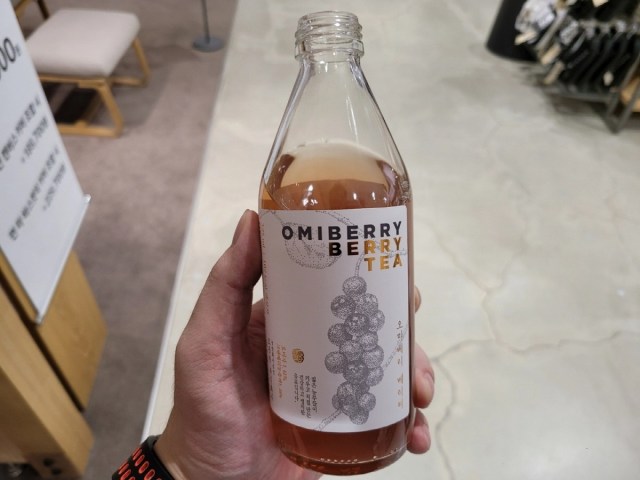
Soon Pyon’s decided to get some Omiberry Berry Tea from the local produce area. It was sweet, tangy and delicious!
…but still, he hadn’t found any unique South Korean products with the Muji brand. He was about to give up and call it a day when…
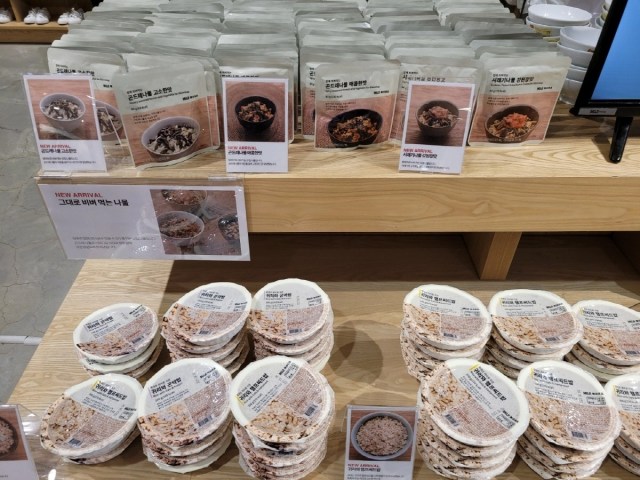
… he finally found some!! There were three kinds of namul (Korean wild vegetables), two types of lentil rice and four kinds of instant soup.
Soon Pyon’s immediately noticed that, unlike all of Muji’s other products that have the usual Japanese packaging with a Korean translation sticker on the back, the writing on these packers was predominantly in Korean.
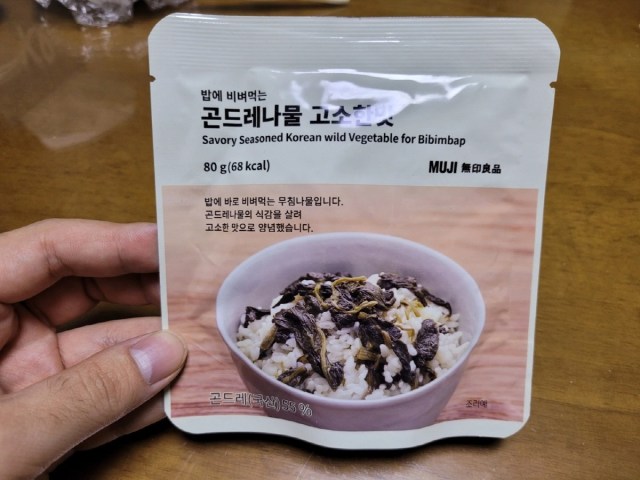
Soon Pyon’s decided to try one of the namul packets, rendered in English as ‘Savory Seasoned Korean wild Vegetable for Bibimbap’.
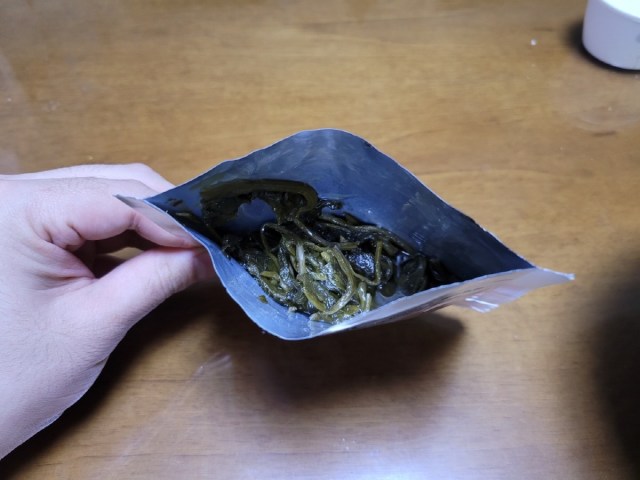
These were definitely products aimed specifically at a Korean market, and not just stuff imported from overseas for Muji fans. These were 100-percent Korean!
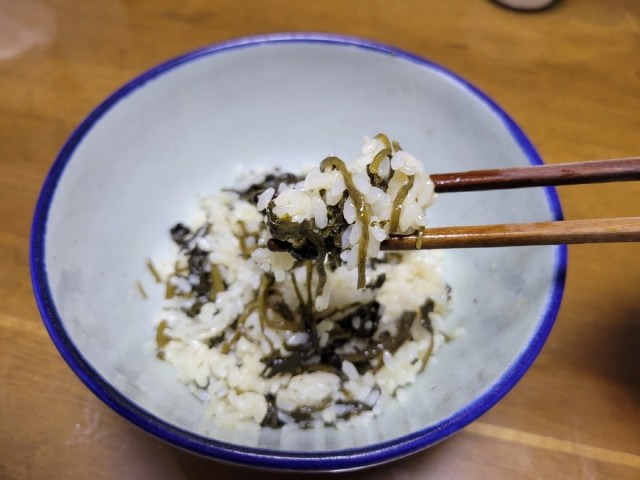
Soon Pyon’s mixed the namul with some rice and had a bite. It was delicious, with the aroma of sesame oil and just the right amount of saltiness. It had a mild taste, and was sure to be liked by even the most fussy of eaters.
So in the end, while most of the products on sale at Muji in South Korea are the same as those in Japan, there are a few that are uniquely South Korean. And with South Korea and France now both checked off our checklist of Mujis Around the World, here’s looking forward to the next trip to an international branch of Muji, wherever it may be!
Photos ©SoraNews24
● Want to hear about SoraNews24’s latest articles as soon as they’re published? Follow us on Facebook and Twitter!
]]> https://soranews24.com/2022/10/04/we-visit-a-muji-in-south-korea-to-search-for-some-uniquely-korean-products/feed/ 0 602984 1eye-2 Cold curry? Mujirushi makes one of our favorite hot meals chilly, but does that make it good? https://soranews24.com/2022/06/01/cold-curry-mujirushi-makes-one-of-our-favorite-hot-meals-chilly-but-does-that-make-it-goof/ https://soranews24.com/2022/06/01/cold-curry-mujirushi-makes-one-of-our-favorite-hot-meals-chilly-but-does-that-make-it-goof/#comments Wed, 01 Jun 2022 03:00:45 +0000 https://soranews24.com/?p=589852 
Is this the edible summer savior we’ve been looking for?
Curry is hot, by just about any meaning of the word. It’s spicy, delicious when poured piping hot onto rice, and becoming more and more popular around the globe.
But on our most recent shopping trip, we came across curry that’s supposed to be cold.
We found this fascinating foodstuff at Mujirushi, which is offering at least two types of cold curry through the summer: Chicken and Ginger Cold Curry and Prawn and Tomato Cold Curry. Naturally, we picked up a pack of each (they’re both priced at 350 yen [US$2.80]) and tossed them in the fridge as soon as we got home.


Once they were thoroughly chilled, we opened up the pouches for a pre-taste testing visual check.

The cold curries have a smoother consistency than standard Japanese curry, closer to a soup broth than ordinary curry roux.


That smooth makes a whole mouthful easy to scoop up in a spoon, and both the cold curries have a nice, spicy kick to them, and Chicken and Ginger Cold Curry isn’t kidding about the ginger either, as that marque ingredient makes its presence unmistakably felt too. Both were undeniably delicious, and either one would be a savior-class meal on a midsummer day when you’re feeling both unhappily hot and horribly hungry. We think they’d be especially refreshing poured over chilled somen or udon noodles.
By the way, Mujirushi says its cold curries can be eaten hot as well, so we tried heating them up to see how that would affect the eating experience. While their texture doesn’t change at all, heating them seems to somehow soften their spiciness. They still taste good, but if you want the full force of their flavor, eating them cold really is the way to go.

Still, now that we know heating the cold curries doesn’t ruin them, we might have to include them the next time we’re making a super curry out of all the 50-plus curry varieties that Mujirushi sells.
Photos © SoraNews24
● Want to hear about SoraNews24’s latest articles as soon as they’re published? Follow us on Facebook and Twitter!
]]> https://soranews24.com/2022/06/01/cold-curry-mujirushi-makes-one-of-our-favorite-hot-meals-chilly-but-does-that-make-it-goof/feed/ 0 589852 CC 2 Muji is selling sake, and it’ll make drinkers feel good in more ways than one https://soranews24.com/2022/05/02/muji-is-selling-sake-and-itll-make-drinkers-feel-good-in-more-ways-than-one/ https://soranews24.com/2022/05/02/muji-is-selling-sake-and-itll-make-drinkers-feel-good-in-more-ways-than-one/#comments Mon, 02 May 2022 02:00:24 +0000 https://soranews24.com/?p=584817 
Delicious sake that gives a small town a helping hand is definitely something worth raising a cup to/of.
Mujirushi Ryohin, also known as Muji, is completely committed to the comprehensive nature of being a lifestyle brand. It’s hard to think of another store you can walk into and buy not only furniture for every room in your home, but a complete wardrobe of clothing to fill the closets, plus a washing machine to wash said clothing in after you wear it (oh, and also 53 different kinds of curry).
And if a nice stiff drink at the end of the day is also part of your lifestyle, Mujirushi is ready to support you on that front too, since this month it’ll be releasing its own sake.
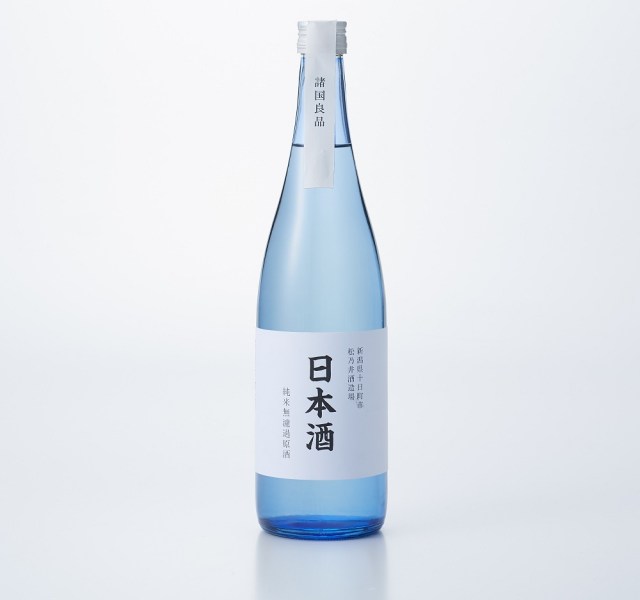
In keeping with the brand’s penchant for understated design, it’s simply called “Nihonshu,” the term used in Japanese for what’s called “sake” in English (in modern-era Japanese, sake is more of a catch-all term for any drinkable alcoholic beverage). Brewed by Matsuno Shuzojo, a Niigata Prefecture brewery that’s been in business for more than 120 years, Mujirushi’s Nihonshu uses Koshihikari rice grown in the Matsudai district of the Niigata town of Tokamachi.
Matsudai’s mountain roads are too steep and narrow for large-scale agricultural machinery to traverse, meaning that much of the farming has to be done by hand. Combine that with an aging population, and growing rice isn’t exactly easy for Matsudai’s farmers, despite the flavor and quality of their produce.
▼ Terraced rice fields in Matsudai’s Hoshitoge (“Star Mountain Pass”) area
星峠の棚田【新潟県】
『日本の里百選』に選ばれた
新潟県十日町市の松代・松之山地区の中でも、
日本一の棚田と呼ばれる星峠の棚田。pic.twitter.com/L3Z793Juwj— みおむぅ@フォロバ100 (@maimai21345) April 2, 2022
So to help them sell all they can grow, Mujirushi, as part of its Local Resource Utilization initiative, uses Matsudai rice, with a luxurious polishing rate of 65 percent, in its Nihonshu. Also part of the brewing process is water thawed from Niigata winter snow, and the result, Mujirushi says, is a dry junmai karakuchi sake with strong rice notes.
Mujirushi’s Nihonshu goes on sale in limited quantities April 29 at the chain’s Ginza, Tokyo Ariake, Shin Yurigaoka Opa, Naoetsu, Grand Front Osaka, Namba, Kyoto Yamashina, Canal City Hakata, and Share Star Hakodate branches, priced at 1,800 yen (US$14.50) for a 720-mililiter (24.3-ounce) bottle.
Source: Mujirushi via Japaaan
Top image ©SoraNews24
Insert image: Mujirushi
● Want to hear about SoraNews24’s latest articles as soon as they’re published? Follow us on Facebook and Twitter!
]]> https://soranews24.com/2022/05/02/muji-is-selling-sake-and-itll-make-drinkers-feel-good-in-more-ways-than-one/feed/ 0 584817 MS 10 The world’s biggest Muji store opened in Hiroshima, and we went to check it out! https://soranews24.com/2022/04/28/the-worlds-biggest-muji-store-opened-in-hiroshima-and-we-went-to-check-it-out/ https://soranews24.com/2022/04/28/the-worlds-biggest-muji-store-opened-in-hiroshima-and-we-went-to-check-it-out/#comments Thu, 28 Apr 2022 01:00:57 +0000 https://soranews24.com/?p=584754 
Over 7,500 products, locally sourced produce and food, eco-friendly initiatives…this Muji is amazing!
Muji fans, are you planning a trip to Hiroshima soon? You should be because Muji just opened their newest store there, and it also happens to be the world’s biggest branch of the popular minimalist lifestyle brand.
The Hiroshima Alpark store, whose market space has the biggest area out of all the Muji stores in the world, not only stocks just about every Muji product available, but sells local produce, hosts fun local events, and more. Our Japanese-language reporter (and frequent product tester) Masanuki Sunakoma happened to be in the area on an errand, so he decided to stop by and see what the new store had to offer.

The world’s biggest Muji store spans two floors of the western building of the large-scale shopping center Alpark, which is a three-minute walk from JR Shin-Inoguchi Station in the city of Hiroshima. Alpark recently underwent a huge renovation and Masanuki, who lived in the area a few years ago, was shocked by how many people he saw there. The once-deserted shopping center was now bustling with customers. It was amazing to see how much it had changed!
What’s more, it seemed like the Muji store was the centerpiece of this renovation. It was certainly the first thing Masanuki saw when he entered the second floor of the mall via a connecting bridge, and it was extremely busy.


The second floor of the Muji Hiroshima Alpark branch seemed to have furniture, storage, kitchen items, and electronics, and they also were holding an event there. On the first floor were clothing and food items, as well as daily necessities. But the most interesting part was, in addition to the standard Muji products and displays, this Muji store seems to also have embarked on a number of first-time initiatives.


For one, this Muji shop is striving for eco-friendliness in several ways. For example, you can buy toiletries like shampoo, conditioner, body soap, and hand soap in bulk by filling up your own bottles or containers with exactly how much you need. The price is charged by the gram, and you can buy as little as 100 grams (3.5 ounces). Apparently, this is in collaboration with Hiroshima Prefecture’s initiative to reduce plastic waste in the Seto Inland Sea.

There is also a bulk food section, where dry foods like tea leaves, cereals, grains, nuts, and fruits are sold by the gram. This is to help prevent food waste, by encouraging customers to only buy what they need. This area seemed very popular as there was a line to get in (though it also had limited admission).

The store also sells furniture made from wood that was discarded for cosmetic reasons. That means each item will be pretty unique, and in Masanuki’s opinion, that’s well worth checking out.

Masanuki wasn’t in the market for any particular thing, but when he came across the farmer’s market section of the store, he had to try out a new product from a local producer: Hiroshima Oyster Chowder (590 yen/US$4.63).

It’s made with low-fat milk and oysters sourced from the Ono Seto channel, which is famous for delicious Hiroshima oysters, that were for one reason or another considered not pretty enough to sell. It required only five minutes in the microwave to heat.

The chowder boasted of having a rich and thick flavor, so Masanuki was excited to try it.

It was insanely delicious. It was super thick and creamy, and Masanuki could not get enough of the rich flavor and generous umami of the broth, which was made from oysters sauteed in butter. Masanuki had it for breakfast, and it felt like he was starting the day at the height of luxury. Apparently, it was developed to make Hiroshima’s famous, delicious oysters more familiar to everyone, and Masanuki thinks they could easily accomplish that goal. Especially if the chowder is available at the highly accessible Muji.
▼ “Let’s eat seasonally.” The local produce section of Muji Hiroshima Alpark

So if you find yourself in Hiroshima–perhaps to have some Hiroshima-style okonomiyaki or to visit the Rilakkuma Cafe–Masanuki highly recommends you stop by this unique Muji store if you get the chance. Not only does it sell about 7,500 different products, but it can also give you a taste of what Hiroshima has to offer, in more ways than one. And if you’re an oyster fan, don’t forget to try the chowder!
Shop Information
Mujirushi Ryohin Hiroshima Alpark Branch / 無印良品 広島アルパーク店
Hiroshima-ken Hiroshima-shi Nishi-ku Inokuchi Myojin 1-16-1 Alpark West Building 1st and 2nd Floor
広島県広島市西区井口明神1-16-1 アルパーク西棟1、2F
Open daily from 10 a.m. to 8 p.m.
Website
Images © SoraNews24
● Want to hear about SoraNews24’s latest articles as soon as they’re published? Follow us on Facebook and Twitter!
]]> https://soranews24.com/2022/04/28/the-worlds-biggest-muji-store-opened-in-hiroshima-and-we-went-to-check-it-out/feed/ 0 584754 hiroshima alpark muji1 Here’s what happens when you mix all 53 kinds of Muji curry into one crazy super curry【Taste test】 https://soranews24.com/2022/04/19/heres-what-happens-when-you-mix-all-53-kinds-of-muji-curry-into-one-crazy-super-curry%e3%80%90taste-test%e3%80%91/ https://soranews24.com/2022/04/19/heres-what-happens-when-you-mix-all-53-kinds-of-muji-curry-into-one-crazy-super-curry%e3%80%90taste-test%e3%80%91/#comments Tue, 19 Apr 2022 01:00:14 +0000 https://soranews24.com/?p=583912 
When choosing what type of Muji instant curry to eat today, the answer we came up with in the SoraKitchen is “All of them.”
Mujirushi Ryohin, a.k.a. Muji, is what you’d call a lifestyle brand, and they really do sell just about everything you need in life. Walk into a typical branch of the chain and you can find everything from furniture and appliances to clothing and toiletries.
Mujirushi also has a huge selection of foodstuffs, with their instant curry pouches being particularly popular. As a matter of fact, there’s so much love for Muji curry that the chain currently offers 53 different single-serving varieties.
And since our palate here at SoraNews24 is both wide and curry-oriented, we decided to buy them all!

As we gazed out over our treasure trove of curry pouches, we quickly noticed some of Japan’s got-to favorites, such as keema and butter chicken curry…

…but Mujirushi also has some more unique, by Japanese standards, varieties, like Chicken Masak Lemak, Beef Randang, and Paneer Makhani.

They even have wild game curries with wild boar and venison.

Now, the sensible thing to do with 53 packs of instant curry would be to eat one a week, stretching out the experience of eating our way through the Muji curry catalog to just over a year. For those of you who think we’re sensible people here at SoraNews24, thank you for visiting our site for the first time, and we hope you’ll become regular readers!
Everyone else, you can probably guess what we decided to do instead…

…which was to see what it would taste like if we mixed every single one of those 53 kinds of curry together.
The complete guest list for our curry party was:
● Kerala Chicken Curry
● Pepper Chicken Curry
● Chicken and Vegetable Spicy Curry
● Mutton Keema Curry
● Butter Chicken Curry
● Creamy Butter Chicken Curry
● Green Curry
● Beef Belly Curry
● Prawn Masala Curry
● Prawn Moilee (Prawn and Coconut Curry)
● Keema Curry
● Saag Chicken Curry
● Keema Tomato Curry
● Massaman Curry
● Chunky Vegetable and Minced Pork Curry

● Spicy Beef Curry
● Homemade Style Beef Curry
● Spicy Chicken Curry
● Beef Tendon Curry
● Homemade Style Pork Curry
● Dry Ginger Keema Curry
● Chicken Curry
● Fond de Veau Beef Curry
● Lemon Cream Chicken Curry
● Mutton Do Piaza Curry
● Soup Curry with Chicken and Vegetables
● Chicken Curry with Three Kinds of Chili Pepper
● Country Style Red Curry
● Dhal Curry
● Spicy Soup Curry with Root Vegetables

● Poo Pad Pong Curry
● Soy Meat and Cheese Keema Curry
● Yellow Curry
● Spicy Keema Curry with Soy Meat
● Paneer Makhani Curry
● Red Curry
● Beef Rendang
● Malaysian Chicken Curry
● Chicken Masak Lemak
● Mild Green Curry
● Apple and Vegetable Curry
● Onion and Pork Curry
● Spinach Keema Curry
● Mild Chicken Curry
● Mild Ginger Keema Curry

● Venison and Mushroom Curry
● Three-Bean Curry with Wild Boar Meat
● Palak Paneer Curry
● Chicken and Tomato Curry
● Beef Curry
● Cheese and Mushroom Curry
● Low-Sugar Keema Curry
● Chicken and Soy Milk Cream Curry

Luckily, we have a gigantic pro-grade cooking pot in the SoraNews24 office, big enough to hold the massive mixed curry we wanted to make. Prep work fell to our Japanese-language reporter Ahiru Neko, who got to squeezing and stirring in order to blend the curries together and heat everything up.

One by one he added them to the melting pot. As you might have guessed from the eclectic list of ingredients, there’s a lot of variety in terms of color and consistency across Mujirushi’s 53 kinds of curry.

Finally, an hour after he’d started, Ahiru Neko was done cooking, and felt like a culinary conjurer who’d created the king of Muji curries in the pot. So what does the king look like?

Surprisingly normal. Shockingly normal, even. We weren’t sure exactly what we were expecting visually my mixing so many different types of roux together, but we definitely wouldn’t have predicted it’d come out looking like the perfect stock photo for “typical Japanese curry.” At a glance, we’d have had a hard time telling this apart from the contents of a bog-standard single-roux Japanese instant curry pouch.
And yet…

…all it took was one bite for Ahiru Neko to confirm the legitimacy of the Muji curry king, because his creation was some truly delicious stuff!

Curry is, of course, a pretty strongly-flavored food. Mixing so many different kinds together hadn’t really upped the intensity, but it had definitely bumped the complexity of the flavor profile up to an amazing degree, stimulating seemingly every one of Ahiru Neko’s taste receptors. The first impression comes from the chicken, beef, and baseline Japanese-style roux, but the flavor then transitions to let the Indian and southeast Asian elements come into play, with the transition noticeable without being forceful.
▼ The consistency of the roux is immaculately balanced, neither lumpy nor runny, but right in the middle.

Now, as we mentioned above, Ahiru Neko was cooking in the office, and you’d better believe everyone else at work that day noticed when the smell of an hour-long curry cooking session started drifting around the place.

So as soon as Ahiru Neko finished his personal taste test, he looked up to see a line of hungry SoraNews24 staffers had formed, so he started ladling out portions for the rest of the team to try.


After all, it’s not like he couldn’t say he didn’t have enough to share, even when people started coming back for seconds.

For those of you wondering how much this very successful cooking experiment would cost to replicate, the price for the 53 packs of curry, purchased through Mujirushi’s online store, came to…


…19,390 yen (US$156). While that’s a pretty huge bill to run up for curry, you’ve got to remember that that’s enough for 53 servings, so really the price isn’t all that bad. The bigger potential problem, though, is not being able to eat all that curry before it goes bad, but there’s a solution for that too…


…since curry is pretty easy to split up into take-home pouches, and when it tastes this good, everyone will be happy to have a cut of the leftovers.
Related: Mujirushi online store curry
Photos ©SoraNews24
● Want to hear about SoraNews24’s latest articles as soon as they’re published? Follow us on Facebook and Twitter!
]]> https://soranews24.com/2022/04/19/heres-what-happens-when-you-mix-all-53-kinds-of-muji-curry-into-one-crazy-super-curry%e3%80%90taste-test%e3%80%91/feed/ 0 583912 MC 11 Taste-testing every single sakura sweet and cherry blossom drink we could find at Mujirushi https://soranews24.com/2022/02/18/taste-testing-every-single-sakura-sweet-and-cherry-blossom-drink-we-could-find-at-mujirushi/ https://soranews24.com/2022/02/18/taste-testing-every-single-sakura-sweet-and-cherry-blossom-drink-we-could-find-at-mujirushi/#comments Fri, 18 Feb 2022 01:00:54 +0000 https://soranews24.com/?p=577400 
Sakura storm into Muji’s sweets section, and we are powerless to resist this delicious dozen.
In Japan, there’s a phenomenon called sakura fubuki, which translates to “cherry blossom blizzard.” Sakura fubuki occur in spring when strong gusts of wind blow through the boughs of cherry blossom trees, creating a swirl of pink petals that surrounds anyone lucky enough to be caught in the middle.
There’s something similar happening at Mujirushi these days, except rather than cherry blossoms it’s cherry blossom sweets everywhere you look. The lifestyle brand has rolled out a whole slew of sakura-flavor sweets, snacks, and even drinks, and we were determined to try each and every one.
As the eventual winner of the no-holds-barred bare-knuckle battle royale by which we determined who would handle this coveted assignment, our Japanese-language reporter Tasuku Egawa hit up our local Mujirushi to assemble a complete set of sakura sweets (as of February 15), which ended up being a total of 12 items.

● Sakura Baumkuchen
● Sakura-Flavored Pao De Lo
● Sakura Roll Cake
● Sakura-Flavored Daifuku Mochi
● Sakura and Sugar Rice Crackers
● Sakura Marshmallows
● Sakura Cream Sandwich Cookie
● Sakura Karinto
● Sakura Steamed Buns
● Sakura Rice Jelly Pancakes
● Sakura Green Tea
● Instant Sakura Latte
Before we get to the taste-testing, we should cover what makes something sakura flavor. Basically, both the petals of the flowers and the leaves of cherry blossom trees are edible, and since they’re often preserved in salt, sakura flavor tends to be a gentle sweetness followed by a crisp, salty finish, with some very subtle floral/herbal touches, and even a bit of bitterness if a larger quantity of leaves or a smaller amount of salt is used.
With that out of the way, let’s get to Tasuku’s notes.
● Sakura Baumkuchen (150 yen [US$1.30])


Baumkuchen, which translates as “tree cake” because of its resemblance in shape to tree rings, is a staple of the Japanese sweets scene, and something Mujirushi is especially well-known for (as our 23-flavor taste test attests to). Mujirushi’s baumkuchen are actually personal-size cake sticks, and while Tasuku didn’t get a sakura sensation the moment this hit his lips, as he chewed the flavor started to resemble sakura mochi sweets, and the fact that the cake isn’t overly sugary let the sakura flavor leave a lasting impression despite its late arrival.
● Sakura-Flavored Pao De Lo (490 yen)


Pao De Lo is a kind of Portuguese sponge cake, sort of a cousin to the castella cakes you can find in Japanese cafes and bakeries. There’s no frosting or glaze, and the white stuff in the above photo is a paper wrapping that has to be removed before eating. With the paper out of the way, Tasuku noticed a stronger sakura scent than with the Baumkuchen, and it also has a sweeter flavor and airier consistency.
● Sakura Roll Cake (390 yen)


Our last stop on the sakura cake circuit, the sakura roll cake (which gives you four slices in the pack) has the strongest sakura flavor of the trio, and the ribbon of cream that spiral to the center makes it the moistest too.
● Sakura-Flavored Daifuku Mochi (250 yen)


With the cherry blossom being Japan’s representative flower, naturally there are plenty of Japanese desserts in Mujirushi’s sakura sweets lineup. Daifuku are chewy mochi dumplings, and these ones are compact enough to be eaten in a single bite. Sweet and delicious, with a stylish dusting of rice flour, these would be a very crowd-pleasing choice, especially since the bag gives you enough daifuku to share.
● Sakura and Sugar Rice Crackers (190 yen)


Here’s a unique one. Senbei (Japanese rice crackers) often tend to have a notably bitter aftertaste that they acquire as the rice flour cooks to a crisp. These ones are sweetened with sugar, though, and also seasoned with powdered sakura tree leaves. Ultimately, though, the underlying toasted rice flavor is what’s strongest here, albeit with a little bit of extra salty sweetness, making the sakura aspect a little hard for your taste buds to lock on to. Still some really tasty senbei, though.
● Sakura Marshmallows (250 yen)


There’s a similar situation going on with the Sakura Marshmallows. Their pale pink color immediately brings to mind cherry blossoms, but their sakura flavoring is pretty subtle. However, as marshmallows, it’s no shock that they taste great…

…and their anko (sweet red bean paste) cores also help them feel just a little more special than ordinary varieties.
● Sakura Cream Sandwich Cookie (120 yen)


No, we don’t know why Tasuku bought two of these, since they’re exactly the same. Maybe he’d had a premonition, though, about how great the cookie was going to taste and used this foreknowledge to conclude that he should pick up another to enjoy when he inevitably started craving an encore. The salted cherry blossom on top gives this some visual pizzazz, and the cream inside has sakura leaf mixed in, giving this a fantastic blend of sweet and salty flavors.
● Sakura Karinto (190 yen)


Karinto are a sweet deep-fried flour snack. These ones have had salted sakura leaf mixed in before cooking, and their flavor comes through in a pretty strong way. They’re so good that, if Tasuku hadn’t had 11 other treats he needed to save space for, he might have eaten the whole bag right then and there.
● Sakura Steamed Buns (390 yen)


To clarify, these are manju, small, sweet dumplings cooked by steaming, and not the palm-sized steamed buns they sell at Japanese convenience stores. Right away, Tasuku could tell these were going to have a strong sakura flavor, as the flecks of sakura leaf in the dough are immediately noticeable. That dough is wrapped around smooth anko, and the red bean paste’s sweetness and sakura leaf’s saltiness complement each other perfectly, so Tasuku was glad that you get eight to a pack, since these are too good to eat just one.
● Sakura Rice Jelly Pancakes (190 yen)


For our final food item, we’ve got another slightly confusing name. The Japanese text on the label calls these the Mini Dorayaki with Sakura Mochi, and that’s a clearer picture of what’s waiting inside this three-piece pack. Granted, dorayaki do resemble pancakes, even if dorayaki are sweeter. But “rice jelly” is a misleading way to describe sakura mochi, a sakura and sticky mochi dessert. The English product name also doesn’t mention the anko filling,

Linguistic/package design quibbles aside, though, there’s nothing to complain about here, with strong sakura flavor, a satisfying mix of textures, and beautiful aesthetics with the colored marbling of the dough.
● Sakura Green Tea (390 yen)


Mujirushi offers two sakura-style ways to wash all those snacks down, and Tasuku started with a cup of Sakura Green Tea (made with one of the 10 tea bags inside the pouch). Sakura leaves are mixed in with the tea leaves, giving this one an ever so slight sweetness to Tasuku’s taste buds. Personally, though, he’d have preferred deeper bitter notes, and since this is a case of adding one type of leaves to another to make the drink, this is the least “SAKURA!”-ish item on our list so far, even if it’s a perfectly passable green tea.
● Instant Sakura Latte (390 yen)

When Tasuku opened the pouch of Sakura Latte powder, he thought there must be some sort of mistake. Cherry blossoms are pink, right? Maybe not an eye-searing hot pink, but at least a soft pastel. The Sakura Latte powder, though, is gray.
▼ Did they give him a bag of ashes?

With the rest of our staff still unconscious, though (remember, bare-knuckle battle royale), Tasuku had no one to foist the final taste test off on. So he spooned some of the powder into a cup, poured in the hot water, and…

…it immediately turned pink!
Tasuku wasn’t sure what manner of sakura sorcery this was, but with his faith restored he took a sip, and sure enough, the sakura flavor was there. If you’ve never had a sakura latte, it’s sort of like a white chocolate hot chocolate, but not as sweet and with a salty finish. That makes it a very relaxing drink, and Tasuku was glad to have it, because with his stomach filled with so many desserts, he wasn’t going to be going anywhere for quite a while.
Photos ©SoraNews24
● Want to hear about SoraNews24’s latest articles as soon as they’re published? Follow us on Facebook and Twitter!
]]> https://soranews24.com/2022/02/18/taste-testing-every-single-sakura-sweet-and-cherry-blossom-drink-we-could-find-at-mujirushi/feed/ 0 577400 MS 0 We visit the Paris branch of Muji in search for some minimalist products only found in France https://soranews24.com/2022/01/14/we-visit-the-paris-branch-of-muji-in-search-for-some-minimalist-products-only-found-in-france/ https://soranews24.com/2022/01/14/we-visit-the-paris-branch-of-muji-in-search-for-some-minimalist-products-only-found-in-france/#comments Thu, 13 Jan 2022 17:30:14 +0000 https://soranews24.com/?p=572891 
Parisian branch of Muji is perfect blend of European and Japanese tastes.
Lifestyle brand Muji is loved for its minimalistic yet chic goods, and has gained such a following that there are now branches of the Japanese store in over thirty countries all over the world. In fact, such is Muji’s international popularity that there are now more Muji stores abroad than in Japan.
Our Japanese-language reporter and avid traveller Ikuna Kamezawa recently found herself visiting one such overseas branch of Muji in Paris, France. But Ikuna wasn’t just popping into a French branch of Muji for a quick shop; she was looking for some Muji merchandise that was exclusive to France.
Often when Japanese companies expand overseas they offer regionally exclusive products, usually showcasing a popular item or scene from the area. Ikuna was excited to see what kind of stylish souvenirs were on offer at the Muji she’d found in the Westfield Forum des Halles shopping mall. Surely they’d be oozing with French charm!

As Ikuna entered the store, she was pleasantly surprised at how similar the interior looked to a regular old Japanese branch of Muji.
▼ Is this really Paris, or did Ikuna somehow get teleported back to Japan?

No, she was very much still in France, and so she began her quest to discover that special item, that product exclusive to the French branches of Muji. It was somewhere in here!

Strawberries covered in white chocolate were being heavily advertised in this French Muji. They certainly looked stylish and sophisticated enough to be considered a France-exclusive product, but as they’re available to buy in Japan too, Ikuna wasn’t interested.

The furniture section looked pretty standard as well. Nothing out of the ordinary here.

The socks were identical too, even the big-toed tabi socks seen here at the bottom, and Ikuna was surprised to learn that French people like to wear such Japanese-looking socks.
And then, when she was just about to give up, she spotted it!
▼ An Eiffel Tower stamp! Surely this had to be France-exclusive?!

Ikuna spotted a tower-shaped stamp in the Muji Yourself stamp station. If there were to be a single symbol to showcase France on a souvenir, it had to be the famous Eiffel Tower. She’d found the France-exclusive item!
…or so she thought, until she asked a nearby member of staff, who told her that the tower stamp was actually available all over the world, and the more we look at it, the silhouette is actually closer to Tokyo Tower. The member of staff broke Ikuna’s heart further by adding:
“Basically, we don’t really have any ‘France-exclusive’ items here.”

Whilst Ikuna was heartbroken, despite the clerk’s words she actually did come across an aisle full of scented candles that are only sold in France. And while this technically counted as a ‘France-exclusive’ item, it didn’t really scream ‘France’ to Ikuna, although the aisle certainly smelled wonderful all the same.
▼ Maybe if they had an Eiffel Tower stamped on them, they’d look more ‘French’.

But as Ikuna made her second and third trip around the store, she noticed a difference in trends between Japanese Muji and French Muji. Wooden clothes pegs seemed to be very popular here and a large volume were on display.
▼ That’s a lot of wooden pegs.

▼ Japanese style bento boxes also seemed to be popular with French Muji fans.

It was the food section that felt the most ‘French’ for Ikuna, though, as the kinds of food on sale and their countries of origins felt very ‘France-like’.
▼ Pasta sauce with ingredients from Italy…

▼ Cheese sticks with ingredients from the Netherlands…

▼ And of course, Muji’s famous garlic potato chips using potatoes grown right here in France!

Yes, it was only when Ikuna hit the food section did she really feel like she was shopping in a French branch of Muji, with so many of the products made from ingredients sourced from Europe. She was especially impressed with the garlic potato chips — after all, every French supermarket must sell potato chips made from French potatoes, but to go to the trouble of re-importing Japanese chips made from French potatoes?
“The French really love their country,” Ikuna thought.
▼ There was a selection of Japanese food products on sale, too.

▼ Ikuna ended up buying some
While there didn’t appear to be any food items exclusive to France, Ikuna decided to get some Japanese instant soup, radish chips and potato chips, namely the Guérande Sea Salt Potato Chips. They’re available in Japan, but this was the first time for her to try them out.

▼ The Guérande Sea Salt Potato Chips cost €2.50 (US$2.84)– roughly the same price as in Japan

As Ikuna took a bite, she couldn’t help but blurt out “Yum!”. The chips were born of French agriculture and Japanese technology — what a combination!
So in the end, Ikuna couldn’t find a good ‘This is from France!’ souvenir from the Parisian branch of Muji, but she did get to enjoy some delicious potato chips. And there’s plenty of delicious Japanese food there too, so if there’s anyone in France missing Japanese cuisine, Muji’s a great place to go to.
Although with the ever increasing number of baumkuchen on sale at Muji, surely it’s surely only a matter of time before they make a French-exclusive flavour, like escargot. After all, it goes well enough with ice-cream, so why not?
Photos ©SoraNews24
● Want to hear about SoraNews24’s latest articles as soon as they’re published? Follow us on Facebook and Twitter!
]]> https://soranews24.com/2022/01/14/we-visit-the-paris-branch-of-muji-in-search-for-some-minimalist-products-only-found-in-france/feed/ 0 572891 IMG_1348 We tried all seven of Muji’s new “Bento of the Day” boxed lunch sets https://soranews24.com/2021/12/07/we-tried-all-seven-of-mujis-new-bento-of-the-day-boxed-lunch-sets/ https://soranews24.com/2021/12/07/we-tried-all-seven-of-mujis-new-bento-of-the-day-boxed-lunch-sets/#comments Mon, 06 Dec 2021 15:00:14 +0000 https://soranews24.com/?p=567934 
Can boxed lunches stay minimalist and delicious at the same time?
Japanese housewares brand Mujirushi Ryohin, better known as Muji, has got you covered when it comes to lifestyle goods.
From casual wear to mini houses to even food like famous Baumkuchen cakes, Muji has a reputation for selling affordably priced, understated goods, and one man who regularly partakes in a Muji shopping spree or two is our very own P.K. Sanjun.
On a recent trip to Muji’s Cafe Meal & MUJI stores, P.K. discovered they have started to sell bentos (boxed lunches). Not only that, but bentos whose menus change daily.

The Muji bentos are said to be healthy lunches that follow the minimalist and simple principals of Muji, but P.K. was curious. With seven bento menus in rotation, there would have to be some ingredients amongst the bentos on offer that wouldn’t fit the minimalist brief, right?
While all this speculation was well and good, there was only one way to find out, and so P.K. bought all seven of the daily bentos on offer over the course of a week.
▼ Each bento cost 750 yen (US$6.65).

▼ The first bento P.K. bought was the Big Salmon Bento.

The Big Salmon Bento was the first of the daily lunch boxes on offer, and after he’d finished, P.K. wasn’t feeling too confident about the rest of the week.
The salmon was steamed, marinated in salted rice malt, and was certainly delicious, but the meal itself felt kind of plain, like he was eating his grandfather’s lunch or something.
The hijiki seaweed, string beans and fried egg were good, and sometimes simple is best, but P.K. is someone who prides himself on his ability to put away a lot of food, and this boxed lunch just wasn’t doing it for him.
▼ Next up was the Double Mackerel.

The Double Mackerel consisted of shredded mackerel and mackerel cooked in a sweet vinegar sauce. The meal also featured kimpira, pickled ginger and stewed shiitake mushrooms, which P.K. immediately decided was the star of the show.
P.K. polished off this lunchbox much quicker than yesterday’s, as there was more variety to the meal.
▼ Day three: Beef and Rice

With the arrival of Beef And Rice, P.K. was starting to get excited.
So far all the meals had been relatively minimalist, with simple yet delicious ingredients. Surely this beefy bento was going to be so bursting with a range of flavours that it would break ranks!
…or so he thought, but the beef was only lightly seasoned, and didn’t make a huge impact in terms of flavour. The stewed shiitake mushrooms did make a return though, and P.K. happily devoured them.
▼ Day four’s Bento of the Day was Chicken and Rice.

There may have been no stewed shiitake mushrooms in the Chicken And Rice bento, but P.K. still thoroughly enjoyed it, due to the soboro — finely ground chicken, with eggs and spinach.
Although the main component of the lunch was the teriyaki chicken on the top, P.K. found that he much preferred the soboro part of the meal much more, as it packed more of a punch in terms of flavour.
▼ Day five was Deep River Rice.

Despite the slightly unappealing name, Deep River Rice — made up of asari clams in ginger sauce and boiled conger eel — was reasonably tasty.
It was slightly blander than P.K. had hoped for, but his favourite stewed shiitake mushrooms made a welcome return, so overall this bento got a thumbs up. Really though, they should just sell the stewed shiitake mushrooms separately, because they’re that delicious.
▼ Day six saw the arrival of Kamameshi-Style Teriyaki Chicken.

The Kamameshi-Style Teriyaki Chicken bento was already scoring big points because it featured — you guessed it — the stewed shiitake mushrooms, but the rest of the meal was equally delicious, particularly the burdock root.
Kamameshi literally means “kettle rice” and is named so because traditionally, the meal was cooked in together a large iron pot. P.K. enjoyed that the rice wasn’t separate from the meat and veggies like in the other lunches. Of course, the volume was still a little less than what P.K would have liked, but apart from that this bento was flawless!
▼ The final Bento of the Day was Saikyo Grilled Pork.

Saikyo Grilled Pork, sometimes called “Kyoto-style” in English, had pork grilled using saikyo miso paste that originated in the Kyoto Imperial Palace many years ago.
The saikyo pork tasted decent enough, but it was lacking a certain something — something stewed and mushroom-y — which meant in the end, P.K. was left feeling a little unsatisfied.
On the whole, the bento lunches on offer from Muji were pretty delicious, but very lightly seasoned and lacking any strong flavours, which might turn people away. They would be perfect for health conscious bento buyers, but the smaller amount of food also might put some people off too.
And for 750 yen, you could definitely get more bang for your buck elsewhere in Tokyo.
Images: ©SoraNews24
● Want to hear about SoraNews24’s latest articles as soon as they’re published? Follow us on Facebook and Twitter!
]]> https://soranews24.com/2021/12/07/we-tried-all-seven-of-mujis-new-bento-of-the-day-boxed-lunch-sets/feed/ 0 567934 IMG_5540-1 Muji adds Japanese haori samurai coats to their casual wear collection https://soranews24.com/2021/09/17/muji-adds-haori-samurai-coats-to-their-casual-wear-collection-in-japan/ https://soranews24.com/2021/09/17/muji-adds-haori-samurai-coats-to-their-casual-wear-collection-in-japan/#comments Fri, 17 Sep 2021 13:00:16 +0000 https://soranews24.com/?p=556962 
Perfect for modern-day warriors.
The haori jacket has been enjoying a boom in popularity in Japan recently. The thigh-length coat, traditionally worn over a kimono or hakama pants, was once the wardrobe of the Japanese elite, before becoming popular everyday wear for samurai, members of the merchant classes, and now, anyone who wants to add some traditional flair to their modern wardrobe.
The classic shape and style of the versatile coat is perfectly suited to modern casual wear, and retail chain Muji, who specialises in no-frills everyday co-ordinates and classic cuts, is now giving us their take on the haori, with the new Water-Repellent Stretch Chino Haori.

The Muji design features a dropped shoulder silhouette and open front, in keeping with the traditional style. It’s incredibly versatile to wear, pairing well with dresses, skirts, shirts and trousers, adding a layer of warmth to your outfit during transitional seasons like spring and autumn, although it can be easily layered with a turtleneck sweater during winter too.

The traditional style has been given a modern overhaul with a stretch chino polyester material, which makes it comfortable to wear and less prone to wrinkling.

It’s also water-repellent, so you won’t have to worry if you find yourself caught in sudden rain or snowfall.

The stretchy material makes it easy to carry in your bag for those times when the weather changes and you need some extra warmth. The haori is available in extra-extra-small through to extra-large sizes, and comes in a choice of two colors — black and greyish brown.


Priced at 6,990 yen (US$63.92), the Muji haori is considerably cheaper than other options you’ll find on the market, and it’s available to purchase now at Muji stores around the country and online.
Related: Muji
Images: Muji (1, 2)
● Want to hear about SoraNews24’s latest articles as soon as they’re published? Follow us on Facebook and Twitter!
]]> https://soranews24.com/2021/09/17/muji-adds-haori-samurai-coats-to-their-casual-wear-collection-in-japan/feed/ 0 556962 Muji haori kimono coat Japanese fashion clothes shop buy photos 6 Japanese minimalist retailer Muji launches new set of disaster preparedness kits https://soranews24.com/2021/09/06/japanese-minimalist-retailer-muji-launches-new-set-of-disaster-preparedness-kits/ https://soranews24.com/2021/09/06/japanese-minimalist-retailer-muji-launches-new-set-of-disaster-preparedness-kits/#comments Sun, 05 Sep 2021 17:30:21 +0000 https://soranews24.com/?p=554988 
Like all things Muji, minimalism and only having what’s necessary are key here.
Known for its straightforward, simple designs, Muji has transformed beyond a brand of minimalism to a veritable lifestyle. From sustainable snacks to even houses, it seems like the powerhouse of a retailer has goods covering any aspect of life, and so unsurprisingly, Muji has also recently relaunched its own line of disaster preparedness kits.
▼ Called “Itsumo Moshimo,” or literally “The Always If” in English, the kits come in undecorated, non-fussy packaging per standard Muji tradition.

In total, the retailer will be offering three kits, which differ in size depending on what specific Muji goods are included, and the goods themselves are all useful items to have in the case of an emergency.
The first and smallest kit, called the “Portable Set,” contains a small selection of goods and will be priced at 990 yen (US$9.01). This kit has bandages, a plastic pouch, anti-bacterial wipes, face masks, a special Itsu no Moshimo handkerchief, as well as an emergency contact guide. For the emergency contact guide, there are even instructions on how to contact local authorities, whether you’re using a smartphone or a payphone.

Next, the second kit is the “Take Out Set.” The Take Out Set includes all the items in the Portable Set as well as a space blanket, earplugs, a headlamp, and a crossbody satchel in which to store everything. Priced at 3,990 yen (US$36.30), this kit also comes in waterproof packaging and with a handle for easy grabbing in case you have to rush out of the house while evacuating.

Lastly, the third and biggest kit Muji offers is the “Furnish Set.” All items included in the Portable Set and the Take Out Set are available in this kit, and the Furnish Set will also have gloves, mini candles, emergency toilet bags, and towels. Compared to the two other kits, this one comes in a sturdy cardboard box instead. With 15 items total, the Furnish Set will be sold at the price of 5,490 yen (US$49.94).

In addition to the main three kits, Muji will also be separately selling an 11-pocket parka and the “Itsumo no Moshimo” collection’s special handkerchief. The parka is waterproof and designed to keep you warm in case you’re left without shelter after a disaster, and the handkerchief comes with a whimsical graphic depicting all the ways it can be used. They will be respectively sold at 6,990 yen (US$63.57) and 490 yen (US$4.46).


All kits and separately sold items can be found at your local Muji store in Japan. Furthermore, Muji will be jumpstarting a “Itsu no Moshimo” series where every month a new product will be released related to disaster preparedness, and you can learn more about it here. To end off, given how disasters differ depending on the region, disaster preparedness may look different for you, so be sure to consult with local authorities on appropriate measures as well as where to best evacuate to if the situation calls for it.
Source, images: PR Times, Muji
● Want to hear about SoraNews24’s latest articles as soon as they’re published? Follow us on Facebook and Twitter!
]]> https://soranews24.com/2021/09/06/japanese-minimalist-retailer-muji-launches-new-set-of-disaster-preparedness-kits/feed/ 0 554988 main-78